

Archive position — measured, not model output
1 like on Devpost
505 of the 7,850 archived projects have more likes, and 1,758 share exactly 1 — so this project's #1,800 place in the like-ranked listing is a tie-break inside that group, not a ranking.
Projects (log scale)
Likes on Devpost. ▲ marks this project's group.
Show the figures
| Likes | Projects | Share of archive |
|---|---|---|
| 0 | 5,587 | 71.2% |
| 1 | 1,758 | 22.4% |
| 2 | 284 | 3.6% |
| 3–4 | 132 | 1.7% |
| 5–9 | 75 | 1.0% |
| 10+ | 14 | 0.2% |
 User Stories BotA demo video on every pull request
Get a demo video on every new feature
GitHub App that watches your pull requests and records a narrated, captioned demo.
Save time on demo prep and make informed decisions faster with a video walkthrough of every new feature.
Executive Summary
What the company appears to be
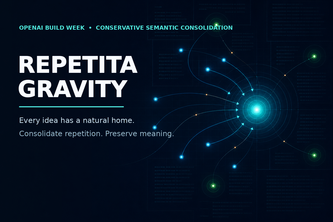
Repetita Gravity is a self-described post-generation control process for long-form documents that consolidates accidental semantic repetition while preserving intentional structure, unique content, evidence, and context. It operates between AI-assisted drafting and final delivery.
What changed
The project description presents a novel approach to document revision that focuses on "loss-controlled semantic redistribution" rather than simple duplication removal. It claims to use a "Logical Gravity Centre" model to determine where recurring concepts should be consolidated.
Single most important open question
Does Repetita Gravity actually solve a meaningful problem for real users, or is it an academic exercise in AI document processing?
What The Product Actually Is
The description states that Repetita Gravity is:
- A general post-generation control process for long-form documents
- Demonstrated through a compact OpenAI Build Week application
- Designed to operate between AI-assisted drafting and final delivery
- Intended for use with documents such as legal submissions, technical specifications, research papers, business reports, emails, stories, and personal letters
The system treats recurring concepts as having "semantic mass" and uses a "Logical Gravity Centre" approach to determine where concepts should be consolidated.
Evidence The description states this is a "general post-generation control process for long-form documents"
Inference This appears to be an AI-powered document editing tool that operates after initial drafting but before final delivery
Positioning & Claim Evolution
The description states:
- Repetita Gravity asks a "more consequential question" than typical repetition tools
- It focuses on semantic mass and logical centre rather than surface similarity
- The system is designed to preserve evidence, qualifications, exceptions, context, and distinctions that are often lost in traditional rewriting
- It treats every recurring concept as having semantic mass and moves content toward its "Logical Gravity Centre"
- The innovation is described as "loss-controlled semantic redistribution"
Evidence The description states these claims about the product's approach and innovation
Inference This represents a positioning shift from simple duplication detection to sophisticated semantic analysis and controlled consolidation
Target Customer & ICP
The description states:
- The problem affects "almost every kind of writing" including legal submissions, technical specifications, architecture documents, research papers, business reports, emails, stories, and personal letters
- It is intended for circumstances where reducing repetition is less important than proving nothing material was lost
- The methodology is relevant to legal, regulatory, compliance, policy, consulting, technical, academic, professional, creative, and personal writing
Evidence The description states these target use cases
Inference The product appears aimed at professionals who produce long-form documents where semantic accuracy is more important than brevity
Business Model & Pricing Evidence
Not evidenced.
The description does not contain any information about pricing, revenue model, monetization strategy, or business model.
Technical & Delivery Signals
The description states:
- Built with: css3, docker, github, gpt-5.6, html5, javascript, json-schema, open-ai-response-api, openai-codex, python
- Uses GPT-5.6 and Codex for bounded semantic decisions that cannot be established through lexical comparison alone
- Python performs deterministic reconciliation against the Conservation Ledger and the immutable original document
- The system evaluates document characteristics to determine processing approach:
- Document length
- Estimated token use
- Section complexity
- Number of recurrence families
- Recurrence density
- Dispersion across sections
- Cross-family dependencies
- Semantic risk
Evidence The description states these technical details and delivery approaches
Inference This suggests a sophisticated system with adaptive processing capabilities that can handle different document complexities
Traction & Maturity Signals
Not evidenced.
The description does not contain any information about:
- Revenue or ARR
- Customer base or adoption
- Product usage metrics
- Market traction
- Business development progress
- Any form of commercial activity beyond the hackathon submission
Competitive Context
The description states:
- Repetita Gravity is substantially different from ProofRail, the author's other Build Week project
- ProofRail operates temporally across successive revisions and prevents accepted decisions from regressing
- Repetita Gravity operates spatially inside a single document and controls where recurring concepts receive their principal treatment
- It is not a grammar checker, paraphraser, summariser, or duplicate-word detector
Evidence The description states these distinctions from other tools
Inference This suggests the product addresses a specific gap in existing document editing tools, particularly those focused on repetition detection vs. semantic control
Open Questions & Risks
The description states:
- No original semantic unit may disappear silently
- Every claim, fact, item of evidence, qualification, limitation, exception, consequence, and recommendation must receive an explicit final disposition
- When available evidence does not justify automatic consolidation, Repetita Gravity fails closed
- The application remains conservative and exposes unresolved decisions instead of manufacturing certainty
Evidence The description states these safety mechanisms
Inference This suggests the system may be overly conservative in its approach, potentially limiting its utility for users seeking aggressive document reduction
Questions the description leaves open
- What specific problems do you observe in current document writing and revision workflows that Repetita Gravity addresses?
- How does your system handle edge cases where semantic meaning is ambiguous or context-dependent?
- What evidence do you have that users actually need this level of semantic control over document consolidation?
- How do you plan to validate the effectiveness of your "Logical Gravity Centre" approach in real-world use?
- What are the practical limitations of your current implementation for large-scale document processing?
- How does Repetita Gravity handle cross-document references and citations that might be affected by semantic redistribution?
Overall Assessment
Not evidenced.
The description does not contain any information about:
- Valuation or funding status
- Commercial traction or revenue
- Market opportunity size
- Competitive positioning in the market
- Any form of investment or partnership interest beyond the hackathon submission
Confidence level Low. The description is entirely self-reported and unverified, with no evidence of commercial activity, traction, or financial metrics to support any investment or partnership assessment.
User Stories BotA demo video on every pull request
Get a demo video on every new feature
GitHub App that watches your pull requests and records a narrated, captioned demo.
Save time on demo prep and make informed decisions faster with a video walkthrough of every new feature.
Source
Submitted to the OpenAI 2026 hackathon on Devpost. Project home on Devpost. Back to the full gallery on Devpost.
This competitive analysis was produced by top-founders.com (opens in a new tab)
Generated by a language model from this project's public Devpost page — its tagline, the author's own write-up and any built-with tags listed there — as captured in August 2026. Short quotations are the author's words. It is an opinion on the idea as a business, not on the people behind it, and it reflects the description as published then. If the project has moved on, request a correction below. The analysis is not independent research and contains no verified traction, revenue or customer data.
An independent guide by KFG International LLC — not affiliated with, endorsed by, or connected to Devpost or OpenAI.