

Archive position — measured, not model output
0 likes on Devpost
2,263 of the 7,850 archived projects have more likes, and 5,587 share exactly 0 — so this project's #5,726 place in the like-ranked listing is a tie-break inside that group, not a ranking.
Projects (log scale)
Likes on Devpost. ▲ marks this project's group.
Show the figures
| Likes | Projects | Share of archive |
|---|---|---|
| 0 | 5,587 | 71.2% |
| 1 | 1,758 | 22.4% |
| 2 | 284 | 3.6% |
| 3–4 | 132 | 1.7% |
| 5–9 | 75 | 1.0% |
| 10+ | 14 | 0.2% |
 User Stories BotA demo video on every pull request
Get a demo video on every new feature
GitHub App that watches your pull requests and records a narrated, captioned demo.
Save time on demo prep and make informed decisions faster with a video walkthrough of every new feature.
Executive Summary
What the company appears to be
OpsCore is a self-reported AI-powered operations brief tool designed for operational control centers. It claims to reduce large ERP workloads into prioritized, evidence-grounded actions using GPT-5.6 Sol and synthetic data.
What changed
The project was submitted as part of an OpenAI 2026 hackathon. The author states it is a proof-of-concept with no production connection, built in isolation from live systems.
Single most important open question
Is there any evidence that this tool has been adopted or tested in real-world operations environments beyond the synthetic judging data?
What The Product Actually Is
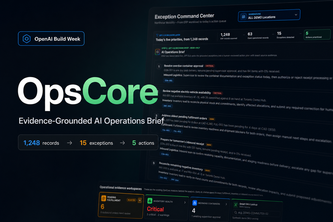
The description states that OpsCore adds an "evidence-grounded AI Operations Brief" to an existing operations control center. It narrows a synthetic ERP workload from 1,248 records to 63 open records, 15 grounded exceptions, and five prioritized actions.
It is described as read-only: it cannot update orders, adjust inventory, receive containers, approve transactions, or mark work complete.
The AI is said to cite exact source records for each action, and reviewers can open those citations in corresponding fulfillment, inventory, or inbound workspaces.
Evidence The author describes how the system works internally, including use of a synthetic ERP twin, rule-based screening, and GPT-5.6 Sol via the OpenAI Responses API.
Inference The product appears to be a dashboard-integrated AI assistant that filters and prioritizes operational tasks based on structured data inputs.
Positioning & Claim Evolution
The author states that operations teams "rarely lack data; they lack a fast, reliable way to decide what deserves attention first."
OpsCore is positioned as a tool that adds an AI start-of-day brief to control centers, focusing on prioritization and traceability of actions.
It claims to be “evidence-grounded,” with each recommendation citing source records and being human-reviewed.
Evidence The author’s own write-up frames the product as solving a specific workflow problem — decision fatigue in operations — through AI-assisted prioritization.
Inference The positioning is that OpsCore helps operational teams make faster, more informed decisions by filtering noise from structured ERP data.
Target Customer & ICP
The description states that OpsCore targets “operations control centers” and is designed for teams dealing with fulfillment, inventory, and inbound operations.
It is implied to be used by operational staff who manage ERP systems, not end-users or executives.
Evidence The author describes the use case as a “start of day” experience in an operations center, where users move between spreadsheets, status reports, and order systems.
Inference The ICP likely includes mid-to-large enterprise teams managing complex fulfillment and inventory workflows, but no specific customer segments or personas are named.
Business Model & Pricing Evidence
The description does not contain any information about pricing, monetization, or business model.
There is no mention of customers, revenue, subscriptions, or commercial arrangements.
Evidence Not evidenced.
Inference The product appears to be a prototype or hackathon submission with no commercial traction or pricing strategy described.
Technical & Delivery Signals
The system is built using:
- Codex
- JavaScript
- Node.js
- OpenAI Responses API
- Vercel
It uses a synthetic ERP twin to generate 742 sales orders, 386 inventory balances, and 120 purchase orders.
The AI is said to be read-only, with no browser-based reasoning; the server owns the payload.
It implements:
- Strict JSON schema
- Post-generation validation
- Password protection
- Rate limits
- Request-size limits
- Security headers
- Automated tests
Evidence The author describes technical architecture and implementation details including API use, data flow, and security measures.
Inference The system is built with a focus on safety, traceability, and structured output — consistent with a read-only AI assistant for operational workflows.
Traction & Maturity Signals
The project was submitted to the OpenAI 2026 hackathon.
It is described as a “judging deployment” isolated from live systems.
There is no evidence of:
- Customers
- Revenue
- Adoption
- Live usage
- Product-market fit
- Any form of traction beyond the synthetic data used for judging
Evidence Not evidenced.
Inference The project is at an early stage — likely a prototype or proof-of-concept with no real-world deployment or user feedback.
Competitive Context
The description does not mention any competitors or market context.
There is no discussion of existing tools in the operations or ERP space, nor how OpsCore compares to them.
Evidence Not evidenced.
Inference The competitive landscape is unknown. The author does not reference similar AI-powered operational tools or ERP systems.
Open Questions & Risks
- No real-world usage: The system is built on synthetic data and isolated from live operations.
- Read-only architecture: While a safety feature, it may limit utility if the goal is to automate actions.
- Single-person team: No evidence of team size beyond one person (Kenny Zhao).
- Hackathon submission: The project was not designed for production use or commercial deployment.
- No pricing or monetization strategy: No indication of how this would be sold or scaled.
Evidence Not evidenced.
Inference These are risks associated with a prototype that has not been tested in real-world operations and lacks commercial infrastructure.
Questions the description leaves open
- What is the actual operational context where this tool would be used?
- Has it ever been tested beyond the synthetic data provided for judging?
- How does the AI handle edge cases or unexpected inputs?
- Are there any plans to integrate with real ERP systems?
- What are the key assumptions about user behavior and workflow integration?
- Is there a plan for feedback loops, configurability, or time-to-resolution tracking?
- Has the founder considered how this would scale beyond a single-person team?
Overall Assessment
Not evidenced.
The project is described as a hackathon submission with no evidence of traction, revenue, customers, or commercial viability.
It is not clear whether this represents a viable product or just an idea that has not yet been tested in real-world conditions.
The author states the system is read-only and isolated from production — which may be intentional for safety but also limits its utility.
Confidence Low. This is a self-reported, unverified prototype with no evidence of adoption, revenue, or product-market fit.
User Stories BotA demo video on every pull request
Get a demo video on every new feature
GitHub App that watches your pull requests and records a narrated, captioned demo.
Save time on demo prep and make informed decisions faster with a video walkthrough of every new feature.
Source
Submitted to the OpenAI 2026 hackathon on Devpost. Project home on Devpost. Back to the full gallery on Devpost.
This competitive analysis was produced by top-founders.com (opens in a new tab)
Generated by a language model from this project's public Devpost page — its tagline, the author's own write-up and any built-with tags listed there — as captured in August 2026. Short quotations are the author's words. It is an opinion on the idea as a business, not on the people behind it, and it reflects the description as published then. If the project has moved on, request a correction below. The analysis is not independent research and contains no verified traction, revenue or customer data.
An independent guide by KFG International LLC — not affiliated with, endorsed by, or connected to Devpost or OpenAI.