

Archive position — measured, not model output
0 likes on Devpost
2,263 of the 7,850 archived projects have more likes, and 5,587 share exactly 0 — so this project's #5,728 place in the like-ranked listing is a tie-break inside that group, not a ranking.
Projects (log scale)
Likes on Devpost. ▲ marks this project's group.
Show the figures
| Likes | Projects | Share of archive |
|---|---|---|
| 0 | 5,587 | 71.2% |
| 1 | 1,758 | 22.4% |
| 2 | 284 | 3.6% |
| 3–4 | 132 | 1.7% |
| 5–9 | 75 | 1.0% |
| 10+ | 14 | 0.2% |
 User Stories BotA demo video on every pull request
Get a demo video on every new feature
GitHub App that watches your pull requests and records a narrated, captioned demo.
Save time on demo prep and make informed decisions faster with a video walkthrough of every new feature.
Executive Summary
What the company appears to be
OpsPilot is an AI-powered incident response platform that claims to automate enterprise log analysis, identify root causes, prioritize severity, and generate resolution reports using an autonomous multi-agent workflow. It was built as a hackathon project by one developer.
What changed
The author describes OpsPilot as a full-stack application designed to reduce manual log review time for engineers. The platform includes features like log parsing, error pattern detection, severity classification, root cause identification, and report generation via PDF export. It is built with FastAPI, Next.js, React, and TypeScript.
Single most important open question
Is there evidence of real-world usage or traction beyond the hackathon prototype? The description states no revenue, customers, or adoption data are available.
What The Product Actually Is
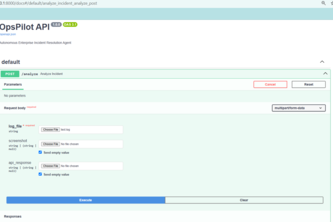
The description states that OpsPilot is an AI-powered incident resolution assistant. It allows users to upload log files through a web interface and automatically:
- Parses application logs
- Detects known error patterns
- Classifies incident severity
- Identifies probable root causes
- Recommends resolution steps
- Generates downloadable investigation reports
- Displays analysis in an interactive dashboard
The system is described as having a modular agent-based architecture, with backend built using FastAPI and Python, and frontend using Next.js, React, and TypeScript. It supports PDF report generation and includes features such as file upload interface, agent activity timeline, and root cause analysis.
Evidence
- Author states: “OpsPilot is an AI-powered incident resolution assistant that transforms raw application logs into meaningful insights.”
- Author states: “Users can upload log files through a modern web interface, and the platform automatically parses application logs...”
- Author states: “The project consists of a full-stack architecture: Backend FastAPI, Python; Frontend Next.js, React, TypeScript.”
Inference It is inferred that OpsPilot functions as a self-contained tool for enterprise engineers to analyze incidents more efficiently.
Positioning & Claim Evolution
The author positions OpsPilot as an AI-powered platform aimed at reducing manual log review time and improving incident response workflows in enterprise environments. It is described as an autonomous agent-based system capable of analyzing logs, identifying root causes, and generating actionable reports.
The project evolved from a hackathon idea focused on automating repetitive tasks in support teams to a modular architecture designed for future AI integration.
Evidence
- Author states: “Enterprise support teams spend a significant amount of time investigating incidents by manually reviewing application logs...”
- Author states: “The goal of OpsPilot is to reduce investigation time and help teams respond to incidents more efficiently.”
- Author states: “The application is designed so that the analysis engine can later be extended with Large Language Models or additional intelligent agents without changing the user experience.”
Inference It is inferred that OpsPilot aims to evolve into an enterprise-grade solution for autonomous incident management, though no evidence of such evolution exists beyond the hackathon prototype.
Target Customer & ICP
The description indicates that OpsPilot targets enterprise support teams and engineers who investigate application incidents manually. These users are said to spend significant time reviewing logs and identifying root causes.
Evidence
- Author states: “Enterprise support teams spend a significant amount of time investigating incidents by manually reviewing application logs...”
- Author states: “The goal of OpsPilot is to reduce investigation time and help teams respond to incidents more efficiently.”
Inference It is inferred that the primary customer segment includes engineers or operations personnel in large enterprises dealing with incident response.
Business Model & Pricing Evidence
No business model or pricing information is provided. The description does not mention any monetization strategy, subscription plans, or commercial arrangements.
Evidence
- No mention of revenue streams, pricing tiers, or sales processes.
Inference It is inferred that no business model has been defined or implemented beyond the prototype stage.
Technical & Delivery Signals
OpsPilot was built as a full-stack application using FastAPI (backend), Next.js + React (frontend), and TypeScript. It includes modular agent-based architecture, REST APIs, PDF report generation, and a responsive dashboard. The system supports file uploads and integrates with Git for version control.
Evidence
- Author states: “The project consists of a full-stack architecture: Backend FastAPI, Python; Frontend Next.js, React, TypeScript.”
- Author states: “Implemented automated PDF report generation...”
- Author states: “Designed a modular AI-inspired multi-agent architecture capable of analyzing application logs...”
- Author states: “Built the analysis engine in a modular way so it can easily be extended with enterprise AI models and additional intelligent agents in the future.”
Inference It is inferred that OpsPilot has a technical foundation suitable for scaling into an enterprise product, but no evidence of production deployment or performance metrics.
Traction & Maturity Signals
There is no evidence of traction, revenue, customer adoption, or usage beyond the hackathon prototype. The project was submitted to a hackathon and lacks any indication of real-world implementation or market validation.
Evidence
- Author states: “This project was submitted to the OpenAI 2026 hackathon on Devpost.”
- Author states: “No revenue, customer or traction data is available beyond what they state.”
Inference It is inferred that OpsPilot has not yet reached a stage where it can be considered a mature product or validated solution in the market.
Competitive Context
The description does not provide information about competitors or how OpsPilot compares to existing solutions in the incident management space. No mention of similar tools such as Splunk, Datadog, or Azure Monitor is made.
Evidence
- Author mentions future integration with platforms like Splunk, Datadog, and Azure Monitor but does not discuss current competitive landscape.
Inference It is inferred that OpsPilot operates in a space where it may compete with or integrate into existing enterprise monitoring tools, but no evidence of this exists.
Open Questions & Risks
- No traction or commercial validation: The product remains a hackathon prototype with no evidence of real-world usage.
- Single founder team: Only one developer is listed; lack of team structure raises concerns about scalability and execution capability.
- Unproven AI integration: While the system is described as modular for future LLM integration, there’s no indication that this has been implemented or tested.
- Limited scope: The project focuses on log parsing and reporting but does not address broader aspects of incident management (e.g., remediation automation).
- Self-reported only: All claims are unverified; no third-party validation or performance data is available.
Evidence
- Author states: “Team size: 1”
- Author states: “No revenue, customer or traction data is available beyond what they state.”
- Author states: “Each challenge helped improve the overall architecture and made the project more maintainable.”
Questions the description leaves open
- What specific enterprise use cases have you identified for OpsPilot?
- Have you tested the platform with actual log data from real enterprise environments?
- How do you plan to scale the multi-agent workflow beyond the prototype?
- Are there any partnerships or pilot programs underway with enterprises?
- What are your plans for monetization and go-to-market strategy?
- Can you demonstrate how the system handles complex, multi-system incidents?
- Have you considered compliance and security requirements for enterprise deployment?
Overall Assessment
Not evidenced.
The description provides no evidence of commercial traction, revenue, customer base, or validated market demand. The project is a hackathon prototype with one founder and no independent verification of its capabilities or outcomes.
Given the lack of any measurable progress beyond the initial build, there is insufficient basis to evaluate whether OpsPilot represents a viable investment or partnership opportunity at this time. Any potential value lies in future development, which cannot be assessed from this self-reported description alone.
Confidence level Low
Reasoning
The entire analysis is based on a single unverified source — the author’s own account. No external data, metrics, or validation are present to support commercial due diligence.
User Stories BotA demo video on every pull request
Get a demo video on every new feature
GitHub App that watches your pull requests and records a narrated, captioned demo.
Save time on demo prep and make informed decisions faster with a video walkthrough of every new feature.
Source
Submitted to the OpenAI 2026 hackathon on Devpost. Project home on Devpost. Back to the full gallery on Devpost.
This competitive analysis was produced by top-founders.com (opens in a new tab)
Generated by a language model from this project's public Devpost page — its tagline, the author's own write-up and any built-with tags listed there — as captured in August 2026. Short quotations are the author's words. It is an opinion on the idea as a business, not on the people behind it, and it reflects the description as published then. If the project has moved on, request a correction below. The analysis is not independent research and contains no verified traction, revenue or customer data.
An independent guide by KFG International LLC — not affiliated with, endorsed by, or connected to Devpost or OpenAI.