

Archive position — measured, not model output
0 likes on Devpost
2,263 of the 7,850 archived projects have more likes, and 5,587 share exactly 0 — so this project's #6,344 place in the like-ranked listing is a tie-break inside that group, not a ranking.
Projects (log scale)
Likes on Devpost. ▲ marks this project's group.
Show the figures
| Likes | Projects | Share of archive |
|---|---|---|
| 0 | 5,587 | 71.2% |
| 1 | 1,758 | 22.4% |
| 2 | 284 | 3.6% |
| 3–4 | 132 | 1.7% |
| 5–9 | 75 | 1.0% |
| 10+ | 14 | 0.2% |
 User Stories BotA demo video on every pull request
Get a demo video on every new feature
GitHub App that watches your pull requests and records a narrated, captioned demo.
Save time on demo prep and make informed decisions faster with a video walkthrough of every new feature.
Executive Summary
What the company appears to be
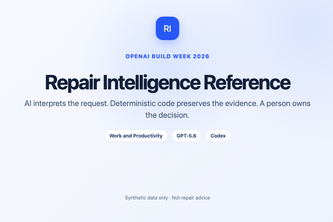
Repair Intelligence Reference (RIR) is a self-reported open-source project that aims to solve the problem of translating multilingual, natural-language vehicle repair requests into structured catalog decisions — with a strong emphasis on deterministic code and human confirmation at key points. The author describes it as a "working pattern" built during a hackathon, intended for reuse by other developers.
What changed
The project was submitted to the OpenAI 2026 hackathon. It is described as a proof-of-concept that uses GPT-5.6 (via Responses API) in a strictly bounded way, with deterministic logic handling catalog matching and provenance tracking. The author states it can run without an API key and includes clean-room practices to prevent real-world identifiers from entering the codebase.
Single most important open question
Is there any evidence of commercial traction or adoption beyond this single-person hackathon project? The description does not indicate any revenue, customers, or usage outside of a demo environment.
What The Product Actually Is
The description states that RIR is a system where:
- Free text input (in any language) is processed.
- GPT-5.6 is used via the Responses API to propose a structured prefill.
- Deterministic code builds a reviewable union of catalog options with source-level provenance.
- A person must explicitly confirm the exact variant before a repair path with parts and per-item provenance is revealed.
- The workflow works end-to-end on synthetic data, and also functions without an API key (GPT-5.6 being optional).
- It was built using Codex, Node.js, HTML5, CSS3, JavaScript, and OpenAI APIs.
Inference This appears to be a prototype for a structured intake system that bridges natural language input with catalog-based decision-making in automotive repair contexts. The architecture emphasizes human-in-the-loop confirmation and traceability.
Positioning & Claim Evolution
The author claims:
- This project is a "map" of an intake problem they experienced firsthand, learned the expensive way.
- It turns years of domain-specific pain into a reusable pattern.
- It's MIT-licensed for reuse by other builders.
- The system is designed to be trustworthy and inspectable — not just described but shipped as code.
Inference The positioning is that of a developer tool or reference implementation, not a commercial product. The author frames it as solving a real-world problem in auto repair with a clean, deterministic approach that can be adapted by others.
Target Customer & ICP
The description states:
- The system is built for use in automotive workshops.
- It addresses the intake process where customers don’t speak in VINs but describe vehicles in natural language.
- It aims to reduce errors from misinterpretation of customer requests, which leads to wrong parts and lost time.
Inference The primary target is likely small-to-medium auto repair businesses or teams working with vehicle catalog systems. The ICP appears to be developers or technical teams who want to implement similar intake logic in their own systems.
Business Model & Pricing Evidence
Not evidenced.
The description does not mention:
- Any pricing model.
- Revenue streams.
- Commercial licensing.
- Subscription or usage fees.
- Monetization strategy.
Inference There is no indication that this project has moved beyond a hackathon prototype into a commercial offering. The author mentions building a "full commercial estimator" separately, but that is not part of the current project.
Technical & Delivery Signals
The description states:
- Built with Codex, Node.js, HTML5, CSS3, JavaScript, OpenAI APIs.
- Uses GPT-5.6 via Responses API with strict Structured Outputs, store: false, and hashed anonymous safety identifier.
- Deterministic code handles catalog matching and provenance.
- Clean-room practices enforced by scanners and tests.
- 31 offline tests and two publication scanners that fail the build on infrastructure or identifier-shaped inputs.
- Zero runtime dependencies.
- Can be run with
npm install,npm run check, thennpm start.
Inference The technical stack is minimal and focused on clean-room development. The use of Codex, deterministic logic, and strict gates suggests a strong emphasis on safety and reproducibility.
Traction & Maturity Signals
Not evidenced.
The description does not provide:
- Customer data.
- Usage metrics.
- Revenue figures.
- Adoption beyond the author’s own environment.
- Product maturity indicators like versioning or release history.
Inference This is a single-person hackathon project with no evidence of traction or ongoing development beyond its initial submission.
Competitive Context
Not evidenced.
The description does not:
- Mention competitors.
- Describe market positioning.
- Provide context on similar tools or platforms in the auto repair or intake automation space.
Inference No competitive landscape is described. The project seems to be positioned as a reference implementation rather than a competing product.
Open Questions & Risks
- Single-person operation: The team size is listed as 1, suggesting limited scalability and maintenance capacity.
- No commercial traction: There is no evidence of real-world usage or adoption beyond the demo.
- Unverified claims: All statements are self-reported and unverified; there’s no third-party validation.
- Limited scope: The system works on synthetic data and with a specific use case (auto repair intake), which may limit its generalizability.
- Hackathon origin: The project was submitted to a hackathon, implying it is experimental and not yet mature for production.
Questions the description leaves open
- What real-world testing has been done beyond the synthetic data used in the demo?
- Are there any plans or early signs of commercial adoption or interest from auto repair businesses?
- How does this system handle edge cases that are not covered in the current implementation?
- Is there a plan to move beyond the reference implementation into a full product or service?
- What is the long-term vision for monetization if this becomes a commercial offering?
Overall Assessment
Not evidenced.
There is no evidence of:
- Revenue.
- Customers.
- Product-market fit.
- Commercial viability.
- Any investment or partnership activity.
Inference This project is currently a hackathon prototype with no demonstrated traction. It may be of interest as a reference implementation or for future development, but it does not appear to be a viable investment or partnership opportunity at this time.
User Stories BotA demo video on every pull request
Get a demo video on every new feature
GitHub App that watches your pull requests and records a narrated, captioned demo.
Save time on demo prep and make informed decisions faster with a video walkthrough of every new feature.
Source
Submitted to the OpenAI 2026 hackathon on Devpost. Project home on Devpost. Back to the full gallery on Devpost.
This competitive analysis was produced by top-founders.com (opens in a new tab)
Generated by a language model from this project's public Devpost page — its tagline, the author's own write-up and any built-with tags listed there — as captured in August 2026. Short quotations are the author's words. It is an opinion on the idea as a business, not on the people behind it, and it reflects the description as published then. If the project has moved on, request a correction below. The analysis is not independent research and contains no verified traction, revenue or customer data.
An independent guide by KFG International LLC — not affiliated with, endorsed by, or connected to Devpost or OpenAI.