

Archive position — measured, not model output
0 likes on Devpost
2,263 of the 7,850 archived projects have more likes, and 5,587 share exactly 0 — so this project's #2,420 place in the like-ranked listing is a tie-break inside that group, not a ranking.
Projects (log scale)
Likes on Devpost. ▲ marks this project's group.
Show the figures
| Likes | Projects | Share of archive |
|---|---|---|
| 0 | 5,587 | 71.2% |
| 1 | 1,758 | 22.4% |
| 2 | 284 | 3.6% |
| 3–4 | 132 | 1.7% |
| 5–9 | 75 | 1.0% |
| 10+ | 14 | 0.2% |
 User Stories BotA demo video on every pull request
Get a demo video on every new feature
GitHub App that watches your pull requests and records a narrated, captioned demo.
Save time on demo prep and make informed decisions faster with a video walkthrough of every new feature.
Executive Summary
What the company appears to be
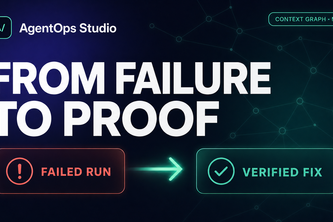
AgentOps Studio is a self-reported debugging tool for AI agents that turns failed execution traces into structured diagnoses, regression tests, and safe replays. It uses GPT-5.6 as the reasoning engine for diagnosis but keeps deterministic code responsible for verification and metrics.
What changed
The project was built over a 2-week Build Week hackathon, with an author who is a solo developer (Artur Mrozowski). It includes a prototype UI, synthetic test cases, and a structured workflow from trace to replay. The tool is described as focused on evidence-based diagnosis rather than generic observability.
The single most important open question
Is there any evidence of real-world adoption or traction beyond the author’s own development environment?
What The Product Actually Is
The description states that AgentOps Studio:
- Turns failed AI-agent execution traces into a debugging workflow.
- Uses GPT-5.6 to analyze normalized traces and return structured diagnoses with root causes, facts, inferences, evidence strength, missing telemetry, and recommended actions.
- Allows developers to jump from claims to supporting trace-span IDs.
- Generates and reviews declarative regression evaluations.
- Runs deterministic replays against failed runs in a mocked sandbox.
- Calculates before-and-after metrics from stored run data.
- Returns an explicit "insufficient-evidence" result when telemetry is incomplete.
- Uses synthetic fixtures for deterministic broken, retry, fixed, and insufficient-evidence runs.
- Is implemented as a single Next.js 16 App Router application with TypeScript, React, Zod, DuckDB, Playwright, Vitest, Docker, and LiteLLM.
Inference The product is a proof-of-concept debugging tool for AI agents in development environments. It is not described as production-ready or integrated into existing agent platforms.
Positioning & Claim Evolution
The author states:
- AI teams have tools for collecting traces but lack structured failure diagnosis.
- AgentOps Studio moves beyond “here is the trace” to “here is the failure, the evidence, the fix, and a way to verify it.”
- It explores debugging when GPT-5.6 is the reasoning engine while deterministic software remains responsible for verification.
Inference The positioning is that of a developer tool focused on AI agent debugging, emphasizing structured diagnosis over generic observability. It positions itself as a solution to the gap between trace collection and actionable failure resolution.
Target Customer & ICP
The description states:
- The target is AI teams working with agents.
- The tool is built for developers who debug failed agent runs.
- It is described as a debugging workflow, not a dashboard or platform.
Inference The ICP appears to be developers or engineering teams building or maintaining AI agents, particularly in early-stage or experimental development. No specific customer segments or personas are named.
Business Model & Pricing Evidence
The description states:
- The project is self-reported as a hackathon prototype.
- It includes a GitHub repository with MIT license and setup instructions.
- There is no mention of pricing, monetization, or business model.
Not evidenced No evidence of any business model or pricing structure.
Technical & Delivery Signals
The description states:
- Built with Next.js 16, TypeScript, React 19, Zod, DuckDB, Playwright, Vitest, Docker, LiteLLM.
- Uses OpenAI SDK and GPT-5.6 via a LiteLLM endpoint.
- Implements structured output validation using Zod.
- Includes synthetic fixtures for deterministic testing.
- Uses a closed vocabulary for evaluation predicates.
- Replay is constrained to one synthetic workflow with mocked tools.
- The tool is deployed in a standalone Debian-based Docker image.
Inference The technical stack suggests a developer-focused, reproducible prototype. The use of deterministic replay and sandboxing indicates an emphasis on safety and testability.
Traction & Maturity Signals
The description states:
- The project was built during a 2-week Build Week hackathon.
- It is a solo developer effort (Artur Mrozowski).
- The demo is credential-free, reproducible, and takes 2 minutes 10 seconds.
- The repository includes synthetic sample data, setup instructions, and testing notes.
Not evidenced No evidence of revenue, customers, or adoption beyond the author’s own development environment. No metrics on usage, retention, or product maturity are provided.
Competitive Context
The description states:
- AI teams have tools for collecting traces but lack structured failure diagnosis.
- The tool is described as a debugging workflow, not a dashboard or platform.
- It is positioned to move beyond trace display to actionable failure resolution.
Not evidenced No mention of competitors or direct market positioning against existing tools. No evidence of competitive differentiation in the marketplace.
Open Questions & Risks
The description states:
- The tool is constrained to one synthetic workflow with mocked side effects.
- It uses a single developer (Artur Mrozowski) and is not described as a scalable product.
- The demo is credential-free, which may limit its real-world applicability.
- GPT-5.6 is used for diagnosis but deterministic code verifies fixes — this is a deliberate boundary.
Inference Risks include:
- Limited scope (only one synthetic workflow).
- No production integration or scalability evidence.
- Solo developer effort raises questions about long-term maintenance and growth.
- The tool is not described as production-ready, which may limit its commercial viability.
Questions the description leaves open
- What is the actual use case for this tool in a real-world AI agent deployment?
- How does it handle integration with existing telemetry or observability systems?
- Has there been any feedback from developers using this in practice, beyond the author’s own testing?
- What are the plans to scale beyond the current synthetic workflow and mocked tools?
- Are there any plans for production-grade integrations or API access?
Overall Assessment
The description states:
- AgentOps Studio is a solo developer hackathon project.
- It is described as a proof-of-concept with a narrow, polished workflow.
- The author emphasizes that AI-native tools need stronger boundaries and deterministic verification.
Inference This is a prototype tool with potential for further development. However, there is no evidence of traction, revenue, or customer adoption. The project is not yet ready for investment or partnership unless it demonstrates early-stage traction or a clear path to commercialization.
User Stories BotA demo video on every pull request
Get a demo video on every new feature
GitHub App that watches your pull requests and records a narrated, captioned demo.
Save time on demo prep and make informed decisions faster with a video walkthrough of every new feature.
Source
Submitted to the OpenAI 2026 hackathon on Devpost. Project home on Devpost. Back to the full gallery on Devpost.
This competitive analysis was produced by top-founders.com (opens in a new tab)
Generated by a language model from this project's public Devpost page — its tagline, the author's own write-up and any built-with tags listed there — as captured in August 2026. Short quotations are the author's words. It is an opinion on the idea as a business, not on the people behind it, and it reflects the description as published then. If the project has moved on, request a correction below. The analysis is not independent research and contains no verified traction, revenue or customer data.
An independent guide by KFG International LLC — not affiliated with, endorsed by, or connected to Devpost or OpenAI.