

Archive position — measured, not model output
0 likes on Devpost
2,263 of the 7,850 archived projects have more likes, and 5,587 share exactly 0 — so this project's #4,383 place in the like-ranked listing is a tie-break inside that group, not a ranking.
Projects (log scale)
Likes on Devpost. ▲ marks this project's group.
Show the figures
| Likes | Projects | Share of archive |
|---|---|---|
| 0 | 5,587 | 71.2% |
| 1 | 1,758 | 22.4% |
| 2 | 284 | 3.6% |
| 3–4 | 132 | 1.7% |
| 5–9 | 75 | 1.0% |
| 10+ | 14 | 0.2% |
 User Stories BotA demo video on every pull request
Get a demo video on every new feature
GitHub App that watches your pull requests and records a narrated, captioned demo.
Save time on demo prep and make informed decisions faster with a video walkthrough of every new feature.
Executive Summary
What the company appears to be
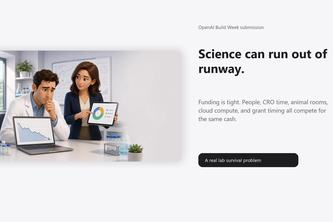
GrantPilot is a self-described AI-powered decision support tool for scientific R&D teams. It positions itself as an "AI CFO" that helps teams allocate scarce funding across competing projects, using financial modeling and Monte Carlo simulations alongside GPT-5.6-generated communication.
What changed
The project was submitted to the OpenAI 2026 hackathon by a husband-and-wife team with backgrounds in academic science and finance/statistics. It is described as a prototype or proof-of-concept, not yet a commercial product.
Single most important open question
Is there evidence of real-world usage or traction from scientific R&D teams? The description states no revenue, customers, or adoption data — only self-reported claims about functionality and design choices.
What The Product Actually Is
The description states that GrantPilot is an AI-powered system designed to help research teams make funding decisions. It models a scientific R&D portfolio under uncertainty, using structured financial calculations (cash flow, manpower demand, capacity bottlenecks, Monte Carlo risk) and GPT-5.6 to generate understandable outputs like CFO memos.
It includes features such as:
- Portfolio optimization
- Monte Carlo stress testing
- Scenario comparison (Survival, Balanced, Breakthrough)
- Sensitivity analysis
- Board-ready memo generation
The system is described as not being a chatbot or dashboard, but rather a decision-support tool that uses deterministic math to inform recommendations, with GPT-5.6 used for communication only.
Evidence
- The author states: “GrantPilot helps research teams decide what to fund, pause, or stop.”
- It models real lab costs and constraints including personnel, reagents, equipment, CROs, and grant delays.
- It uses GPT-5.6 to turn structured outputs into clear language for non-financial stakeholders.
Inference The system appears to be built around a hybrid approach: deterministic modeling + AI-generated communication — not a pure LLM-based tool.
Positioning & Claim Evolution
The description states that GrantPilot is positioned as an "AI CFO" for scientific R&D teams. It aims to bridge the gap between scientific ambition and financial survival, helping teams navigate funding bottlenecks without losing their passion for discovery.
It claims:
- To help teams decide what to fund, pause, or stop.
- To model real lab costs and constraints.
- To provide portfolio-level decision support using Monte Carlo risk analysis.
- To generate board-ready CFO memos.
- To combine scientific understanding with financial discipline.
The positioning evolved from a personal problem faced by the founders — funding scarcity in research teams — to a tool that addresses this issue through AI and financial modeling.
Evidence
- “We wanted to build an AI CFO that understands research reality and helps more good science survive the funding bottleneck.”
- “GrantPilot is not just a chatbot or a financial dashboard. It is a working decision system that connects scientific ambition with financial survival.”
Inference The positioning reflects a niche market need: funding decisions in early-stage R&D teams where capital is limited and uncertainty high.
Target Customer & ICP
The description states the default scenario involves:
- A translational R&D team
- USD 1.2 million in cash
- Seven people
- Six competing projects
It targets:
- Research teams with limited runway
- Small labs or early-stage biotech teams
- PIs, lab managers, and board members who make funding decisions
Evidence
- “The default scenario represents a translational R&D team with USD 1.2 million in cash, seven people, and six competing projects.”
- “It can explain why an exciting project may need to wait, identify which resource is actually limiting progress, and show how one portfolio decision changes runway and risk.”
Inference The target customer is likely early-stage scientific teams with limited financial resources and complex project portfolios.
Business Model & Pricing Evidence
Not evidenced. The description does not contain any information about pricing, monetization, or business model.
Evidence
- No mention of revenue streams, subscriptions, licensing, or pricing tiers.
- No indication of whether the tool is sold to institutions, individuals, or via grants.
Technical & Delivery Signals
The project was built using:
- GPT-5.6
- Node.js, JavaScript, HTML5, CSS3
- OpenAI APIs
- Codex
- API integrations (implied)
It uses a hybrid approach:
- Deterministic financial modeling for decision-making
- GPT-5.6 to generate human-readable outputs
Evidence
- “GPT-5.6 Sol then turns those structured outputs into clear language for a PI, founder, lab manager, or board member.”
- “The math makes the decision. GPT makes the decision understandable.”
Inference This suggests a deliberate separation between calculation and communication layers — not a pure LLM-driven interface.
Traction & Maturity Signals
Not evidenced. The description does not contain any data about:
- Customers
- Revenue
- Usage metrics
- Product adoption
- Market traction
It is described as a hackathon submission, not a commercial product.
Evidence
- “This project was submitted to the OpenAI 2026 hackathon on Devpost.”
- “GrantPilot is not just a chatbot or a financial dashboard. It is a working decision system…”
Competitive Context
Not evidenced. The description does not mention:
- Competitors
- Existing tools in the market
- Market size or landscape
Evidence
- No reference to similar products or platforms.
Open Questions & Risks
- No commercial traction or revenue evidence: The project is described as a hackathon submission with no indication of real-world usage.
- Unverified claims about AI capabilities: GPT-5.6 is used for communication, but the description does not validate whether this model is actually integrated or functional in practice.
- Unclear monetization strategy: No pricing or business model details are provided.
- Highly specialized domain: The tool targets a narrow niche (scientific R&D finance), which may limit scalability or market appeal.
- Lack of real-world testing: The system is described as a prototype, not validated in actual lab settings.
Evidence
- “This project was submitted to the OpenAI 2026 hackathon.”
- “It is a working decision system that connects scientific ambition with financial survival.” (No evidence of real-world validation.)
Questions the description leaves open
- What specific financial models are used for portfolio optimization and risk analysis?
- How does the tool integrate with existing lab management or grant tracking systems?
- Has the tool been tested in any real scientific teams or labs?
- What is the current stage of development — prototype, MVP, or beta?
- Are there any plans to monetize the product, and how?
- How do you plan to scale beyond the current hackathon-level prototype?
Overall Assessment
Not evidenced. No information is provided about:
- Valuation
- Funding history
- Investor interest
- Partnership opportunities
The project is described as a hackathon submission with no commercial or financial data.
Evidence
- “This project was submitted to the OpenAI 2026 hackathon on Devpost.”
- “Everything above is the authors' own account. It is not independently verified, and no revenue, customer or traction data is available beyond what they state.”
Inference At this stage, it appears to be a concept or prototype with potential in a niche market, but lacks commercial viability or traction indicators.
User Stories BotA demo video on every pull request
Get a demo video on every new feature
GitHub App that watches your pull requests and records a narrated, captioned demo.
Save time on demo prep and make informed decisions faster with a video walkthrough of every new feature.
Source
Submitted to the OpenAI 2026 hackathon on Devpost. Project home on Devpost. Back to the full gallery on Devpost.
This competitive analysis was produced by top-founders.com (opens in a new tab)
Generated by a language model from this project's public Devpost page — its tagline, the author's own write-up and any built-with tags listed there — as captured in August 2026. Short quotations are the author's words. It is an opinion on the idea as a business, not on the people behind it, and it reflects the description as published then. If the project has moved on, request a correction below. The analysis is not independent research and contains no verified traction, revenue or customer data.
An independent guide by KFG International LLC — not affiliated with, endorsed by, or connected to Devpost or OpenAI.