

Archive position — measured, not model output
0 likes on Devpost
2,263 of the 7,850 archived projects have more likes, and 5,587 share exactly 0 — so this project's #6,346 place in the like-ranked listing is a tie-break inside that group, not a ranking.
Projects (log scale)
Likes on Devpost. ▲ marks this project's group.
Show the figures
| Likes | Projects | Share of archive |
|---|---|---|
| 0 | 5,587 | 71.2% |
| 1 | 1,758 | 22.4% |
| 2 | 284 | 3.6% |
| 3–4 | 132 | 1.7% |
| 5–9 | 75 | 1.0% |
| 10+ | 14 | 0.2% |
 User Stories BotA demo video on every pull request
Get a demo video on every new feature
GitHub App that watches your pull requests and records a narrated, captioned demo.
Save time on demo prep and make informed decisions faster with a video walkthrough of every new feature.
Executive Summary
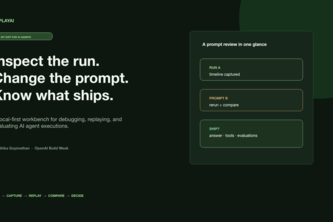
The company appears to be a solo developer project named ReplayAI, self-described as a tool for developers to debug and understand AI agents by replaying their behavior, inspecting tool calls, and comparing prompt versions. The author states that the project was submitted to the OpenAI 2026 hackathon.
What changed: The author describes building a developer workspace for AI agent debugging, with features like execution timelines, prompt comparison, and trace inspection. This is presented as an evolution from traditional code debugging to AI agent debugging.
The single most important open question: Is there any evidence of actual developer adoption or usage beyond the author's own development work?
This analysis is based entirely on self-reported information from the project description and author's write-up. No independent verification, traction data, revenue, customers or market validation is available.
What The Product Actually Is
The description states that ReplayAI is:
- A developer workspace for building reliable intelligent workflows
- A tool that allows developers to replay executions
- A system that inspects tool calls
- A platform for comparing different prompt versions
- A solution for evaluating behavior across test cases
- A way to understand exactly how an agent reached its final output
The author describes it as making AI agent executions "transparent and reproducible" instead of treating them as a "black box."
Inference: The product appears to be a debugging/observability tool for AI agents, with UI components for timeline visualization, prompt comparison, and execution trace inspection.
Positioning & Claim Evolution
The author states:
- Traditional code changes can be reviewed with Git
- Agent prompt changes cannot
- ReplayAI does both: replay behavior, detect regressions, show what changed before shipping
Claim: The positioning is that ReplayAI bridges the gap between traditional software debugging and AI agent debugging.
Inference: This represents an evolution from standard software development practices to a new category of tooling for AI agents. The claim is that current tools are inadequate for AI agent debugging.
Target Customer & ICP
The description states:
- Target: Developers
- Use case: Building reliable intelligent workflows
- Audience: Developers who build, evaluate, and debug AI agents
Inference: The target customer is software developers working with AI agents, particularly those building autonomous systems. The ICP appears to be developers who are already using or building with AI agents.
Business Model & Pricing Evidence
Not evidenced.
The description does not contain any information about:
- Revenue model
- Pricing structure
- Monetization strategy
- Customer acquisition costs
- Unit economics
Technical & Delivery Signals
The author states:
- Built with Codex and GPT-5.6
- Frontend: Next.js, TypeScript, Tailwind CSS
- Backend: OpenAI Agents SDK and modern web technologies
- Features include: visual execution timelines, agent execution replay, prompt version comparison, evaluation dashboards, performance analytics, trace inspection
Inference: The technical stack suggests a modern web application using AI APIs for backend processing. The features indicate an emphasis on observability and debugging capabilities.
Traction & Maturity Signals
Not evidenced.
The description does not contain any information about:
- Customers
- Revenue
- Usage metrics
- Product-market fit
- Market traction
- User feedback
- Iteration history
- Product maturity
Competitive Context
Not evidenced.
The description does not contain any information about:
- Competitors
- Market size
- Competitive landscape
- Differentiation from existing tools
- Market positioning relative to other debugging/observability tools
Open Questions & Risks
Risk 1: Solo development. The team size is listed as 1, which may indicate limited capacity for execution or scaling.
Risk 2: No evidence of traction or market validation. The project appears to be in early development phase with no customer data or usage metrics.
Risk 3: Unclear commercial viability. The description focuses on the technical solution but lacks any indication of how this will be monetized or scaled.
Risk 4: Dependency on AI APIs. Heavy reliance on OpenAI and Codex/GPT services may create vendor lock-in risks and cost concerns.
Questions the description leaves open
- What specific problems are you solving that existing debugging tools don't address?
- How do you plan to validate your assumptions about developer needs in this space?
- What is your go-to-market strategy for reaching developers who build AI agents?
- Have you identified any early adopters or potential customers?
- What is your timeline for product development and market entry?
- How do you plan to monetize this tool?
- What are the key technical challenges you've faced in building this solution?
Overall Assessment
Not evidenced.
The description provides no information about:
- Financial performance
- Market opportunity size
- Competitive advantages
- Team track record
- Investment requirements
- Partnership potential
- Return on investment metrics
Confidence Level: Very low. This is a solo project in early development phase with no evidence of traction, customers or market validation. The analysis is based entirely on self-reported claims without any independent verification.
User Stories BotA demo video on every pull request
Get a demo video on every new feature
GitHub App that watches your pull requests and records a narrated, captioned demo.
Save time on demo prep and make informed decisions faster with a video walkthrough of every new feature.
Source
Submitted to the OpenAI 2026 hackathon on Devpost. Project home on Devpost. Back to the full gallery on Devpost.
This competitive analysis was produced by top-founders.com (opens in a new tab)
Generated by a language model from this project's public Devpost page — its tagline, the author's own write-up and any built-with tags listed there — as captured in August 2026. Short quotations are the author's words. It is an opinion on the idea as a business, not on the people behind it, and it reflects the description as published then. If the project has moved on, request a correction below. The analysis is not independent research and contains no verified traction, revenue or customer data.
An independent guide by KFG International LLC — not affiliated with, endorsed by, or connected to Devpost or OpenAI.