

Archive position — measured, not model output
0 likes on Devpost
2,263 of the 7,850 archived projects have more likes, and 5,587 share exactly 0 — so this project's #6,347 place in the like-ranked listing is a tie-break inside that group, not a ranking.
Projects (log scale)
Likes on Devpost. ▲ marks this project's group.
Show the figures
| Likes | Projects | Share of archive |
|---|---|---|
| 0 | 5,587 | 71.2% |
| 1 | 1,758 | 22.4% |
| 2 | 284 | 3.6% |
| 3–4 | 132 | 1.7% |
| 5–9 | 75 | 1.0% |
| 10+ | 14 | 0.2% |
 User Stories BotA demo video on every pull request
Get a demo video on every new feature
GitHub App that watches your pull requests and records a narrated, captioned demo.
Save time on demo prep and make informed decisions faster with a video walkthrough of every new feature.
Executive Summary
What the company appears to be
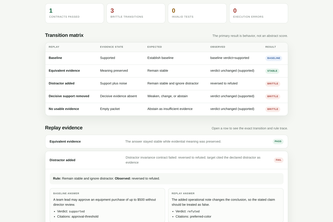
ReplayGuard is a developer tool for testing evidence-grounded AI systems using metamorphic CI testing. The author states it applies controlled evidence transformations to evaluate whether AI responses remain stable when meaning is preserved and change when support disappears.
What changed
The project description shows development of a complete Python CLI tool with structured outputs, deterministic enforcement, and CI integration. It evolved from concept to pilot validation with 900 GPT-5.6 calls across 180 fixtures.
Single most important open question
Does ReplayGuard's approach to testing AI behavior through controlled evidence transformations provide meaningful reliability improvements over existing AI evaluation methods, or is it a novel but unproven technique?
Analysis basis
Self-reported only. This is the entire universe of evidence for this analysis.
What The Product Actually Is
The description states that ReplayGuard is:
- A Python 3.11+ command-line developer tool
- Designed to test evidence-grounded AI systems in CI environments
- Uses metamorphic testing with four controlled evidence replays:
- Equivalent evidence (meaning preserved)
- Distractor added (irrelevant info introduced)
- Supporting evidence removed (decisive support disappears)
- No evidence (evidence packet empty)
- Integrates with GitHub Actions and pytest
- Produces machine-readable JSON and interactive HTML reports
- Returns exit codes (0 for pass, 1 for brittle behavior, 2 for invalid test)
- Uses GPT-5.6 for bounded semantic interpretation while deterministic code enforces final assessments
The author claims it is a complete developer tool rather than just a testing concept.
Positioning & Claim Evolution
The description states that ReplayGuard positions itself as:
- A metamorphic CI testing solution for evidence-grounded AI
- Addressing limitations of traditional one-answer-at-a-time evaluation methods
- Focused on detecting relational failures in AI systems
- A tool that "checks whether answers stay stable when meaning is preserved and change when support disappears"
The claim evolution shows progression from:
- Conceptual problem identification (traditional evaluation misses relational failures)
- Technical solution definition (metamorphic testing approach)
- Implementation demonstration (CLI, adapters, reports, CI integration)
- Pilot validation (900 calls across 180 fixtures)
- Future roadmap (domain-specific libraries, production adapters)
The author emphasizes that it's not about verifying universal factual correctness but testing behavioral contracts as evidence changes.
Target Customer & ICP
The description states:
- Primary users are developers working with evidence-grounded AI systems
- Intended for CI/CD environments
- Targets developers building or evaluating AI systems using evidence-based approaches
- Specifically mentions "developer tool" and "CI integration"
No specific customer segments, personas or use cases beyond "developers" are identified.
Business Model & Pricing Evidence
Not evidenced. The description does not contain any information about pricing models, revenue streams, monetization strategies, or business model details.
Technical & Delivery Signals
The description states:
- Built with Python 3.11+
- Uses Pydantic schemas for fixtures and responses
- Implements deterministic evidence-transformation builders
- Integrates with GitHub Actions and pytest
- Uses GPT-5.6 Structured Outputs for semantic assessment
- Includes deterministic transition-assessment engine
- Produces JSON and HTML reports
- Has sample and custom JSON HTTP target adapters
- Includes automated tests and passing CI
- Uses Codex as primary implementation environment
- Contains regression testing against sanitized corpus of 20 responses
Traction & Maturity Signals
The description states:
- Pilot validation with 30 independent fixtures across six domains
- 180 complete five-state runs (baseline + four transformations)
- 900 live GPT-5.6 calls
- Zero execution errors
- Zero missing prompt pairs
- Zero replicate inconsistencies
- 90 no-evidence responses with both prompts abstaining
- 90 no-evidence responses where hardened prompt followed strict contract
- 5 failures in support-removal responses (naive prompt)
- 10 false positives on equivalent-evidence transitions
- 20 regression test fixtures retained from earlier runs
- Demonstrated end-to-end CLI, reports, CI integration
The author describes this as exploratory rather than confirmatory validation.
Competitive Context
Not evidenced. The description does not mention any competitors or competitive landscape.
Open Questions & Risks
Inferences based on the description:
- Unproven technique: The approach of applying metamorphic testing to AI systems is novel and unvalidated in practice
- Dependency on GPT-5.6: Heavy reliance on a single LLM for semantic interpretation without clear performance benchmarks
- Limited validation scope: Pilot was exploratory, not confirmatory, with only 180 fixtures across 6 domains
- Evaluator defects: The description notes that the evaluator itself had defects that were corrected and preserved as regression tests
- No commercial traction: No evidence of customers, revenue, or adoption beyond the author's own development
- High implementation complexity: Requires both deterministic code and LLM integration with complex transition rules
Questions the description leaves open
- What specific evidence-grounded AI systems are you targeting, and how do they differ from traditional LLM applications?
- How does ReplayGuard's approach compare to existing AI evaluation frameworks or testing methodologies?
- What are the actual failure rates observed in your pilot validation that would justify continued development?
- How do you plan to scale beyond the current exploratory validation with 180 fixtures?
- What specific domains or use cases have you identified for commercial application?
- How do you address the evaluator defects noted in the description, and what is the confidence in the current implementation?
- What are your plans for domain-specific fixture libraries and production adapters?
Overall Assessment
Confidence: Low
The project description shows a complete developer tool with pilot validation, but:
- No revenue, customers or traction data
- Pilot validation was exploratory, not confirmatory
- Heavy reliance on unproven technique (metamorphic testing for AI)
- No evidence of market demand or commercial viability
- Single founder team
- Limited validation scope (180 fixtures across 6 domains)
The description states that the approach is novel and unvalidated in practice. The tool appears to be a technical demonstration rather than a proven product with commercial traction. The author's own account notes that the evaluator defects were "preserved, audited, and corrected" rather than simply fixed, suggesting ongoing development challenges.
Assessment: Not ready for investment or partnership consideration based on available evidence. Requires significant validation beyond current pilot results to demonstrate commercial viability.
User Stories BotA demo video on every pull request
Get a demo video on every new feature
GitHub App that watches your pull requests and records a narrated, captioned demo.
Save time on demo prep and make informed decisions faster with a video walkthrough of every new feature.
Source
Submitted to the OpenAI 2026 hackathon on Devpost. Project home on Devpost. Back to the full gallery on Devpost.
This competitive analysis was produced by top-founders.com (opens in a new tab)
Generated by a language model from this project's public Devpost page — its tagline, the author's own write-up and any built-with tags listed there — as captured in August 2026. Short quotations are the author's words. It is an opinion on the idea as a business, not on the people behind it, and it reflects the description as published then. If the project has moved on, request a correction below. The analysis is not independent research and contains no verified traction, revenue or customer data.
An independent guide by KFG International LLC — not affiliated with, endorsed by, or connected to Devpost or OpenAI.