

Archive position — measured, not model output
0 likes on Devpost
2,263 of the 7,850 archived projects have more likes, and 5,587 share exactly 0 — so this project's #2,421 place in the like-ranked listing is a tie-break inside that group, not a ranking.
Projects (log scale)
Likes on Devpost. ▲ marks this project's group.
Show the figures
| Likes | Projects | Share of archive |
|---|---|---|
| 0 | 5,587 | 71.2% |
| 1 | 1,758 | 22.4% |
| 2 | 284 | 3.6% |
| 3–4 | 132 | 1.7% |
| 5–9 | 75 | 1.0% |
| 10+ | 14 | 0.2% |
 User Stories BotA demo video on every pull request
Get a demo video on every new feature
GitHub App that watches your pull requests and records a narrated, captioned demo.
Save time on demo prep and make informed decisions faster with a video walkthrough of every new feature.
Executive Summary
The company appears to be a solo project named AgentOS, self-described as an infrastructure layer for building, running, observing, and optimizing AI agents. The author states that it provides a Python SDK, local server, SQLite event store, and React dashboard for agent observability and improvement.
What changed: The author reports having built a prototype system with a structured event model, including live monitoring, historical views, and skill seeds for learning from past runs. The project was submitted to the OpenAI 2026 hackathon.
The single most important open question: Is there evidence of any real-world usage or adoption beyond the author's own development work?
This analysis is based entirely on the self-reported, unverified description provided by the author. No third-party corroboration, revenue data, customer information, or traction metrics are available.
What The Product Actually Is
The description states that AgentOS is:
- An infrastructure layer for building, running, observing, and optimizing AI agents.
- A system with:
- A Python SDK for emitting structured agent events.
- A local server and SQLite event store for storing agent runs, traces, decisions, errors, tools, and token usage.
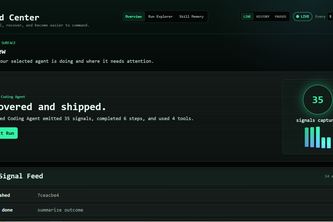
- A React dashboard with Live, History, and Paused modes.
- Human-readable execution timelines and failure insights.
- "Skill Seeds" that capture lessons from past runs for future improvement.
The author describes how the system works: agents use the SDK to emit events → these are stored locally in SQLite → a React dashboard visualizes them into practical insights.
This is a self-reported description of a technical prototype. No evidence of actual deployment, usage or integration with external AI systems beyond simulation exists in the provided text.
Positioning & Claim Evolution
The author positions AgentOS as:
- An "operating system for AI agents".
- A layer that makes agents more visible, understandable, controllable, and effective.
- Inspired by operating systems like Windows that simplified personal computing by abstracting complexity.
Claims made include:
- Making agents easier to understand, control, and improve.
- Providing structured event models for agent behavior.
- Offering insights into task completion, decision-making, token usage, failures, recovery, and improvements.
- Supporting multiple types of assistants (orchestrator, prompt enhancer, etc.) in the future.
These are claims about intent and positioning. There is no evidence of market traction or customer feedback to validate these assertions.
Target Customer & ICP
The description states that AgentOS aims to help:
- Everyday users who want to understand what AI agents are doing.
- Users who need to see why an agent made a decision, where it failed, or how much effort it spent on a task.
It also mentions:
- Making agents less like black boxes.
- Enabling users to trust and improve agents over time.
However, there is no explicit mention of specific personas, industries, or use cases beyond general "users" or "developers".
Not evidenced. The description does not define target customer segments or ideal customer profiles.
Business Model & Pricing Evidence
There is no evidence in the description of any pricing structure, monetization strategy, or business model.
The author mentions:
- Future scope includes richer observability assistants.
- Ways to compare runs over time.
- Agent integrations and performance recommendations.
But none of this implies a commercial offering or revenue generation mechanism.
Not evidenced. No indication of how the product would be sold or whether it has any commercial viability.
Technical & Delivery Signals
The author reports:
- Built with: codex, css, git, html, http, javascript, node.js, python, react, sdk, sqlite.
- Uses a structured event model.
- SDK emits events such as planning, model calls, tool usage, decisions, failures, retries, and completion.
- Backend stores events in SQLite.
- Dashboard built with React, supports Live, History, and Paused modes.
- Simulated coding agent to demonstrate behavior including failures and recovery.
- Masks sensitive fields recursively.
- Server does not impact agent performance due to bounded queue (10,000 events).
- Dynamic SDK base URL for flexibility across environments.
These are technical details from a prototype. No evidence of production deployment or scalability beyond the author’s own development environment.
Traction & Maturity Signals
There is no evidence of traction, adoption, or user engagement beyond the author's own work.
The description mentions:
- A simulated agent to demonstrate functionality.
- Implementation of future scope changes in a GitHub branch.
- Submission to a hackathon (OpenAI 2026).
No data on:
- Customers, users, or partners.
- Revenue, ARR, or funding rounds.
- Product usage metrics or retention.
Not evidenced. No signs of real-world traction or product maturity beyond the author’s prototype work.
Competitive Context
The description does not mention any competitors or existing solutions in the space.
It focuses on the author's own vision and implementation without reference to:
- Similar tools or platforms.
- Market positioning relative to others.
- Existing agent monitoring or observability systems.
Not evidenced. No competitive landscape information provided.
Open Questions & Risks
Key risks identified from the description:
- Solo development: Only one team member (the author) is mentioned, raising questions about scalability and long-term maintenance.
- Prototype-only: The system appears to be a prototype built for a hackathon with no indication of production readiness or real-world usage.
- No commercial viability: No evidence of pricing, monetization, or business model.
- Limited scope: The author’s own write-up indicates this is an early-stage project with future features still under development.
- Unverified claims: All descriptions are self-reported and unverified; no third-party validation exists.
These are inferred risks based on the lack of evidence for traction, scale, or commercialization.
Questions the description leaves open
- What is the actual use case or problem you're solving that users currently face?
- Have you tested this with any real users or teams beyond yourself?
- How do you plan to monetize AgentOS? Is there a pricing model in mind?
- What are your plans for scaling beyond a single developer’s prototype?
- Are there any existing integrations or partnerships with AI platforms or tools?
- What is the timeline for moving from prototype to production-ready product?
- How do you intend to differentiate AgentOS from other agent observability or orchestration tools?
These questions aim to uncover whether the project has evolved beyond a personal experiment into something viable for market adoption.
Overall Assessment
There is no evidence of any investment, partnership, or commercial traction associated with AgentOS. The project appears to be a solo developer’s prototype submitted to a hackathon.
The author describes a vision for an operating system for AI agents but provides no data on:
- Product-market fit.
- Revenue or customer acquisition.
- Team size or structure beyond one person.
- Market validation or competitive positioning.
Not evidenced. No basis for evaluating investment or partnership potential exists in the provided description.
User Stories BotA demo video on every pull request
Get a demo video on every new feature
GitHub App that watches your pull requests and records a narrated, captioned demo.
Save time on demo prep and make informed decisions faster with a video walkthrough of every new feature.
Source
Submitted to the OpenAI 2026 hackathon on Devpost. Project home on Devpost. Back to the full gallery on Devpost.
This competitive analysis was produced by top-founders.com (opens in a new tab)
Generated by a language model from this project's public Devpost page — its tagline, the author's own write-up and any built-with tags listed there — as captured in August 2026. Short quotations are the author's words. It is an opinion on the idea as a business, not on the people behind it, and it reflects the description as published then. If the project has moved on, request a correction below. The analysis is not independent research and contains no verified traction, revenue or customer data.
An independent guide by KFG International LLC — not affiliated with, endorsed by, or connected to Devpost or OpenAI.