

Archive position — measured, not model output
0 likes on Devpost
2,263 of the 7,850 archived projects have more likes, and 5,587 share exactly 0 — so this project's #6,333 place in the like-ranked listing is a tie-break inside that group, not a ranking.
Projects (log scale)
Likes on Devpost. ▲ marks this project's group.
Show the figures
| Likes | Projects | Share of archive |
|---|---|---|
| 0 | 5,587 | 71.2% |
| 1 | 1,758 | 22.4% |
| 2 | 284 | 3.6% |
| 3–4 | 132 | 1.7% |
| 5–9 | 75 | 1.0% |
| 10+ | 14 | 0.2% |
 User Stories BotA demo video on every pull request
Get a demo video on every new feature
GitHub App that watches your pull requests and records a narrated, captioned demo.
Save time on demo prep and make informed decisions faster with a video walkthrough of every new feature.
Executive Summary
What the company appears to be
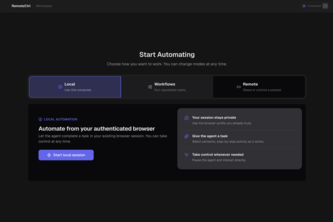
RemoteCtrl is a self-reported task-scoped browser automation tool built as a hackathon project. The author describes it as a desktop application (Electron-based) that allows AI agents or human operators to perform specific browser tasks within defined boundaries, using runtime-enforced policies and local-first architecture.
What changed
The description indicates an evolution from general-purpose remote access tools (like RustDesk, AnyDesk) or browser agent platforms (like Browserbase, n8n) toward a more granular delegation model — one that scopes access to individual tasks rather than entire machines or sessions. This is framed as a security and usability improvement.
Single most important open question
Is there evidence of real-world usage, customer feedback, or product-market fit beyond the author’s own account? The self-reported nature of the description means no traction data exists.
Note: All claims in this report are based on the author's own description. No external verification is available. This analysis reflects only what was stated by the project owner.
What The Product Actually Is
The description states that RemoteCtrl is:
- A desktop application built with Electron, React, Playwright, and TypeScript.
- Designed to run AI agents or remote human operators on a user’s real browser session.
- Uses a “Policy Gate” inside the CDP/Playwright layer to enforce action scope (domain whitelist, action budget).
- Integrates with Vercel AI SDK for LLM orchestration.
- Employs WebRTC and Socket.IO for remote operator streaming.
- Includes local-first features such as OS-level credential encryption and offline Whisper speech-to-text.
Inference: The product appears to be a hybrid of browser automation, AI agent control, and secure task delegation — aimed at enabling safe, scoped access without full machine or session control.
Positioning & Claim Evolution
The author claims RemoteCtrl addresses limitations in existing tools:
- Traditional remote access tools (e.g., AnyDesk) require full machine access.
- Browser agents (e.g., Browserbase) offer clean but disconnected sessions.
- RPA tools (e.g., n8n) are brittle and don’t adapt well to UI changes.
- AI safety is currently based on prompt instructions, not runtime enforcement.
The positioning shifts from generic automation toward task-scoped delegation with runtime-enforced boundaries, emphasizing:
- Security through scope enforcement
- Deterministic workflows that heal themselves
- Human-in-the-loop design
- Local-first execution
Claim: The author positions RemoteCtrl as a safer, more precise alternative to current browser-agent models.
Target Customer & ICP
The description does not explicitly name target customers or personas. However, the author implies use cases include:
- Developers building AI agents who want secure task delegation.
- Teams needing remote support without exposing full sessions.
- Users requiring deterministic workflows that can recover from UI changes.
Inference: Likely targets are developers, enterprise teams, and AI researchers working with browser automation or agent systems. No evidence of specific customer segments or personas is provided.
Business Model & Pricing Evidence
There is no mention of pricing, monetization strategy, or business model in the description.
Not evidenced — no indication whether this will be sold as SaaS, freemium, open-source, or another model.
Technical & Delivery Signals
Key technical elements described:
- Built with Electron + React + Playwright
- Uses CDP (Chrome DevTools Protocol) to attach to real Chrome profiles
- Implements a “Policy Gate” at the browser layer for runtime enforcement
- Zod-validated IPC between frontend and main process
- Local-first features: OS-level credential encryption, offline Whisper model
- WebRTC + Socket.IO for remote operator streaming
- Workflow editor with drag-and-drop interface
Inference: The tool is built with strong security and performance constraints in mind. It uses modern web technologies and enforces strict boundaries at runtime.
Traction & Maturity Signals
The description makes no mention of:
- Revenue or ARR
- Customers or user base
- Product adoption metrics
- Market traction or usage data
Not evidenced — the project is described as a hackathon submission, with no evidence of real-world deployment or customer feedback.
Competitive Context
The author compares RemoteCtrl to:
- RustDesk / AnyDesk (full machine access)
- Browserbase / browser-use (clean but disconnected sessions)
- n8n and classic RPA (brittle replay mechanisms)
- Current AI safety approaches (prompt-based enforcement)
Inference: The product positions itself as a niche solution between full remote access and generic browser automation, focusing on task-scoped delegation with runtime enforcement.
Open Questions & Risks
- No traction or validation — the project is described only in self-reporting terms.
- Single-person team — limited capacity for development, testing, or scaling.
- Hackathon origin — implies early-stage prototype, not production-ready product.
- Unproven market demand — no evidence of customer interest or competitive pressure.
- Limited scope enforcement — remote human input is noted as “next” and not yet implemented.
Inference: The project lacks commercial viability indicators and may be too early to assess for investment or partnership potential.
Questions the description leaves open
- What specific use cases are you targeting, and how do they differ from existing tools?
- Have you tested the Policy Gate with real-world AI agents or workflows?
- How does the self-healing workflow mechanism handle complex failures?
- Are there any known performance bottlenecks in the current architecture?
- What is your plan for scaling beyond a single developer’s use case?
- Do you have any early adopters or pilot users?
- How do you intend to monetize this product?
Overall Assessment
There is no evidence of revenue, customers, or traction to support an investment or partnership decision.
Assessment: Based on the self-reported description alone, RemoteCtrl appears to be a conceptually interesting but unproven prototype. It lacks commercial validation and market signals. Any strategic interest would depend on deeper due diligence into its technical feasibility, team capacity, and future roadmap beyond the hackathon phase.
User Stories BotA demo video on every pull request
Get a demo video on every new feature
GitHub App that watches your pull requests and records a narrated, captioned demo.
Save time on demo prep and make informed decisions faster with a video walkthrough of every new feature.
Source
Submitted to the OpenAI 2026 hackathon on Devpost. Project home on Devpost. Back to the full gallery on Devpost.
This competitive analysis was produced by top-founders.com (opens in a new tab)
Generated by a language model from this project's public Devpost page — its tagline, the author's own write-up and any built-with tags listed there — as captured in August 2026. Short quotations are the author's words. It is an opinion on the idea as a business, not on the people behind it, and it reflects the description as published then. If the project has moved on, request a correction below. The analysis is not independent research and contains no verified traction, revenue or customer data.
An independent guide by KFG International LLC — not affiliated with, endorsed by, or connected to Devpost or OpenAI.