

Archive position — measured, not model output
0 likes on Devpost
2,263 of the 7,850 archived projects have more likes, and 5,587 share exactly 0 — so this project's #6,335 place in the like-ranked listing is a tie-break inside that group, not a ranking.
Projects (log scale)
Likes on Devpost. ▲ marks this project's group.
Show the figures
| Likes | Projects | Share of archive |
|---|---|---|
| 0 | 5,587 | 71.2% |
| 1 | 1,758 | 22.4% |
| 2 | 284 | 3.6% |
| 3–4 | 132 | 1.7% |
| 5–9 | 75 | 1.0% |
| 10+ | 14 | 0.2% |
 User Stories BotA demo video on every pull request
Get a demo video on every new feature
GitHub App that watches your pull requests and records a narrated, captioned demo.
Save time on demo prep and make informed decisions faster with a video walkthrough of every new feature.
Executive Summary
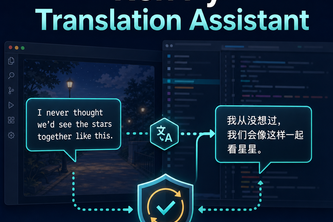
The description states that Ren'Py Translation Assistant is a Windows desktop application designed to help players and small localization teams translate English Ren'Py visual novels into Simplified Chinese without manually editing scripts. The tool automates extraction of RPA archives, decompilation of RPYC scripts, translation via Google Translate or OpenAI-compatible providers, and validation of output before writing back to the game files.
The author reports using Codex with GPT-5.6 during Build Week to audit, improve, and validate the workflow, including implementing fixes for reliability and safety failures, writing regression tests, and preparing documentation and build materials. The tool includes features such as protection of variables and tags, backup and recovery mechanisms, and validation against real Ren'Py lint and compile checks.
Key commercial due-diligence questions include: Is there a market demand for this specific tool? What is the actual adoption or usage by target users? How does it compare to existing translation workflows in the Ren'Py community? Does the author have a sustainable business model or path to monetization?
The single most important open question is whether this tool has any commercial traction, revenue, or customer base beyond the author's own use case.
What The Product Actually Is
- The description states that Ren'Py Translation Assistant is a Windows desktop application.
- It combines localization workflow in one interface for translating Ren'Py games.
- It detects Ren'Py games and their likely executables.
- It extracts RPA archives and decompiles RPYC scripts.
- It generates and scans translation templates for Simplified Chinese.
- It translates through Google Translate or a user-selected OpenAI-compatible provider.
- It validates model output before writing it back.
- It protects variables, tags, escaped characters, and technical format strings.
- It keeps the English source when a translation is structurally unsafe.
- It adds a CJK font and an in-game language switch.
- It records backups and deployment transactions for recovery of interrupted operations.
Positioning & Claim Evolution
- The description states that the tool is designed for players and small localization teams who want to translate English Ren'Py games into Simplified Chinese without manually unpacking archives, decompiling scripts, or editing translation blocks.
- The author claims it's a "safety-first" tool that protects against errors that could prevent games from launching.
- It positions itself as an automated solution for a complex localization task in the Ren'Py ecosystem.
- The project existed before OpenAI Build Week but was enhanced during the event using Codex and GPT-5.6.
Target Customer & ICP
- The description states that the tool targets players and small localization teams.
- It is specifically aimed at translating English Ren'Py games into Simplified Chinese.
- The author notes that it's intended for users who own or have permission to translate and modify games.
- Not evidenced: specific customer segments, size of target market, or user personas beyond "players and small teams."
Business Model & Pricing Evidence
- Not evidenced: no pricing information, subscription model, licensing fees, or monetization strategy provided.
- The description does not mention any revenue streams or business model.
- The tool appears to be self-developed by one person (Skipper Wan) with no indication of commercial sales or distribution channels.
Technical & Delivery Signals
- Built with: aiohttp, codex, gpt-5.6, python, ren'py, tkinter
- The application includes an offline smoke test, sample Ren'Py data, a regression suite, a reproducible Windows build, and a judge guide.
- During Build Week, Codex with GPT-5.6 was used to audit and improve the workflow.
- Automated suite grew from zero tests at start of optimization task to more than 100 passing regression tests.
- A recorded validation run scanned 45 scripts and 47,584 translation entries without introducing or worsening a validation issue.
- The tool handles archive extraction, exact text-span writeback, token and encoding preservation, multi-file transactions, cancellation, project locking, crash recovery, provider-response validation, and real Ren'Py lint and compile checks.
Traction & Maturity Signals
- Not evidenced: no customer data, usage metrics, or adoption statistics.
- The author mentions a recorded validation run scanning 45 scripts and 47,584 translation entries.
- The tool includes offline smoke test, sample data, regression suite, reproducible Windows build, and judge guide.
- No evidence of revenue, customers, or market traction beyond the author's own development and testing.
Competitive Context
- Not evidenced: no information about existing competitors or market landscape.
- The description implies that manual translation processes are currently used by players and teams.
- It positions itself as an automated solution for a complex localization task in the Ren'Py ecosystem.
- No mention of direct competitors or substitutes in the market.
Open Questions & Risks
- The tool is described as being built by one person (Skipper Wan) with no indication of team size beyond that.
- The description states that all evidence is self-reported and unverified, including lack of revenue, customers, or traction data.
- There's no evidence of commercial viability or sustainable business model.
- The tool appears to be a personal project rather than a commercial product with market demand.
- No indication of scalability or ability to handle larger volumes of translations beyond the author's own use case.
Questions the description leaves open
- What is your actual experience with Ren'Py game translation and localization?
- How many games have you personally translated using this tool?
- Have you received any feedback from other users or the Ren'Py community?
- What are your plans for monetization or commercialization of this tool?
- Are there any legal or licensing concerns around translating copyrighted games?
- What is the actual market demand for this specific type of tool in the Ren'Py community?
- How do you plan to scale beyond a single-person development effort?
- What are the technical limitations or edge cases that this tool cannot handle?
Overall Assessment
- Not evidenced: no financial data, revenue, customer base, or commercial traction.
- The description is self-reported and unverified, with no independent corroboration of claims.
- The tool appears to be a personal project built by one individual (Skipper Wan) without any evidence of commercial viability or market demand.
- No indication of sustainable business model or path to monetization.
- The author states that the project was submitted to an OpenAI hackathon, suggesting it may be experimental or proof-of-concept in nature.
- Without evidence of traction, revenue, or customer adoption, there is insufficient basis for investment or partnership consideration at this time.
User Stories BotA demo video on every pull request
Get a demo video on every new feature
GitHub App that watches your pull requests and records a narrated, captioned demo.
Save time on demo prep and make informed decisions faster with a video walkthrough of every new feature.
Source
Submitted to the OpenAI 2026 hackathon on Devpost. Project home on Devpost. Back to the full gallery on Devpost.
This competitive analysis was produced by top-founders.com (opens in a new tab)
Generated by a language model from this project's public Devpost page — its tagline, the author's own write-up and any built-with tags listed there — as captured in August 2026. Short quotations are the author's words. It is an opinion on the idea as a business, not on the people behind it, and it reflects the description as published then. If the project has moved on, request a correction below. The analysis is not independent research and contains no verified traction, revenue or customer data.
An independent guide by KFG International LLC — not affiliated with, endorsed by, or connected to Devpost or OpenAI.