

Archive position — measured, not model output
0 likes on Devpost
2,263 of the 7,850 archived projects have more likes, and 5,587 share exactly 0 — so this project's #6,337 place in the like-ranked listing is a tie-break inside that group, not a ranking.
Projects (log scale)
Likes on Devpost. ▲ marks this project's group.
Show the figures
| Likes | Projects | Share of archive |
|---|---|---|
| 0 | 5,587 | 71.2% |
| 1 | 1,758 | 22.4% |
| 2 | 284 | 3.6% |
| 3–4 | 132 | 1.7% |
| 5–9 | 75 | 1.0% |
| 10+ | 14 | 0.2% |
 User Stories BotA demo video on every pull request
Get a demo video on every new feature
GitHub App that watches your pull requests and records a narrated, captioned demo.
Save time on demo prep and make informed decisions faster with a video walkthrough of every new feature.
Executive Summary
The company appears to be a solo developer project named RenderGS, which self-reports as a mobile-first viewer for 3D Gaussian-splat scenes. The author states that it supports PLY, SPZ, and SOG file formats on Android, using native Vulkan rendering. It is described as an experimental product built during a hackathon (OpenAI 2026), with no evidence of revenue, customers or traction.
What changed: The project evolved from an earlier experimental renderer into a focused Android product using AI assistance (Codex and GPT-5.6) during Build Week. It is not clear if this represents a pivot or a proof-of-concept.
The single most important open question: Is there any evidence of commercial traction, user adoption, or monetization strategy beyond the author's own description?
What The Product Actually Is
- The description states that RenderGS is a mobile-first viewer for 3D Gaussian-splat scenes.
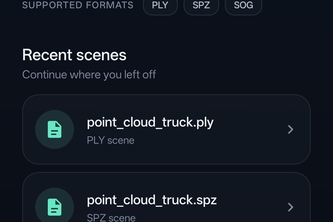
- It supports opening PLY, SPZ, and SOG files directly from Android storage.
- Users can explore scenes using touch controls (orbit, pan, zoom, camera roll).
- It is built with native Vulkan renderer, using GPU-based projection, visibility culling, color evaluation, compaction, and depth sorting.
- The author reports testing on a OnePlus 13R running Android 16 with a 1.5 GB Bicycle scene containing 5.56 million splats.
- Formats are decoded into a common scene representation, keeping support for PLY, SPZ, and SOG independent from the renderer.
Not evidenced: No information about pricing, monetization, or whether this is a commercial product or prototype.
Positioning & Claim Evolution
- The tagline states: “Your 3D worlds, ready to explore anywhere.”
- The author claims that Gaussian splats preserve real places and objects as explorable 3D scenes.
- The project aims to make opening a splat on Android feel as natural as opening any other image file.
- It positions itself as a mobile-first solution for viewing 3D Gaussian-splat content, with an emphasis on accessibility and ease-of-use.
- The author mentions that existing workflows are designed around desktop editing or publishing, suggesting a differentiation from those tools.
Inference: This is a self-reported positioning statement. No evidence of market feedback or competitive positioning beyond the author's own claims.
Target Customer & ICP
- The description does not identify specific customer segments or personas.
- It implies use by individuals who want to explore 3D Gaussian-splat scenes on mobile devices.
- The product is described as a viewer, suggesting it targets end-users rather than developers or content creators directly.
Not evidenced: No evidence of target customer segmentation, ICP definition, or user research.
Business Model & Pricing Evidence
- There is no evidence in the description of any pricing model, monetization strategy, or business model.
- The project is described as a personal or experimental effort, built during a hackathon.
- No mention of subscriptions, licensing, or paid features.
Not evidenced: No commercial structure or revenue streams are described.
Technical & Delivery Signals
- Built with Android, C++, Kotlin, Vulkan.
- Uses native Vulkan renderer for GPU-based processing including projection, visibility culling, color evaluation, compaction, and global depth sorting.
- Implements a four-stable radix pass to produce back-to-front order before a single indirect draw.
- Supports scenes up to six million splats, subject to device memory.
- The author reports using Codex and GPT-5.6 for implementation and documentation of Kotlin, JNI, C++, Vulkan, and shader stack.
- Includes support for SPZ and SOG formats through decoding into a common representation.
Inference: Technical depth is evident from the description, but no evidence of production-grade delivery or scalability beyond one developer's testing.
Traction & Maturity Signals
- The project was submitted to the OpenAI 2026 hackathon, indicating it’s an experimental or prototype effort.
- It includes a README with full architecture, verification notes, Build Week history, and setup instructions.
- The author tested on a OnePlus 13R with a large scene (5.56 million splats).
- No evidence of user adoption, downloads, or usage metrics.
Not evidenced: No data on traction, customer base, or product maturity beyond the author’s own testing.
Competitive Context
- The description does not mention any competitors.
- It references Gaussian splats as a technology and implies that existing workflows are desktop-centric.
- No evidence of market analysis or competitive positioning.
Not evidenced: No information about the competitive landscape or differentiation from other tools in the 3D scene viewer space.
Open Questions & Risks
- The project is self-reported by one developer, with no third-party validation.
- It was built during a hackathon, suggesting it may be a proof-of-concept rather than a scalable product.
- No evidence of commercial traction or monetization strategy.
- The use of AI tools (Codex and GPT-5.6) raises questions about the extent to which this is an original engineering effort vs. AI-assisted prototyping.
- The project supports only three file formats (PLY, SPZ, SOG), with no indication of broader format support or extensibility.
Inference: Risks include lack of commercial viability, limited scalability, and absence of a clear go-to-market strategy.
Questions the description leaves open
- What is the intended use case for RenderGS beyond personal exploration?
- Are there any plans to expand support for additional file formats or platforms (e.g., iOS)?
- Has this product been tested with actual users, and what feedback has been received?
- Is there a plan to monetize the product or integrate it into a larger commercial offering?
- What are the technical limitations of the current implementation that would prevent scaling to larger scenes or more users?
- How does RenderGS compare to existing 3D viewers in terms of performance, usability, and compatibility?
Overall Assessment
- The project is self-reported as a solo developer effort built during a hackathon.
- It shows technical capability but lacks evidence of traction or commercial viability.
- No revenue, customer data, or business model are evident.
- The author’s use of AI tools raises questions about originality and scalability.
Assessment: Not ready for investment or partnership at this stage. This appears to be an experimental prototype with no demonstrated market need or commercial potential. Further evidence of traction, user feedback, or a monetization strategy would be required to consider it further.
User Stories BotA demo video on every pull request
Get a demo video on every new feature
GitHub App that watches your pull requests and records a narrated, captioned demo.
Save time on demo prep and make informed decisions faster with a video walkthrough of every new feature.
Source
Submitted to the OpenAI 2026 hackathon on Devpost. Project home on Devpost. Back to the full gallery on Devpost.
This competitive analysis was produced by top-founders.com (opens in a new tab)
Generated by a language model from this project's public Devpost page — its tagline, the author's own write-up and any built-with tags listed there — as captured in August 2026. Short quotations are the author's words. It is an opinion on the idea as a business, not on the people behind it, and it reflects the description as published then. If the project has moved on, request a correction below. The analysis is not independent research and contains no verified traction, revenue or customer data.
An independent guide by KFG International LLC — not affiliated with, endorsed by, or connected to Devpost or OpenAI.