

Archive position — measured, not model output
0 likes on Devpost
2,263 of the 7,850 archived projects have more likes, and 5,587 share exactly 0 — so this project's #6,339 place in the like-ranked listing is a tie-break inside that group, not a ranking.
Projects (log scale)
Likes on Devpost. ▲ marks this project's group.
Show the figures
| Likes | Projects | Share of archive |
|---|---|---|
| 0 | 5,587 | 71.2% |
| 1 | 1,758 | 22.4% |
| 2 | 284 | 3.6% |
| 3–4 | 132 | 1.7% |
| 5–9 | 75 | 1.0% |
| 10+ | 14 | 0.2% |
 User Stories BotA demo video on every pull request
Get a demo video on every new feature
GitHub App that watches your pull requests and records a narrated, captioned demo.
Save time on demo prep and make informed decisions faster with a video walkthrough of every new feature.
Executive Summary
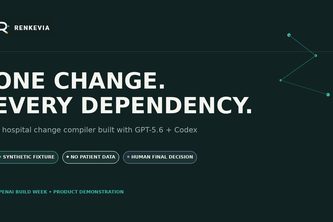
What the company appears to be: RENKEVIA is described as a Flutter Web institutional change compiler built for hospital environments. It is positioned as a system that identifies dependencies missed by plausible patches, particularly in clinical settings where changes must propagate across multiple systems and artifacts.
What changed: The project description indicates this is a hackathon submission (OpenAI 2026) with no production or commercial traction. It was built to demonstrate how an AI-assisted change management system could handle complex institutional dependencies without granting autonomous authority to commit changes.
Single most important open question: Is there any evidence of real-world adoption, pilot testing, or revenue generation beyond the hackathon demo?
What The Product Actually Is
The description states that RENKEVIA is a Flutter Web institutional change compiler, not a clinical chatbot. It operates through connected workspaces to:
- Review impact and map dependencies across twelve artifacts and seven institutional systems.
- Generate a typed Patch IR (Information Representation) and project reversible changes across six artifact types.
- Run safety checks using 24 synthetic patient pathways and 96 deterministic assertions.
- Manage approval records with independent reviews from pharmacy, clinical-informatics, pediatric-safety, and adversarial specialists.
- Interface with a fictional legacy EHR system (Northstar Clinical System) via controlled browser flow.
The product uses GPT-5.6, multi-agent systems, programmatic tool calling, and Computer Use to execute bounded read-only operations while preserving dissent and rollback evidence.
It is explicitly stated that the demo is a fixture replay using only synthetic data, and the final commit is blocked by design — no AI can autonomously write changes.
Claim: RENKEVIA is an institutional change compiler for hospitals.
Evidence: The description states this is a "Flutter Web institutional change compiler" used to manage dependencies in clinical environments. It includes specific technical components like Patch IR, typed changes, and safety checks.
Positioning & Claim Evolution
The author positions RENKEVIA as a solution to coordination failures in hospital change management — specifically where a patch may appear complete but misses one dependency (e.g., a pediatric pathway).
It is framed as not a chatbot, but a system that:
- Identifies hidden dependencies.
- Ensures deterministic safety checks.
- Preserves dissent and provenance.
- Prevents autonomous commit.
The project distinguishes itself from simple AI tools by emphasizing:
- Schema-constrained objects.
- Deterministic validation via TypeScript.
- Independent agent reviews.
- Controlled browser flow with no API access to AI models.
Claim: RENKEVIA is a system that prevents "plausible changes that quietly miss one dependency."
Evidence: The description highlights this as the core problem it solves, with examples like an IV-carrier shortage patch missing a pediatric pathway.
Target Customer & ICP
The target customer is described as hospitals or institutional environments requiring change management across multiple systems and artifacts. The system is designed for use in clinical settings, particularly where:
- Policies, order sets, pump libraries, labels, staff communications, and legacy systems are involved.
- Changes must be coordinated across systems with no API access.
The ICP (Ideal Customer Profile) appears to be institutions managing complex institutional change processes, especially those dealing with legacy systems and regulatory compliance.
Claim: RENKEVIA targets hospitals or clinical institutions needing change management.
Evidence: The description mentions hospital environments, institutional systems, and legacy EHRs like Northstar Clinical System.
Business Model & Pricing Evidence
No business model or pricing information is provided in the description. The project is described as a hackathon submission with no mention of monetization, licensing, or customer acquisition.
Claim: No evidence of business model or pricing.
Evidence: The description does not include any details about revenue streams, pricing tiers, or commercialization plans.
Technical & Delivery Signals
The system is built using:
- Flutter Web
- TypeScript
- Node.js
- GPT-5.6 (for contradiction resolution and Patch IR revision)
- Multi-agent systems
- Programmatic tool calling
- Computer Use for sandboxed legacy EHR interaction
It uses a fail-closed architecture, meaning:
- No API key is passed to OpenAI.
- Network, schema, or provenance failures block execution instead of silently substituting fixture data.
- Browser flow stops before final commit.
The system includes:
- Deterministic patient pathway testing.
- Hash-chained audit trails.
- Exact rollback capabilities.
- Mobile-responsive UI.
Claim: RENKEVIA is technically robust with deterministic safety checks and controlled browser interaction.
Evidence: The description details TypeScript validation, patient regression testing, and a fail-closed architecture that prevents autonomous writes.
Traction & Maturity Signals
The project is described as a hackathon submission (OpenAI 2026). It uses synthetic data only and is not a production system or medical device. There is no evidence of:
- Customers
- Revenue
- Adoption
- Product-market fit
- Real-world pilots
Claim: No traction or maturity signals.
Evidence: The project is explicitly labeled as a demo, using only synthetic data and not intended for clinical use.
Competitive Context
The description does not mention any direct competitors. It positions itself as distinct from chatbots and AI tools that lack deterministic safety checks or institutional control.
It implies a niche in:
- Institutional change management
- Clinical systems with no API access
- Regulatory compliance and audit trails
Claim: No competitive landscape is described.
Evidence: The description does not name competitors or reference existing solutions in the market.
Open Questions & Risks
Key risks include:
- No real-world testing or validation — all work is synthetic.
- Highly technical and institutional niche — may limit scalability or commercial appeal.
- Design choice to prevent autonomous commit — while safe, may reduce perceived utility.
- Hackathon origin — implies no long-term product development or market traction.
Claim: Risks include lack of real-world validation and limited commercial viability.
Evidence: The project is a hackathon demo with synthetic data and no production use case.
Questions the description leaves open
- What are the actual institutional change management pain points you're solving for?
- Has there been any pilot testing or feedback from hospital teams?
- How does this system integrate with existing EHRs or legacy systems in practice?
- What is the plan to move from synthetic data to real-world use cases?
- Are there any regulatory or compliance considerations that have been addressed?
- What are the key assumptions about user behavior and institutional workflows?
Inference: These questions aim to uncover whether the project has moved beyond the demo stage into real-world application.
Overall Assessment
There is no evidence of revenue, customers, or traction beyond a hackathon submission. The system is described as a proof-of-concept with synthetic data and no production use. It is not evident that this represents a viable commercial opportunity or partnership target at this time.
Claim: No investment or partnership case is evident.
Evidence: The project is a demo, not a product in the market, with no evidence of adoption or monetization.
User Stories BotA demo video on every pull request
Get a demo video on every new feature
GitHub App that watches your pull requests and records a narrated, captioned demo.
Save time on demo prep and make informed decisions faster with a video walkthrough of every new feature.
Source
Submitted to the OpenAI 2026 hackathon on Devpost. Project home on Devpost. Back to the full gallery on Devpost.
This competitive analysis was produced by top-founders.com (opens in a new tab)
Generated by a language model from this project's public Devpost page — its tagline, the author's own write-up and any built-with tags listed there — as captured in August 2026. Short quotations are the author's words. It is an opinion on the idea as a business, not on the people behind it, and it reflects the description as published then. If the project has moved on, request a correction below. The analysis is not independent research and contains no verified traction, revenue or customer data.
An independent guide by KFG International LLC — not affiliated with, endorsed by, or connected to Devpost or OpenAI.