

Archive position — measured, not model output
0 likes on Devpost
2,263 of the 7,850 archived projects have more likes, and 5,587 share exactly 0 — so this project's #2,413 place in the like-ranked listing is a tie-break inside that group, not a ranking.
Projects (log scale)
Likes on Devpost. ▲ marks this project's group.
Show the figures
| Likes | Projects | Share of archive |
|---|---|---|
| 0 | 5,587 | 71.2% |
| 1 | 1,758 | 22.4% |
| 2 | 284 | 3.6% |
| 3–4 | 132 | 1.7% |
| 5–9 | 75 | 1.0% |
| 10+ | 14 | 0.2% |
 User Stories BotA demo video on every pull request
Get a demo video on every new feature
GitHub App that watches your pull requests and records a narrated, captioned demo.
Save time on demo prep and make informed decisions faster with a video walkthrough of every new feature.
Executive Summary
What the company appears to be
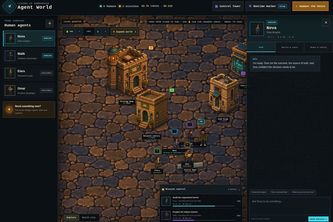
Agentic world is a self-reported project submitted to the OpenAI 2026 hackathon. The description states it aims to create a "living pixel city" where GPT-5.6 agents use real tools, complete missions, and make every action, permission, token, cost, and result visible.
What changed
No evidence of prior version or evolution is provided. This appears to be a single submission with no prior history.
Single most important open question
Is there any evidence of actual product development, traction, or commercial viability beyond the hackathon submission?
What The Product Actually Is
The description states: “Turn work into a living pixel city where GPT-5.6 agents use real tools, complete missions, and make every action, permission, token, cost, and result visible.”
This is a self-reported claim about a conceptual system involving AI agents operating in an environment that visualizes their activities.
Evidence
- The author describes the product as enabling GPT-5.6 agents to interact with real tools.
- It includes functionality for tracking actions, permissions, tokens, costs, and results.
- The metaphor of a "living pixel city" suggests a visualization or interface layer.
Inference The system may be conceptual or experimental in nature, possibly built as part of a hackathon project.
Positioning & Claim Evolution
The description states: “Turn work into a living pixel city where GPT-5.6 agents use real tools, complete missions, and make every action, permission, token, cost, and result visible.”
Evidence
- The tagline positions the product as an environment for AI agents to operate with full transparency.
- It implies integration of AI agents with real-world tooling and visibility into their operations.
Inference The positioning is aspirational and conceptual. No evidence of prior positioning or evolution is provided.
Target Customer & ICP
Not evidenced.
Evidence needed
- Who are the intended users?
- What specific problems does it solve for them?
- Is there a defined persona or use case?
Business Model & Pricing Evidence
Not evidenced.
Evidence needed
- How does the product generate revenue?
- Is pricing disclosed or implied?
- Are there any commercial arrangements or monetization strategies mentioned?
Technical & Delivery Signals
The description states: “Built with (author-declared): chatgpt”
Evidence
- The project was built using ChatGPT.
- No further technical architecture, stack, or delivery details are provided.
Inference This suggests a prototype or experimental build, likely not production-ready. No evidence of scalability, infrastructure, or deployment strategy is given.
Traction & Maturity Signals
Not evidenced.
Evidence needed
- Has the product been used by anyone?
- Are there any users, customers, or feedback?
- Is there evidence of development beyond a hackathon submission?
Competitive Context
Not evidenced.
Evidence needed
- What existing solutions does this compete with?
- How is it differentiated from other AI agent platforms or workflow tools?
- Are there comparable products in the market?
Open Questions & Risks
- The project is described as a single-person hackathon submission.
- No evidence of traction, revenue, or customer base.
- The description lacks technical depth or clarity on how the system works.
- The use of "GPT-5.6" is not substantiated; no indication of model version or capabilities.
- No mention of data privacy, security, or compliance considerations.
Questions the description leaves open
- What is the actual technical architecture of this system?
- How does it integrate with real-world tools?
- Is there any evidence of usage beyond the hackathon?
- What are the key assumptions behind the "living pixel city" metaphor?
- Are there any plans for commercialization or product development beyond this prototype?
Overall Assessment
Not evidenced.
Evidence needed
- Is there a viable business case?
- Does the founder have a track record of execution?
- Is there a clear path to market or product-market fit?
User Stories BotA demo video on every pull request
Get a demo video on every new feature
GitHub App that watches your pull requests and records a narrated, captioned demo.
Save time on demo prep and make informed decisions faster with a video walkthrough of every new feature.
Source
Submitted to the OpenAI 2026 hackathon on Devpost. Project home on Devpost. Back to the full gallery on Devpost.
This competitive analysis was produced by top-founders.com (opens in a new tab)
Generated by a language model from this project's public Devpost page — its tagline and any built-with tags listed there, since the author published no write-up — as captured in August 2026. Short quotations are the author's words. It is an opinion on the idea as a business, not on the people behind it, and it reflects the description as published then. If the project has moved on, request a correction below. The analysis is not independent research and contains no verified traction, revenue or customer data.
An independent guide by KFG International LLC — not affiliated with, endorsed by, or connected to Devpost or OpenAI.