

Archive position — measured, not model output
2 likes on Devpost
221 of the 7,850 archived projects have more likes, and 284 share exactly 2 — so this project's #448 place in the like-ranked listing is a tie-break inside that group, not a ranking.
Projects (log scale)
Likes on Devpost. ▲ marks this project's group.
Show the figures
| Likes | Projects | Share of archive |
|---|---|---|
| 0 | 5,587 | 71.2% |
| 1 | 1,758 | 22.4% |
| 2 | 284 | 3.6% |
| 3–4 | 132 | 1.7% |
| 5–9 | 75 | 1.0% |
| 10+ | 14 | 0.2% |
 User Stories BotA demo video on every pull request
Get a demo video on every new feature
GitHub App that watches your pull requests and records a narrated, captioned demo.
Save time on demo prep and make informed decisions faster with a video walkthrough of every new feature.
Executive Summary
What the company appears to be
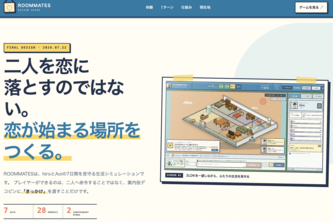
ROOMMATES is a seven-day autonomous relationship simulation game built as a hackathon project. The author describes it as an experiment in agentic game design where two AI characters make independent decisions within a shared world, reconciled by a Director agent. Players can influence but not control outcomes.
What changed
This is a self-reported project submitted to the OpenAI 2026 hackathon. No evidence indicates any commercial evolution or product development beyond this prototype.
Single most important open question
Is there any evidence of traction, revenue, customer adoption or commercial viability beyond the hackathon submission?
What The Product Actually Is
The description states that ROOMMATES is a "seven-day autonomous relationship simulation." It involves two AI residents who independently interpret situations and make choices based on their personalities and memories. A Director agent reconciles these independent decisions into a shared event.
The game uses:
- React, Vite, TypeScript for the client
- Express and Cloudflare Workers for runtime
- D1 persistence for anonymous hosted sessions
- GPT-5.6 (gpt-5.6-terra) as the primary language model
- Zod schemas for validation
- Server-Sent Events for communication
The author claims it supports editable names and personalities, replaceable characters, furniture, placements, and action anchors. It records memories and state changes, animates transitions between daily phases, and presents a recap with reflections and a Dekopin Support Score.
Evidence Self-reported by the author; no independent verification or demonstration of functionality beyond the submission.
Positioning & Claim Evolution
The project's positioning centers on exploring "a different question" in relationship games: whether players can create an environment for connection while preserving each character's agency. The author explicitly states that rejection or modification is not a failure state but evidence that the character owns the choice.
Key claims include:
- Players offer one everyday suggestion but cannot control either resident
- Residents decide independently from the same world state
- The Director agent reconciles their choices into a shared event
- Character Studio supports editable names and personalities
- Asset Manager supports replaceable characters, furniture, placements, and action anchors
Evidence Self-reported claims about design philosophy and features; no evidence of market positioning or commercial messaging beyond the hackathon submission.
Target Customer & ICP
The description does not identify a specific target customer or ideal customer profile (ICP). It focuses on the gameplay mechanics rather than user demographics or use cases.
Evidence Not evidenced. The author describes the game's mechanics but does not specify who would play it or how it would be monetized.
Business Model & Pricing Evidence
There is no evidence of a business model or pricing structure in the provided description. The project is described as a hackathon submission with no indication of monetization, subscriptions, or sales channels.
Evidence Not evidenced. No mention of revenue streams, pricing tiers, or commercial strategy.
Technical & Delivery Signals
The technical stack includes:
- Frontend: React 19, Vite 6, TypeScript
- Backend: Express 5, Cloudflare Workers, D1
- AI/ML: OpenAI GPT-5.6 (gpt-5.6-terra), Codex App Server Agent Worker, OpenAI Responses API
- Development tools: npm workspaces, Vitest, Drizzle ORM, Zod
Key technical features mentioned:
- Map-first client architecture
- Parallel model calls with isolated resident scopes
- Director boundary for reconciling decisions
- Schema validation and deterministic engine code
- Provider attribution for fallback handling
- Edge deployment adapted from local process-oriented architecture
Evidence Self-reported; no independent verification of technical implementation or delivery quality.
Traction & Maturity Signals
The description indicates this is a hackathon project submitted to the OpenAI 2026 hackathon. The author mentions:
- Full seven-day arc, recap, reflections, and explainable score are playable
- 617 automated tests, type checks, production builds passed
- Zero production dependency vulnerabilities reported
However, there is no evidence of user adoption, customer base, revenue, or product maturity beyond the prototype stage.
Evidence Not evidenced. No data on usage, retention, or commercial traction.
Competitive Context
The description does not provide any information about competitors or market context. It does not mention existing relationship simulation games, AI-driven narrative tools, or similar products in the space.
Evidence Not evidenced. No competitive analysis or positioning relative to other offerings.
Open Questions & Risks
Key risks and open questions based on the self-reported description:
- The project is a hackathon submission with no evidence of commercial viability
- No revenue model, pricing, or monetization strategy described
- No indication of user traction or market demand
- Reliance on GPT-5.6 (gpt-5.6-terra) raises questions about long-term availability and cost
- The system is described as a prototype with no evidence of scaling or production readiness
Evidence Inferred from lack of commercial evidence and self-reported nature of the project.
Questions the description leaves open
- What is the intended business model for ROOMMATES?
- How does the team plan to scale beyond this prototype?
- Are there any plans to monetize or commercialize the product?
- What are the key assumptions about user behavior and engagement?
- Has the team validated demand for this type of experience in the market?
Evidence Inferred from lack of information in the description.
Overall Assessment
There is no evidence to support a commercial investment or partnership opportunity at this time. The project is described as a hackathon submission with no indication of traction, revenue, or product-market fit beyond its prototype stage.
Evidence Self-reported and unverified; no evidence of commercial viability or strategic value.
User Stories BotA demo video on every pull request
Get a demo video on every new feature
GitHub App that watches your pull requests and records a narrated, captioned demo.
Save time on demo prep and make informed decisions faster with a video walkthrough of every new feature.
Source
Submitted to the OpenAI 2026 hackathon on Devpost. Project home on Devpost. Back to the full gallery on Devpost.
This competitive analysis was produced by top-founders.com (opens in a new tab)
Generated by a language model from this project's public Devpost page — its tagline, the author's own write-up and any built-with tags listed there — as captured in August 2026. Short quotations are the author's words. It is an opinion on the idea as a business, not on the people behind it, and it reflects the description as published then. If the project has moved on, request a correction below. The analysis is not independent research and contains no verified traction, revenue or customer data.
An independent guide by KFG International LLC — not affiliated with, endorsed by, or connected to Devpost or OpenAI.