

Archive position — measured, not model output
0 likes on Devpost
2,263 of the 7,850 archived projects have more likes, and 5,587 share exactly 0 — so this project's #2,409 place in the like-ranked listing is a tie-break inside that group, not a ranking.
Projects (log scale)
Likes on Devpost. ▲ marks this project's group.
Show the figures
| Likes | Projects | Share of archive |
|---|---|---|
| 0 | 5,587 | 71.2% |
| 1 | 1,758 | 22.4% |
| 2 | 284 | 3.6% |
| 3–4 | 132 | 1.7% |
| 5–9 | 75 | 1.0% |
| 10+ | 14 | 0.2% |
 User Stories BotA demo video on every pull request
Get a demo video on every new feature
GitHub App that watches your pull requests and records a narrated, captioned demo.
Save time on demo prep and make informed decisions faster with a video walkthrough of every new feature.
Executive Summary
The company appears to be a solo developer project named "Agentic Model Router", self-described as a tool that decomposes tasks into steps and routes each step to the most appropriate GPT-5.6 tier (Luna, Terra, or Sol) based on complexity, rather than using one model for an entire task.
The author states this is a proof-of-concept built for the OpenAI 2026 hackathon, with no evidence of revenue, customers, or traction beyond a demo feature added to Kanboard.
The single most important open question: Is there any evidence that this concept has been validated in a real-world context beyond the hackathon demo?
What The Product Actually Is
- The description states it is a tool that "decomposes a task into steps and routes each one to the right GPT-5.6 tier — Luna, Terra, or Sol".
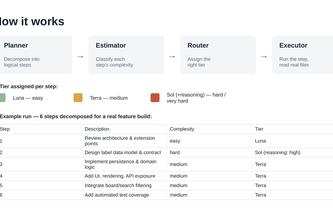
- It uses a pipeline: Planner → Estimator → Router → Executor.
- The Planner breaks down tasks and lists relevant files (not contents).
- The Estimator classifies each step as easy/medium/hard/very hard using a rubric.
- The Router assigns each step to the appropriate model tier based on classification.
- The Executor executes steps against a real codebase using file read/list tools.
- Context handoff between steps uses git-diff-based approach for lean context.
Not evidenced: What the actual product interface looks like, how it integrates with existing development environments, or whether it's available as a standalone tool or service.
Positioning & Claim Evolution
- The author claims the product addresses a problem in AI coding assistant usage: "developers using AI coding assistants almost always default to one familiar model for every task — the one they're used to, regardless of whether the task actually needs that much power."
- It positions itself as an improvement over existing auto-routers that optimize for cost/performance rather than task fit.
- The author states it is built "inside Codex", iterating module by module.
- It is described as a PoC submitted to the OpenAI 2026 hackathon.
Inferred: The positioning suggests a shift from generic AI tool usage toward more precise, task-specific model selection. However, this is not substantiated with any data or user feedback beyond the author's own narrative.
Target Customer & ICP
- The description states: "Developers using AI coding assistants almost always default to one familiar model for every task."
- It implies a target audience of developers working with AI coding tools.
- No specific customer segments, personas, or use cases are detailed beyond the hackathon demo.
Not evidenced: No evidence of actual customers, user interviews, or market segmentation. The ICP is inferred from the stated problem but not validated.
Business Model & Pricing Evidence
- No pricing information, revenue model, or monetization strategy is described.
- The project is presented as a hackathon submission with no indication of commercial intent or business structure.
- It is built using open-source tools (e.g., Kanboard, Docker) and author-declared tech stack.
Not evidenced: No evidence of any business model, pricing tiers, or monetization approach beyond the self-reported description.
Technical & Delivery Signals
- Built with: codex, docker, gpt-5.6-(sol, kanboard, luna), openai-responses-api, poetry, python, terra.
- The system uses a modular pipeline: Planner → Estimator → Router → Executor.
- Context handoff between steps is handled via git-diff-based approach.
- The estimator initially over-classified tasks but was refined to achieve a realistic distribution (1 easy / 4 medium / 1 hard).
- The demo involved adding a Labels feature to Kanboard, which was manually verified end-to-end.
Inferred: The technical architecture shows some sophistication in task decomposition and routing. However, no evidence of scalability, production readiness, or integration with enterprise systems.
Traction & Maturity Signals
- The project is described as a PoC submitted to the OpenAI 2026 hackathon.
- It was demonstrated by adding a feature to Kanboard (open source, MIT license).
- Manual verification of end-to-end execution was performed.
- No evidence of user adoption, customer feedback, or product usage beyond this demo.
Not evidenced: No evidence of traction, revenue, customers, or any real-world deployment. The maturity is limited to a hackathon-level prototype.
Competitive Context
- The description does not mention competitors or existing solutions in the space.
- It references "research on model adoption patterns showing usage is driven by habit and brand familiarity, not task fit" — implying a gap in current tools.
- No mention of similar tools or platforms that may already offer task decomposition or intelligent routing.
Not evidenced: No competitive landscape analysis, benchmarking, or comparison to existing tools.
Open Questions & Risks
- The project is a solo effort (team size: 1) with no evidence of team expansion or support.
- It is presented as a hackathon submission with no indication of commercial viability or product-market fit.
- The estimator’s rubric was manually adjusted and validated only through repeated runs, suggesting limited automation or calibration.
- No fallback mechanisms for tier unavailability (e.g., circuit breaker pattern) are mentioned.
- No automated result verification (test/lint + LLM-as-judge) is implemented yet.
Inferred: High risk of being a one-off prototype with no clear path to commercialization or scalability.
Questions the description leaves open
- What specific problem in AI coding assistant usage are you trying to solve, and how does this approach address it?
- How did you validate the estimator rubric? Was there any external testing or user feedback involved?
- Are you planning to expand beyond the Kanboard demo into other development environments or platforms?
- What is your roadmap for moving from a PoC to a production-ready product?
- Have you considered how this would scale in enterprise settings with more complex workflows and governance?
Overall Assessment
- The project is described as a hackathon submission with no evidence of traction, revenue, or customer adoption.
- It is built by a single individual (team size: 1) with no indication of team growth or support structure.
- The concept is novel in theory but lacks any demonstration of real-world impact or scalability.
Assessment: Not ready for investment or partnership at this stage. The project shows potential in concept and execution, but there is no evidence of commercial viability, user feedback, or product maturity beyond a prototype.
User Stories BotA demo video on every pull request
Get a demo video on every new feature
GitHub App that watches your pull requests and records a narrated, captioned demo.
Save time on demo prep and make informed decisions faster with a video walkthrough of every new feature.
Source
Submitted to the OpenAI 2026 hackathon on Devpost. Project home on Devpost. Back to the full gallery on Devpost.
This competitive analysis was produced by top-founders.com (opens in a new tab)
Generated by a language model from this project's public Devpost page — its tagline, the author's own write-up and any built-with tags listed there — as captured in August 2026. Short quotations are the author's words. It is an opinion on the idea as a business, not on the people behind it, and it reflects the description as published then. If the project has moved on, request a correction below. The analysis is not independent research and contains no verified traction, revenue or customer data.
An independent guide by KFG International LLC — not affiliated with, endorsed by, or connected to Devpost or OpenAI.