

Archive position — measured, not model output
2 likes on Devpost
221 of the 7,850 archived projects have more likes, and 284 share exactly 2 — so this project's #446 place in the like-ranked listing is a tie-break inside that group, not a ranking.
Projects (log scale)
Likes on Devpost. ▲ marks this project's group.
Show the figures
| Likes | Projects | Share of archive |
|---|---|---|
| 0 | 5,587 | 71.2% |
| 1 | 1,758 | 22.4% |
| 2 | 284 | 3.6% |
| 3–4 | 132 | 1.7% |
| 5–9 | 75 | 1.0% |
| 10+ | 14 | 0.2% |
 User Stories BotA demo video on every pull request
Get a demo video on every new feature
GitHub App that watches your pull requests and records a narrated, captioned demo.
Save time on demo prep and make informed decisions faster with a video walkthrough of every new feature.
Executive Summary
What the company appears to be
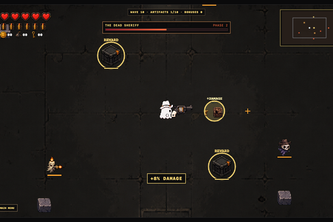
Rogue Ralphy is a browser-based, pixel-art roguelike shooter built as a game jam project for OpenAI Build Week. It features a cowboy ghost character named Ralphy who fights waves of enemies using a six-shot revolver and collects artifacts that mutate weapon behavior on every shot. The game includes an artifact stacking system with 36 unique items, a combat lab for testing builds, and runs in the browser without installation.
What changed
This is a self-reported project submitted to a hackathon. There is no evidence of prior development, funding, or commercial traction beyond its submission as a demo.
Single most important open question
Is there any indication that this project will evolve into a product with sustainable commercial potential, or is it purely experimental?
What The Product Actually Is
The description states:
- Rogue Ralphy is a browser-based arena roguelite.
- Players control Ralphy, a cowboy ghost with a revolver, fighting waves of enemies.
- The game features artifact stacking: players collect artifacts that mutate weapon behavior after each shot.
- There are 36 artifacts, which can modify projectiles, add effects like homing or piercing, and create combinations.
- A Combat Lab allows players to test builds without playing full runs.
- It was built using TypeScript, Vite, Bun, and Canvas 2D.
This is a self-reported game jam project with no evidence of revenue, customers, or commercial adoption.
Positioning & Claim Evolution
The description states:
- The project was made for OpenAI Build Week, suggesting it was an experimental or exploratory effort.
- It was built as a game jam and not intended to be a full product.
- The team aimed to build a real game around Ralphy, not just a demo.
- The focus was on item stacking rather than invisible stat bonuses, implying a design philosophy of visible, interactive mechanics.
No claims about market positioning or commercial intent are evident beyond the project’s origin as a hackathon submission.
Target Customer & ICP
The description states:
- The game is designed for players of roguelikes and pixel-art shooters.
- It targets fans of arena-based combat, artifact stacking, and browser-based games.
- No specific customer segments or personas are defined beyond general interest in the genre.
No evidence of target customer data, user acquisition, or market segmentation is provided.
Business Model & Pricing Evidence
The description states:
- The game runs in the browser with no installation required.
- It was built as a demo, not a monetized product.
- No pricing model, monetization strategy, or revenue streams are mentioned.
No evidence of any business model or pricing structure is present.
Technical & Delivery Signals
The description states:
- Built with TypeScript, Vite, Bun, and Canvas 2D.
- Uses a fixed timestep for simulation and momentum-based movement.
- Artifact system is data-driven, allowing effects to interact without separate implementations.
- Visuals are generated pixel art, with constraints on style and layout.
- The game includes a Combat Lab for debugging and sandboxing.
These technical details suggest a functional prototype but no evidence of scalability, performance optimization, or production-grade delivery.
Traction & Maturity Signals
The description states:
- The project was completed within a game jam schedule (OpenAI Build Week).
- It includes a complete playable loop: combat waves, rewards, artifact choices, stat pickups, and a boss fight.
- A Combat Lab was added for debugging but became a favorite part of the project.
- The team plans to expand it into a full run with procedural rooms, shops, and more bosses.
No evidence of user engagement, retention, or adoption is provided. No metrics or usage data are available.
Competitive Context
The description states:
- The game draws inspiration from room-based roguelikes and pixel shooters.
- It includes a stacking system, which is a feature found in other games like Risk of Rain 2 or Hades.
- No mention of direct competitors or market positioning.
No evidence of competitive analysis, market share, or differentiation from existing products.
Open Questions & Risks
The description states:
- The project was built as a game jam demo, not a commercial product.
- It has no revenue or traction data.
- The team is one person (alex Oleinik).
- No evidence of monetization, user base, or long-term vision beyond the initial prototype.
Key risks include:
- Lack of commercial viability or scalability.
- Single-person development may limit execution.
- No evidence of product-market fit or customer validation.
Questions the description leaves open
- What is the intended path from this demo to a monetized product?
- Are there any plans for user feedback, community building, or engagement beyond the initial prototype?
- How does the team plan to scale beyond a single developer?
- Is there any interest in partnering with game publishers or platforms?
- What is the long-term vision for artifact stacking and progression systems?
Overall Assessment
The description states:
- This is a self-reported demo project submitted to a hackathon.
- No evidence of commercial traction, revenue, or customer adoption exists.
- The team is one person, and the project was built in a short timeframe.
- There are no signs of a scalable or monetizable business model.
Assessment Not evidenced as a viable investment or partnership opportunity at this stage. This appears to be an experimental prototype with no commercial signals.
User Stories BotA demo video on every pull request
Get a demo video on every new feature
GitHub App that watches your pull requests and records a narrated, captioned demo.
Save time on demo prep and make informed decisions faster with a video walkthrough of every new feature.
Source
Submitted to the OpenAI 2026 hackathon on Devpost. Project home on Devpost. Back to the full gallery on Devpost.
This competitive analysis was produced by top-founders.com (opens in a new tab)
Generated by a language model from this project's public Devpost page — its tagline, the author's own write-up and any built-with tags listed there — as captured in August 2026. Short quotations are the author's words. It is an opinion on the idea as a business, not on the people behind it, and it reflects the description as published then. If the project has moved on, request a correction below. The analysis is not independent research and contains no verified traction, revenue or customer data.
An independent guide by KFG International LLC — not affiliated with, endorsed by, or connected to Devpost or OpenAI.