

Archive position — measured, not model output
0 likes on Devpost
2,263 of the 7,850 archived projects have more likes, and 5,587 share exactly 0 — so this project's #6,332 place in the like-ranked listing is a tie-break inside that group, not a ranking.
Projects (log scale)
Likes on Devpost. ▲ marks this project's group.
Show the figures
| Likes | Projects | Share of archive |
|---|---|---|
| 0 | 5,587 | 71.2% |
| 1 | 1,758 | 22.4% |
| 2 | 284 | 3.6% |
| 3–4 | 132 | 1.7% |
| 5–9 | 75 | 1.0% |
| 10+ | 14 | 0.2% |
 User Stories BotA demo video on every pull request
Get a demo video on every new feature
GitHub App that watches your pull requests and records a narrated, captioned demo.
Save time on demo prep and make informed decisions faster with a video walkthrough of every new feature.
Executive Summary
What the company appears to be
Remnic Relay is a self-reported project submitted to the OpenAI 2026 hackathon. The description states it addresses issues with AI agents learning incorrect information from stale memory, and aims to correct such beliefs through human approval before retraining.
What changed
There is no evidence of prior version or evolution — this is a single submission with no history.
The single most important open question
Is there any evidence of actual product-market fit, customer traction, or commercial viability beyond the hackathon submission?
What The Product Actually Is
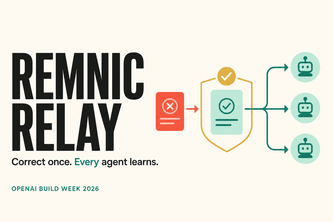
The description states that Remnic Relay is designed to address cases where an AI agent learns incorrect information from stale memory. It claims to expose the belief and failure caused by this, place corrections behind human approval, and prove a new agent learned the fix.
Evidence
- The author describes the product as addressing "stale memory" in AI agents.
- It is said to "expose the belief & the failure it caused".
- It claims to "put the correction behind human approval".
- It states that this process proves a "brand-new agent learned the fix".
Inference This appears to be a tool for managing and correcting knowledge updates in AI agents, likely in a development or operational context.
Not evidenced No specific functionality, architecture, or implementation details beyond the general problem it addresses are provided.
Positioning & Claim Evolution
The description states that Remnic Relay is a solution for when "stale memory teaches an AI agent the wrong thing". It positions itself as a mechanism to correct such errors through human oversight and validation.
Evidence
- The tagline: “When stale memory teaches an AI agent the wrong thing, Remnic Relay exposes the belief & the failure it caused, puts the correction behind human approval, and proves a brand-new agent learned the fix.”
Inference The positioning is that of a corrective mechanism for AI agents, likely in enterprise or developer tooling contexts where accuracy of data and model behavior is critical.
Not evidenced No claim evolution or prior versions are mentioned. No evidence of how this differs from existing tools or approaches.
Target Customer & ICP
The description does not state the target customer or ideal customer profile (ICP).
Evidence None provided.
Inference Given that it is a hackathon submission and uses OpenAI technologies, the likely audience may include developers or enterprise users working with AI agents or LLMs in production environments.
Not evidenced No explicit customer segments or personas are described.
Business Model & Pricing Evidence
The description does not state anything about pricing or business model.
Evidence None provided.
Inference If this were to evolve into a product, it might be priced as a SaaS or developer tool, but no such indication exists in the submission.
Not evidenced No revenue model, pricing structure, or monetization strategy is mentioned.
Technical & Delivery Signals
The author states that Remnic Relay was built using:
- OpenAI Codex CLI
- GPT-5.6
- Remnic
- Model Context Protocol (MCP)
- TypeScript and Node.js
- HTML, CSS, and JavaScript
Evidence These are the technologies declared by the author.
Inference The project is built using modern AI tooling and web development stacks, suggesting a developer-oriented or experimental approach. The use of MCP implies integration with AI agent frameworks.
Not evidenced No evidence of scalability, deployment architecture, or production readiness.
Traction & Maturity Signals
There is no evidence of traction or maturity beyond the hackathon submission.
Evidence
- It was submitted to a hackathon.
- No mention of users, customers, revenue, or adoption.
Inference This is an early-stage idea or prototype, not a product with market validation.
Not evidenced No data on usage, feedback, or product development milestones.
Competitive Context
The description does not provide any information about competitors or the competitive landscape.
Evidence None provided.
Inference Given its focus on AI agent memory correction and human-in-the-loop workflows, it may relate to tools in the LLM agent management, prompt engineering, or AI governance space. However, no specific competitors are mentioned.
Not evidenced No mention of existing solutions or how Remnic Relay compares.
Open Questions & Risks
- No evidence of traction or product-market fit: This is a hackathon submission with no commercial history.
- Unproven value proposition: The description does not demonstrate real-world utility or impact.
- Unclear differentiation: No indication of how it differs from existing AI agent tools or memory management systems.
- Single founder, early-stage project: Lack of team or development history raises questions about execution capability.
Evidence None of the above are directly stated but are inferred from the lack of evidence in other sections.
Questions the description leaves open
- What specific problem does Remnic Relay solve in practice?
- How does it integrate with existing AI agent frameworks or tools?
- Has there been any real-world testing or feedback on its effectiveness?
- What is the path to product-market fit, and how do you plan to scale beyond a hackathon prototype?
- Are there any existing customers or partners interested in using this tool?
Overall Assessment
Not evidenced
The project description provides no evidence of revenue, traction, or commercial viability. It is a single submission from a hackathon with no indication of product development beyond the initial idea.
Confidence Low This is a self-reported, unverified, and extremely thin dataset — not enough to form a meaningful due-diligence judgment.
User Stories BotA demo video on every pull request
Get a demo video on every new feature
GitHub App that watches your pull requests and records a narrated, captioned demo.
Save time on demo prep and make informed decisions faster with a video walkthrough of every new feature.
Source
Submitted to the OpenAI 2026 hackathon on Devpost. Project home on Devpost. Back to the full gallery on Devpost.
This competitive analysis was produced by top-founders.com (opens in a new tab)
Generated by a language model from this project's public Devpost page — its tagline and any built-with tags listed there, since the author published no write-up — as captured in August 2026. Short quotations are the author's words. It is an opinion on the idea as a business, not on the people behind it, and it reflects the description as published then. If the project has moved on, request a correction below. The analysis is not independent research and contains no verified traction, revenue or customer data.
An independent guide by KFG International LLC — not affiliated with, endorsed by, or connected to Devpost or OpenAI.