

Archive position — measured, not model output
2 likes on Devpost
221 of the 7,850 archived projects have more likes, and 284 share exactly 2 — so this project's #445 place in the like-ranked listing is a tie-break inside that group, not a ranking.
Projects (log scale)
Likes on Devpost. ▲ marks this project's group.
Show the figures
| Likes | Projects | Share of archive |
|---|---|---|
| 0 | 5,587 | 71.2% |
| 1 | 1,758 | 22.4% |
| 2 | 284 | 3.6% |
| 3–4 | 132 | 1.7% |
| 5–9 | 75 | 1.0% |
| 10+ | 14 | 0.2% |
 User Stories BotA demo video on every pull request
Get a demo video on every new feature
GitHub App that watches your pull requests and records a narrated, captioned demo.
Save time on demo prep and make informed decisions faster with a video walkthrough of every new feature.
Executive Summary
What the company appears to be
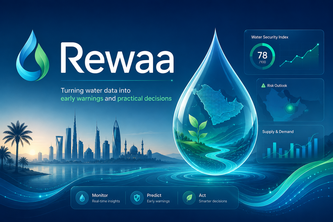
Rewaa is a self-reported water-intelligence platform designed for government authorities and decision-makers. It claims to transform local water data into forecasts, early warnings, and practical recommendations using AI tools like OpenAI GPT-5.6 and Codex.
What changed
The project evolved from a competition entry (second place in Qatar’s Youth Creativity Competition) into an interactive web platform built with Python, Streamlit, and AI tools. The author states it was rebuilt during OpenAI Build Week to become a more complete decision-intelligence experience.
Single most important open question — the commercial due-diligence read
Is there evidence of real-world adoption or integration by water authorities or utilities? The description does not mention any customers, pilots, or live data connections beyond stated ambitions.
What The Product Actually Is
The description states that Rewaa is an interactive web platform built using Python and Streamlit. It integrates:
- Water-demand forecasting
- Scenario analysis
- Neighborhood-level risk indicators
- Smart irrigation recommendations
- Decision-support dashboards and visual reports
- Exportable executive reports
- Bilingual (Arabic and English) interface
It also uses OpenAI GPT-5.6 and Codex for analysis and decision-ready recommendations.
Inference The platform appears to be a prototype or early-stage tool aimed at helping water authorities make proactive decisions based on data inputs, but no evidence of deployment or use in production is provided.
Positioning & Claim Evolution
The author claims Rewaa helps authorities plan ahead and manage water resources with greater confidence, moving from reactive to anticipatory decision-making.
It positions itself as a decision-support platform that brings together multiple data streams (population growth, temperature changes, water demand) into one place for actionable insights.
Inference The evolution from competition project to a more complete tool suggests an intent to scale beyond a proof-of-concept. However, the claim of “real-time alerts” and “scalable system” is not substantiated by evidence of actual implementation or data integration.
Target Customer & ICP
The description states that Rewaa targets government authorities and decision-makers who need actionable conclusions rather than raw data.
It also mentions support for utilities, weather, and IoT data, implying a potential audience including water management agencies and local governments.
Inference The target customer segment is likely public sector or utility organizations focused on water resource planning. No specific customer names, use cases, or market segments are mentioned.
Business Model & Pricing Evidence
There is no evidence in the description of pricing models, monetization strategies, or business model details.
The author does not describe how the platform would be sold, licensed, or offered to users.
Inference The business model remains undefined. It could be a public-sector tool, SaaS offering, or grant-funded project — none of which are confirmed.
Technical & Delivery Signals
Rewaa is built using:
- Python
- Streamlit
- OpenAI GPT-5.6 and Codex
- Pandas, Plotly, WeasyPrint
- CSS, HTML
The platform supports bilingual interfaces (Arabic and English) and generates executive reports.
Inference The technical stack suggests a prototype or MVP built for demonstration purposes. There is no mention of scalability, cloud infrastructure, or backend architecture beyond the tools used in development.
Traction & Maturity Signals
Rewaa has:
- Won second place in a youth competition (Qatar’s Youth Creativity Competition)
- Been rebuilt and expanded during OpenAI Build Week
- Evolved from an idea to an interactive platform with multiple features
However, there is no evidence of:
- Live data integration
- Customer adoption or feedback
- Revenue or funding rounds
- Deployment in real-world settings
Inference The project shows early development maturity but lacks traction indicators such as users, pilots, or commercial activity.
Competitive Context
The description does not mention competitors or similar platforms. It also does not provide any information about the broader market for water-intelligence tools or decision-support systems.
Inference No competitive positioning or landscape is evident. The project may be in a niche or emerging space with limited public comparison points.
Open Questions & Risks
- No real-world use or customer validation: The platform exists only as described by the author.
- Unverified AI claims: GPT-5.6 is referenced, but no details on its application or performance are given.
- Lack of data integration: The ambition to connect with live government and IoT data is stated, but not realized.
- No business model or monetization strategy.
- Self-reported only: All claims are unverified and based solely on the author’s account.
Questions the description leaves open
- Has Rewaa been tested or piloted with any government authorities or utilities?
- What specific data sources does it currently integrate, and how is that data collected and validated?
- Is there a plan to monetize the platform? If so, what is the business model?
- How does the platform handle data privacy and security, especially when dealing with public infrastructure data?
- What are the technical limitations of the current prototype, and how would they be addressed in a production version?
Overall Assessment
Not evidenced.
There is no evidence of revenue, customers, or traction to support an investment or partnership decision. The project is described as a self-developed prototype with limited real-world application.
The author states ambitions to connect with live data and scale into a system for authorities, but these are unproven claims.
Confidence level: Low
This analysis is based entirely on the self-reported description provided by the author. No external verification or historical data is available.
User Stories BotA demo video on every pull request
Get a demo video on every new feature
GitHub App that watches your pull requests and records a narrated, captioned demo.
Save time on demo prep and make informed decisions faster with a video walkthrough of every new feature.
Source
Submitted to the OpenAI 2026 hackathon on Devpost. Project home on Devpost. Back to the full gallery on Devpost.
This competitive analysis was produced by top-founders.com (opens in a new tab)
Generated by a language model from this project's public Devpost page — its tagline, the author's own write-up and any built-with tags listed there — as captured in August 2026. Short quotations are the author's words. It is an opinion on the idea as a business, not on the people behind it, and it reflects the description as published then. If the project has moved on, request a correction below. The analysis is not independent research and contains no verified traction, revenue or customer data.
An independent guide by KFG International LLC — not affiliated with, endorsed by, or connected to Devpost or OpenAI.