

Archive position — measured, not model output
0 likes on Devpost
2,263 of the 7,850 archived projects have more likes, and 5,587 share exactly 0 — so this project's #2,408 place in the like-ranked listing is a tie-break inside that group, not a ranking.
Projects (log scale)
Likes on Devpost. ▲ marks this project's group.
Show the figures
| Likes | Projects | Share of archive |
|---|---|---|
| 0 | 5,587 | 71.2% |
| 1 | 1,758 | 22.4% |
| 2 | 284 | 3.6% |
| 3–4 | 132 | 1.7% |
| 5–9 | 75 | 1.0% |
| 10+ | 14 | 0.2% |
 User Stories BotA demo video on every pull request
Get a demo video on every new feature
GitHub App that watches your pull requests and records a narrated, captioned demo.
Save time on demo prep and make informed decisions faster with a video walkthrough of every new feature.
Executive Summary
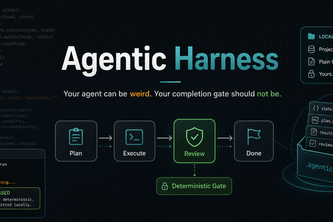
What the company appears to be: Agentic Harness is a developer tool designed to provide independent verification for coding agents such as Codex. The product runs a coding agent against a local project goal, records its work, and checks the result using an independent verification command chosen by the user. It supports both CLI and browser interfaces and includes packaged recipes for common tasks like testing, linting, and documentation.
What changed: The author states that they built this tool to address a key problem: coding agents can say “done” before the requested outcome actually works. Agentic Harness introduces an independent verification gate to ensure that agent-generated work is not accepted until it passes user-defined checks.
The single most important open question: Is there evidence of real-world adoption or usage beyond the author’s own development and testing? The description does not indicate any customers, revenue, or traction beyond a self-reported evaluation.
What The Product Actually Is
- The description states that Agentic Harness is a tool that runs coding agents (e.g., Codex) against one project-local goal.
- It records the agent’s work and checks the result using an independent verification command chosen by the user.
- If verification fails, it can return the failure to the agent for another attempt.
- The tool supports:
- A browser interface with setup, live progress, changed files, checks, retries, and final evidence
- A command-line interface for automated and developer workflows
- Packaged recipes for tests, linting, type checking, documentation, and changelog work
- It is distributed as a Python package containing:
- Shared execution engine
- CLI
- Browser interface
- Project-state model
- Retry loop
- Evidence contract
- Redaction controls
- Independent completion gate
Confidence: High — the description provides a clear, self-contained definition of what the tool does.
Positioning & Claim Evolution
- The author states: “A coding agent saying ‘done’ is not proof that the task is done.”
- The core positioning is to act as a “practical supervisor” for coding agents.
- The tool is framed as a way to make “completion depend on independent evidence—not confidence, prose, or a successful-looking status message.”
- The author emphasizes that verification must be:
- Independent
- Current
- Reproducible
- Tied to the original objective
- The long-term goal is: “Let developers use powerful coding agents while making ‘done’ mean independently verified.”
Confidence: Medium — claims are self-reported and lack external validation or traction data.
Target Customer & ICP
- The description states that Agentic Harness targets developers using coding agents like Codex.
- It supports both:
- Developer workflows (CLI)
- Browser-based use for live progress and reporting
- The tool is designed to be used with project-local goals, suggesting it’s aimed at developers working on specific codebases.
Confidence: Medium — the description implies a developer audience but does not name or define a specific ICP beyond that.
Business Model & Pricing Evidence
- Not evidenced.
- No mention of pricing, monetization strategy, or business model in the description.
Confidence: Low — no evidence provided.
Technical & Delivery Signals
- Built with: agentic-workflows, cli, codex, css3, github-actions, gpt-5.6, html5, javascript, local-first, openai-compatible-api, pypi, pytest, python, rest-api
- The tool is distributed as a Python package.
- It includes:
- CLI and browser interface
- Project-state model
- Retry loop
- Evidence contract
- Redaction controls
- Independent completion gate
- The author used Codex with GPT-5.6 to help develop the product workflow.
- The current release (v0.13.1) is available on GitHub and PyPI.
- Cross-platform CI, automated type, lint, packaging, and browser checks are included.
Confidence: Medium — technical details are provided but not validated or verified.
Traction & Maturity Signals
- The tool is publicly available (GitHub and PyPI).
- A controlled 24-case evaluation was conducted.
- A preregistered Codex comparison showed that Agentic Harness refused to mark a missed task complete, while direct execution falsely accepted it.
- The author reports that the current release includes cross-platform CI and automated checks.
Confidence: Low — no evidence of customers, revenue, or adoption beyond self-reported testing.
Competitive Context
- Not evidenced.
- No mention of competitors or market positioning in the description.
Confidence: Low — no competitive analysis or context provided.
Open Questions & Risks
- The tool is built by a single person (team size: 1).
- No evidence of traction, revenue, or customer base.
- The product is described as a hackathon submission (submitted to OpenAI 2026 hackathon).
- The author states that the hardest challenge was preventing the verification system from becoming another source of false confidence — this suggests potential complexity and risk in implementation.
- No evidence of scalability, long-term support, or roadmap beyond the current version.
Confidence: Medium — risks are inferred from the description but not explicitly stated.
Questions the description leaves open
- What is your plan for scaling beyond a single developer?
- Have you tested Agentic Harness on real-world repositories outside of controlled environments?
- How do you intend to monetize or sustain this product?
- What are the key assumptions about user behavior and adoption that underpin your design decisions?
- Are there any known limitations in how well it works with different coding agents or OpenAI-compatible models?
Confidence: Medium — these questions are based on the self-reported nature of the description.
Overall Assessment
- Not evidenced.
- No information is provided about funding, valuation, or investment interest.
- The product appears to be a proof-of-concept or early-stage tool with no demonstrated traction or commercial viability.
Confidence: Low — no evidence supports any investment or partnership potential.
User Stories BotA demo video on every pull request
Get a demo video on every new feature
GitHub App that watches your pull requests and records a narrated, captioned demo.
Save time on demo prep and make informed decisions faster with a video walkthrough of every new feature.
Source
Submitted to the OpenAI 2026 hackathon on Devpost. Project home on Devpost. Back to the full gallery on Devpost.
This competitive analysis was produced by top-founders.com (opens in a new tab)
Generated by a language model from this project's public Devpost page — its tagline, the author's own write-up and any built-with tags listed there — as captured in August 2026. Short quotations are the author's words. It is an opinion on the idea as a business, not on the people behind it, and it reflects the description as published then. If the project has moved on, request a correction below. The analysis is not independent research and contains no verified traction, revenue or customer data.
An independent guide by KFG International LLC — not affiliated with, endorsed by, or connected to Devpost or OpenAI.