

Archive position — measured, not model output
0 likes on Devpost
2,263 of the 7,850 archived projects have more likes, and 5,587 share exactly 0 — so this project's #6,276 place in the like-ranked listing is a tie-break inside that group, not a ranking.
Projects (log scale)
Likes on Devpost. ▲ marks this project's group.
Show the figures
| Likes | Projects | Share of archive |
|---|---|---|
| 0 | 5,587 | 71.2% |
| 1 | 1,758 | 22.4% |
| 2 | 284 | 3.6% |
| 3–4 | 132 | 1.7% |
| 5–9 | 75 | 1.0% |
| 10+ | 14 | 0.2% |
 User Stories BotA demo video on every pull request
Get a demo video on every new feature
GitHub App that watches your pull requests and records a narrated, captioned demo.
Save time on demo prep and make informed decisions faster with a video walkthrough of every new feature.
Executive Summary
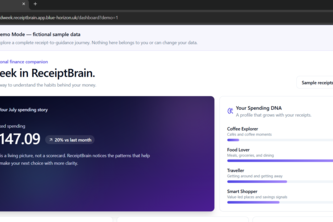
ReceiptBrain is a personal finance tool that the author describes as turning scattered receipts into a “trusted spending memory” through AI-powered extraction and analysis. The product is self-reported to store, parse, and contextualize receipt data, then answer user questions using cited evidence from the receipts themselves. It includes a demo mode for judges without requiring an account or API key.
The project appears to be a solo effort built with a stack including Next.js, FastAPI, Supabase, and Qwen models. The author emphasizes trust, privacy, and grounded AI responses over flashy features. No revenue, customers, or traction data are evidenced beyond the self-report.
The single most important open question
What is the actual commercial viability of a personal finance tool that relies on individuals uploading their own receipts? How does the author plan to scale beyond demo mode and build a sustainable business model?
What The Product Actually Is
The description states that ReceiptBrain:
- Securely stores receipts
- Extracts merchant, date, totals, and line items from them
- Turns this data into “financial context”
- Creates a “Spending Story” and “Spending DNA”
- Detects recurring patterns in spending
- Answers questions through an AI chat grounded in receipt evidence
It also includes:
- A demo mode for judges that uses fictional data
- Asynchronous processing of receipts via FastAPI and Supabase
- Use of Qwen Vision for OCR and Qwen reasoning for chat
- Deterministic parsing, reconciliation, confidence signals, and review states to maintain trustworthiness
Inference The product is a personal finance assistant that aims to help users understand spending habits by analyzing their own receipt data. It is not a marketplace or SaaS platform for businesses.
Positioning & Claim Evolution
The author positions ReceiptBrain as:
- A tool that turns “scattered receipts into trusted spending memory”
- One that helps people “understand habits, not just log expenses”
- A calm, private financial memory with cited evidence
- An AI chat that answers questions based on actual receipt data, not generic advice
Inference The positioning evolved from a simple OCR tool to a more sophisticated personal finance assistant that emphasizes trust, privacy, and grounded insights. The claim is that it’s not just about logging expenses but understanding spending behavior.
Target Customer & ICP
The description states:
- ReceiptBrain is for individuals who want to understand their spending habits
- It aims to be a “calm, private financial memory”
- Users are expected to upload their own receipts manually
Inference The target customer is likely a self-directed individual user — not a business or enterprise. The ICP appears to be someone interested in personal finance management and privacy.
Business Model & Pricing Evidence
The description does not state:
- Any pricing model
- Revenue streams
- Monetization strategy
- Subscription plans or freemium tiers
Not evidenced No evidence of a business model beyond the self-reported product features.
Technical & Delivery Signals
The author states that ReceiptBrain was built with:
- Next.js, TypeScript, FastAPI, Supabase Auth/Postgres/Storage
- Qwen Vision for OCR and Qwen reasoning for chat
- Deterministic parsing, reconciliation, confidence signals, and review states
- Asynchronous processing using FastAPI and Supabase
- Demo Mode with public journey and no account required
Inference The technical stack suggests a modern, server-side rendered web app with backend APIs and AI integration. The use of Qwen models and Supabase indicates an attempt to build a scalable, privacy-conscious solution.
Traction & Maturity Signals
The description states:
- It is a solo project built by one person (Sandhya Verma)
- Demo Mode exists for judges
- No revenue or customer data is reported
- The author mentions “what’s next” features but no traction metrics
Not evidenced No evidence of users, customers, revenue, or product adoption beyond the demo.
Competitive Context
The description does not mention:
- Competitors
- Market positioning relative to existing personal finance tools
- Differentiation from similar products
Not evidenced No competitive landscape or market analysis is provided.
Open Questions & Risks
Key risks and open questions based on the self-report:
- Solo development: One person building a complex product with AI, backend, and frontend
- Demo-only mode: No evidence of real users or adoption beyond a hackathon submission
- Privacy concerns: Storing personal receipts raises data privacy issues that are not addressed in the description
- AI reliability: OCR is described as unreliable; how it’s handled may affect user trust
- Scalability: No mention of how the system would scale to handle many users or large volumes of receipts
Inference The product is at a very early stage and lacks real-world validation. It’s unclear if there is a path from demo to commercial viability.
Questions the description leaves open
- What is your plan for monetization beyond the demo mode?
- How do you intend to scale beyond one person building the product?
- What are the privacy and data security implications of storing personal receipts?
- How do you plan to improve OCR accuracy without user feedback loops?
- Do you have any users or early adopters who are willing to pay for the service?
- What is your long-term vision for the product beyond personal finance?
Overall Assessment
The description states that ReceiptBrain is a solo project built for a hackathon, with no evidence of traction, revenue, or customers.
Assessment Not evidenced as a viable commercial opportunity at this stage. The author claims to have built a complete experience but provides no data on adoption, usage, or monetization. The product is in demo mode and lacks real-world validation.
Confidence level Low — based entirely on self-reported information with no external corroboration.
User Stories BotA demo video on every pull request
Get a demo video on every new feature
GitHub App that watches your pull requests and records a narrated, captioned demo.
Save time on demo prep and make informed decisions faster with a video walkthrough of every new feature.
Source
Submitted to the OpenAI 2026 hackathon on Devpost. Project home on Devpost. Back to the full gallery on Devpost.
This competitive analysis was produced by top-founders.com (opens in a new tab)
Generated by a language model from this project's public Devpost page — its tagline, the author's own write-up and any built-with tags listed there — as captured in August 2026. Short quotations are the author's words. It is an opinion on the idea as a business, not on the people behind it, and it reflects the description as published then. If the project has moved on, request a correction below. The analysis is not independent research and contains no verified traction, revenue or customer data.
An independent guide by KFG International LLC — not affiliated with, endorsed by, or connected to Devpost or OpenAI.