

Archive position — measured, not model output
2 likes on Devpost
221 of the 7,850 archived projects have more likes, and 284 share exactly 2 — so this project's #389 place in the like-ranked listing is a tie-break inside that group, not a ranking.
Projects (log scale)
Likes on Devpost. ▲ marks this project's group.
Show the figures
| Likes | Projects | Share of archive |
|---|---|---|
| 0 | 5,587 | 71.2% |
| 1 | 1,758 | 22.4% |
| 2 | 284 | 3.6% |
| 3–4 | 132 | 1.7% |
| 5–9 | 75 | 1.0% |
| 10+ | 14 | 0.2% |
 User Stories BotA demo video on every pull request
Get a demo video on every new feature
GitHub App that watches your pull requests and records a narrated, captioned demo.
Save time on demo prep and make informed decisions faster with a video walkthrough of every new feature.
Executive Summary
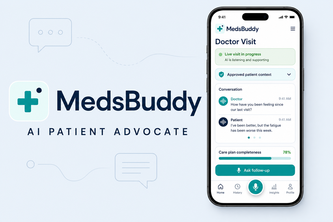
Company: MedsBuddy - AI Patient Advocate
Self-reported basis: The description is entirely self-reported by the author, unverified, and submitted as part of a hackathon project. No external validation or evidence of traction exists.
What it appears to be: A mobile application that uses AI to assist patients during doctor visits — helping with preparation, real-time support during appointments, and post-visit care planning.
What changed: The author describes building a prototype for a hackathon, using technologies like React Native, Expo, OpenAI APIs, and GPT-5.6.
Most important open question: Is there evidence of any user testing, clinical validation, or real-world adoption that would indicate demand beyond the single developer's prototype?
What The Product Actually Is
The description states that MedsBuddy is a mobile AI patient advocate built with React Native, Expo, and OpenAI APIs. It supports:
- Preparing for doctor visits by collecting symptoms, medications, allergies, concerns, and questions.
- Speaking aloud during appointments after patient approval and doctor consent.
- Organizing transcripts into visit summaries and care plans after the appointment.
The app uses OpenAI Realtime voice, transcription, and spoken responses. It includes features like:
- Shared patient context across screens (Home, Talk, Doctor Visit, Medications, Symptoms, Summary).
- Secure handling of API keys and session tokens.
- Use of GPT-5.6 to shape behavior and ensure privacy-safe boundaries.
Not evidenced: whether the app has been tested with users or deployed beyond a prototype.
Positioning & Claim Evolution
The author states that MedsBuddy was inspired by how stressful doctor visits can be, especially for patients who feel nervous or forget important details. The positioning is:
- A supportive AI assistant for patients during healthcare interactions.
- Focused on preparation, real-time support, and post-visit follow-up.
The claim evolution appears to be:
- From a personal idea (stress of doctor visits) → to a technical prototype (using AI voice, transcription, consent flows).
- The app is positioned as an AI patient advocate, not a diagnostic or treatment tool.
Not evidenced: any market positioning beyond the author’s own description, or evidence of user feedback or validation.
Target Customer & ICP
The description states that MedsBuddy is intended for:
- Patients who feel nervous during doctor visits.
- People who forget details, have trouble speaking up, or need help organizing care instructions.
It also mentions support for:
- Sexual health concerns.
- Wellness and care instruction follow-up.
Not evidenced: specific customer segments, personas, or user research. No evidence of target customer interviews or usage data.
Business Model & Pricing Evidence
The description does not state any business model or pricing strategy. It is a single-developer hackathon project with no indication of monetization plans, subscription models, or partnerships.
Not evidenced: revenue streams, pricing tiers, or commercialization strategy.
Technical & Delivery Signals
The app is built using:
- React Native
- Expo.io
- OpenAI Realtime API
- GPT-5.6
- Node.js
- TypeScript
- WebRTC
Key technical elements include:
- Use of shared patient context across screens.
- Handling of voice reliability issues on mobile (e.g., echo detection, speaker routing).
- Scope detection to keep conversations focused.
- Consent flows for doctor approval and patient privacy.
Not evidenced: production deployment, scalability, or performance data. The project is described as a hackathon prototype.
Traction & Maturity Signals
The description states:
- It was built in the context of a hackathon.
- The author used Codex and GPT-5.6 for development.
- No user testing, clinical validation, or real-world usage is mentioned.
Not evidenced: any traction, customer base, or adoption metrics.
Competitive Context
The description does not mention any competitors. It does not reference:
- Other AI health tools.
- Patient advocacy platforms.
- Doctor visit support apps.
Not evidenced: competitive landscape or differentiation from existing solutions.
Open Questions & Risks
Inferences based on the self-reported description:
- Single developer prototype: No team, no validation, no product-market fit evidence.
- Healthcare AI risks: The app handles sensitive data (medications, symptoms, sexual health) and requires consent. Any missteps in privacy or safety could be significant.
- Voice reliability on mobile: The author notes challenges with voice quality and routing — a critical UX issue for an app that relies heavily on audio.
- No clinical or user testing: The app is not validated by users or healthcare professionals.
Not evidenced: any risk mitigation, compliance, or regulatory considerations.
Questions the description leaves open
- What was the process of developing this prototype? Was there any user feedback or clinical input?
- How does the app handle patient privacy and data security in real-world use?
- Has the app been tested with actual patients or healthcare providers?
- Are there plans to partner with healthcare organizations or institutions?
- What are the technical limitations of using OpenAI APIs for voice interaction on mobile devices?
- Is there any plan to monetize the product, and how would that work?
Overall Assessment
The description indicates a single-developer hackathon project with no evidence of traction, revenue, or user adoption.
- Confidence level: Low.
- Investment potential: Not evidenced. The app is not yet a product, but a concept.
- Partnership interest: Not evident. No commercial or clinical validation exists.
The author states that the project was submitted to the OpenAI 2026 hackathon — this is a conceptual prototype, not a product in market.
Assessment: Not ready for investment or partnership at this stage. The idea has potential, but no evidence of execution, traction, or validation exists.
User Stories BotA demo video on every pull request
Get a demo video on every new feature
GitHub App that watches your pull requests and records a narrated, captioned demo.
Save time on demo prep and make informed decisions faster with a video walkthrough of every new feature.
Source
Submitted to the OpenAI 2026 hackathon on Devpost. Project home on Devpost. Back to the full gallery on Devpost.
This competitive analysis was produced by top-founders.com (opens in a new tab)
Generated by a language model from this project's public Devpost page — its tagline, the author's own write-up and any built-with tags listed there — as captured in August 2026. Short quotations are the author's words. It is an opinion on the idea as a business, not on the people behind it, and it reflects the description as published then. If the project has moved on, request a correction below. The analysis is not independent research and contains no verified traction, revenue or customer data.
An independent guide by KFG International LLC — not affiliated with, endorsed by, or connected to Devpost or OpenAI.