

Archive position — measured, not model output
1 like on Devpost
505 of the 7,850 archived projects have more likes, and 1,758 share exactly 1 — so this project's #1,784 place in the like-ranked listing is a tie-break inside that group, not a ranking.
Projects (log scale)
Likes on Devpost. ▲ marks this project's group.
Show the figures
| Likes | Projects | Share of archive |
|---|---|---|
| 0 | 5,587 | 71.2% |
| 1 | 1,758 | 22.4% |
| 2 | 284 | 3.6% |
| 3–4 | 132 | 1.7% |
| 5–9 | 75 | 1.0% |
| 10+ | 14 | 0.2% |
 User Stories BotA demo video on every pull request
Get a demo video on every new feature
GitHub App that watches your pull requests and records a narrated, captioned demo.
Save time on demo prep and make informed decisions faster with a video walkthrough of every new feature.
Executive Summary
The company appears to be a student-controlled adaptive learning workspace for middle-school algebra, built as a hackathon project by a team of four. The product is described as using AI (GPT-5.6) and cloud infrastructure (Cloudflare D1, Next.js, React, TypeScript), with an emphasis on transparency in learner modeling through "evidence" and "hypotheses." It allows students to build expressions, test them, explain reasoning, and save the attempt as evidence, while teachers can inspect and override recommendations.
What changed: The project is a self-reported hackathon submission. No prior version or evolution is described; it is presented as a new product concept.
The single most important open question: Is there any evidence of traction, revenue, or customer adoption beyond the authors' own description?
What The Product Actually Is
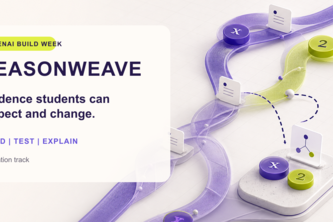
- The description states that ReasonWeave is a student-controlled adaptive learning workspace for middle-school algebra.
- It enables students to construct expressions with visual tokens, test results, explain reasoning, and save attempts as evidence.
- The system builds testable hypotheses from learner work, which can be supported, uncertain, or expired unless confirmed by further work.
- Teachers can inspect the evidence and override learning program recommendations.
- It includes a learner workspace, journey view, educator console, persistent evidence API, and learning-hypothesis data model.
Note: The description does not state whether this is a web application, mobile app, or platform. It also does not describe any specific features beyond the core workflow of building, testing, explaining, and saving.
Positioning & Claim Evolution
- The description states that ReasonWeave treats personalization as a falsifiable claim rather than a permanent label.
- It contrasts itself with other adaptive learning products by saying: “Most adaptive learning products personalize behind the scenes. ReasonWeave treats personalization as a falsifiable claim rather than a permanent label.”
- The product is positioned to make learner modeling transparent and participatory, allowing students to challenge or change their own learning path.
- It claims to demonstrate this with a module on algebraic distribution using a Build → Test → Explain loop.
- The description implies that the same architecture can be expanded across middle-school mathematics.
Inference: This positioning suggests an emphasis on learner agency and pedagogical transparency, but no evidence is provided about how this differs from existing tools or whether it has been tested with users.
Target Customer & ICP
- The description states that the product is for middle-school algebra students.
- It also mentions that teachers can inspect and override recommendations, implying a dual audience: students and educators.
- No further segmentation of student demographics or teacher roles is described.
Note: There is no evidence of specific customer personas, usage scenarios, or targeting beyond the stated grade level and subject area.
Business Model & Pricing Evidence
- The description does not state anything about pricing, monetization, or a business model.
- It does not mention whether the product is sold to schools, individuals, or institutions.
- No information is given on how the service would be funded or scaled beyond its current prototype.
Not evidenced: No commercial structure, pricing tiers, or revenue streams are described.
Technical & Delivery Signals
- The project was built using:
- Codex
- GPT-5.6
- Cloudflare D1
- Drizzle ORM
- Next.js
- React
- TypeScript
- The description states that Codex accelerated design, implementation, database schema, interaction testing, QA, and deployment.
- It includes a responsive application, learner workspace, journey view, educator console, persistent evidence API, and learning-hypothesis data model.
Inference: Use of AI tools (Codex, GPT) suggests rapid prototyping. However, no information is provided about scalability, performance, or long-term technical architecture beyond the prototype.
Traction & Maturity Signals
- The project was submitted to the OpenAI 2026 hackathon.
- It includes a live app and instructions for users to try it.
- The team size is stated as 4 people.
- No evidence of user adoption, retention, or revenue is provided.
Not evidenced: No data on usage, customers, or product-market fit beyond the prototype.
Competitive Context
- The description states that most adaptive learning products personalize behind the scenes, contrasting this with ReasonWeave’s approach.
- It does not name specific competitors or describe how it compares to existing tools in the space.
- No mention of market size, competitive landscape, or differentiation from other platforms.
Not evidenced: No competitive analysis or positioning relative to known players in adaptive learning or edtech.
Open Questions & Risks
- The product is described as a hackathon submission, not a mature product or company.
- There is no evidence of traction, revenue, or customer feedback.
- The team size (4) and prototype nature suggest early-stage development with limited validation.
- Use of AI tools like Codex and GPT-5.6 may raise questions about scalability or long-term control over the technology stack.
- No mention of data privacy, compliance, or integration capabilities.
Inference: Risk of overstatement in claims due to lack of independent verification or user testing.
Questions the description leaves open
- What is the actual scope of the prototype? Is it a working MVP or just a demonstration?
- How does the system handle learner data privacy and compliance (e.g., FERPA, GDPR)?
- Has the product been tested with real students and teachers? If so, what were the results?
- What are the plans for scaling beyond the current prototype?
- Is there any plan to monetize or commercialize this product?
- How does the system ensure that learners understand how their hypotheses are being used?
Overall Assessment
- This is a self-reported hackathon project with no evidence of traction, revenue, or customer adoption.
- The description presents an idea with potential pedagogical value but lacks any commercial or operational foundation.
- There is no indication that the product has moved beyond prototype stage or gained real-world validation.
Assessment: Not ready for investment or partnership. The project needs significant development and evidence of market demand before it can be considered viable.
User Stories BotA demo video on every pull request
Get a demo video on every new feature
GitHub App that watches your pull requests and records a narrated, captioned demo.
Save time on demo prep and make informed decisions faster with a video walkthrough of every new feature.
Source
Submitted to the OpenAI 2026 hackathon on Devpost. Project home on Devpost. Back to the full gallery on Devpost.
This competitive analysis was produced by top-founders.com (opens in a new tab)
Generated by a language model from this project's public Devpost page — its tagline, the author's own write-up and any built-with tags listed there — as captured in August 2026. Short quotations are the author's words. It is an opinion on the idea as a business, not on the people behind it, and it reflects the description as published then. If the project has moved on, request a correction below. The analysis is not independent research and contains no verified traction, revenue or customer data.
An independent guide by KFG International LLC — not affiliated with, endorsed by, or connected to Devpost or OpenAI.