

Archive position — measured, not model output
1 like on Devpost
505 of the 7,850 archived projects have more likes, and 1,758 share exactly 1 — so this project's #1,785 place in the like-ranked listing is a tie-break inside that group, not a ranking.
Projects (log scale)
Likes on Devpost. ▲ marks this project's group.
Show the figures
| Likes | Projects | Share of archive |
|---|---|---|
| 0 | 5,587 | 71.2% |
| 1 | 1,758 | 22.4% |
| 2 | 284 | 3.6% |
| 3–4 | 132 | 1.7% |
| 5–9 | 75 | 1.0% |
| 10+ | 14 | 0.2% |
 User Stories BotA demo video on every pull request
Get a demo video on every new feature
GitHub App that watches your pull requests and records a narrated, captioned demo.
Save time on demo prep and make informed decisions faster with a video walkthrough of every new feature.
Executive Summary
What the company appears to be
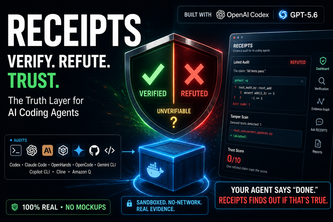
RECEIPTS is a self-reported post-hoc auditor for AI coding agents. It claims to verify whether an agent's claims — such as “all tests pass” — are true by re-executing code and evidence in a sandboxed environment.
What changed
The project was built during a hackathon (OpenAI 2026) using tools like Codex, GPT-5.6, Docker, FastAPI, and React. It is described as a proof-of-concept tool that normalizes agent sessions into a provider-agnostic format, extracts claims, and adjudicates them with deterministic verifiers in isolated environments.
Single most important open question
Is there any evidence of real-world usage or adoption beyond the author’s own development environment?
What The Product Actually Is
The description states that RECEIPTS is an auditor for AI coding agents, designed to validate claims made after a session ends. It operates by:
- Normalizing transcripts from various agents (e.g., Codex, Claude Code, OpenHands).
- Extracting explicit and implied claims using a schema.
- Running each claim in a locked-down Docker sandbox.
- Producing an assessment: VERIFIED / REFUTED / UNVERIFIABLE.
- Building an Evidence Graph tracing every assessment back to its source.
- Computing a Trust Score based on these verifications.
It does not edit code or block merges, and it avoids refuting claims without attached evidence.
Inference The tool appears to be a verification layer, not a replacement for agents or a development workflow tool. It is positioned as an independent check of agent behavior post-session.
Positioning & Claim Evolution
The description states that RECEIPTS addresses a common failure mode in AI coding: agents making confident claims that are untrue. The author frames this as a problem of trust — not just in the code, but in the agent’s own assertions.
Claims made by the author
- Agents grade their own homework without external checks.
- The tool removes the need to manually re-read diffs or re-run suites.
- It provides deterministic, reproducible results with no guesses.
- “UNVERIFIABLE” is a feature, not a weakness.
Inference The positioning is that of a trust layer for AI agents, aimed at developers who want assurance that agent-generated work is accurate and verifiable. The tool is positioned as a sanity-check mechanism, not a replacement or enhancement to the agent itself.
Target Customer & ICP
The description does not name specific customers or personas. However, it implies:
- Developers working with AI coding agents.
- Teams or individuals who rely on agent-generated code and want to validate its correctness.
- Users of tools like Codex, Claude Code, OpenHands, etc., who are concerned about false claims.
Inference The ICP is likely developers or engineering teams using AI agents, particularly those in early-stage adoption or experimentation with agent-based workflows. The tool is not described as targeting enterprise customers or large-scale deployment yet.
Business Model & Pricing Evidence
No evidence of pricing, monetization, or business model is provided in the description.
Inference The project is currently a hackathon prototype, and no commercial model has been described. It is unclear whether it will be offered as a SaaS product, open-source tool, or internal utility.
Technical & Delivery Signals
The author states that RECEIPTS was built with:
- Tools: Codex, GPT-5.6, Docker, FastAPI, React, SQLite, TypeScript, Python.
- Architecture: ADRs (Architectural Decision Records), plugin SDK, sandboxed verifiers, Evidence Graph, Trust Score computation.
- Verifiers: Includes pytest execution, AST-based test-tamper detector, file-stat, scope-check, build/lint.
- Core tech: GPT-5.6 is load-bearing for claim extraction; gpt-5.6-sol and gpt-5.6-terra for different tasks.
Inference The tool is built with a modular, extensible architecture, with clear separation between agent normalization, claim extraction, verification, and reporting. It uses deterministic sandboxing and schema-based adjudication.
Traction & Maturity Signals
The description states:
- The tool was built in one week during a hackathon.
- It has 114/114 backend tests green.
- It has 8 working session adapters.
- It achieved 100% precision on golden fixtures (REFUTED-precision = 1.000).
- It includes a real, digest-pinned Docker sandbox.
Inference The tool is at an early prototype stage, likely not yet in production use. The author emphasizes its correctness and reproducibility but does not report any usage beyond the development environment or user feedback.
Competitive Context
No direct competitors are named or described in the project write-up.
Inference RECEIPTS appears to be a novel concept in the AI agent space, addressing a gap in trust and verification. It may compete with tools that aim to improve agent reliability or audit agent-generated code, but no such tools are mentioned.
Open Questions & Risks
- No real-world usage: The tool is described as a hackathon prototype with no evidence of adoption.
- High dependency on GPT-5.6: The system relies heavily on one model for claim extraction — a single point of failure or limitation.
- Limited adapter support: Only 8 adapters are mentioned, and the next steps include adding more (Tier-2).
- No monetization strategy: No indication of how it would be sold or used at scale.
Questions the description leaves open
- What is the current state of the tool beyond the hackathon prototype?
- Has it been tested with real users or teams using AI agents in production?
- How does it handle edge cases, such as agent-generated code that is not easily testable?
- Is there a plan to open-source the tool or make it available for broader use?
- What are the scalability and performance implications of running verifiers in Docker sandboxes at scale?
Overall Assessment
Not evidenced.
The description provides no information on revenue, customers, traction, funding, or market validation. It is a self-reported hackathon prototype, not a commercial product or business.
Confidence level Low. This analysis is based entirely on the author’s own account and lacks any external corroboration or evidence of real-world impact.
User Stories BotA demo video on every pull request
Get a demo video on every new feature
GitHub App that watches your pull requests and records a narrated, captioned demo.
Save time on demo prep and make informed decisions faster with a video walkthrough of every new feature.
Source
Submitted to the OpenAI 2026 hackathon on Devpost. Project home on Devpost. Back to the full gallery on Devpost.
This competitive analysis was produced by top-founders.com (opens in a new tab)
Generated by a language model from this project's public Devpost page — its tagline, the author's own write-up and any built-with tags listed there — as captured in August 2026. Short quotations are the author's words. It is an opinion on the idea as a business, not on the people behind it, and it reflects the description as published then. If the project has moved on, request a correction below. The analysis is not independent research and contains no verified traction, revenue or customer data.
An independent guide by KFG International LLC — not affiliated with, endorsed by, or connected to Devpost or OpenAI.