

Archive position — measured, not model output
0 likes on Devpost
2,263 of the 7,850 archived projects have more likes, and 5,587 share exactly 0 — so this project's #3,748 place in the like-ranked listing is a tie-break inside that group, not a ranking.
Projects (log scale)
Likes on Devpost. ▲ marks this project's group.
Show the figures
| Likes | Projects | Share of archive |
|---|---|---|
| 0 | 5,587 | 71.2% |
| 1 | 1,758 | 22.4% |
| 2 | 284 | 3.6% |
| 3–4 | 132 | 1.7% |
| 5–9 | 75 | 1.0% |
| 10+ | 14 | 0.2% |
 User Stories BotA demo video on every pull request
Get a demo video on every new feature
GitHub App that watches your pull requests and records a narrated, captioned demo.
Save time on demo prep and make informed decisions faster with a video walkthrough of every new feature.
Executive Summary
What the company appears to be: Dinghuobao is a WeChat-native B2B order-request workflow system designed for small wholesalers. The product enables customers to submit orders via a WeChat Mini Program and operators to manage those orders through an admin dashboard, with backend logic handled by Express + MySQL on Tencent CloudBase.
What changed: During the Devpost hackathon submission period, the team refactored 18 Mini Program pages into a reusable component system, added robust handling for long content, empty states, failures, privacy prompts, and session expiry, normalized WeChat identity metadata, and implemented release validation checks. AI tools (Codex + GPT-5.6) were used to support these changes.
Single most important open question: Is there any evidence of actual customer adoption or revenue generation beyond the hackathon prototype? The description states no traction data exists.
What The Product Actually Is
The description states that Dinghuobao is a WeChat-native B2B order-request workflow for small wholesalers, operating across three connected surfaces:
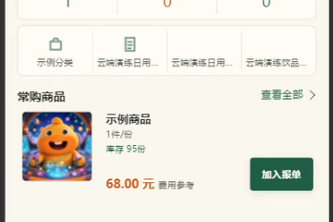
- Customer-facing WeChat Mini Program: Allows browsing products, submitting orders, managing delivery addresses, viewing history/status, saving favorites, and reordering.
- Operator-facing Vue admin dashboard or Mini Program entry: Enables managing products, customers, order status, delivery, inventory, stocktakes, payment records, and audit logs.
- Backend stack: Uses Express + MySQL on Tencent CloudBase for enforcing identity, inventory, and order-state rules.
The system is described as intentionally an order-request system rather than a marketplace, where prices are reference-only and final quantities, delivery, and payment are confirmed offline.
Confidence level: High — based on the detailed breakdown of components and architecture in the author's own write-up.
Positioning & Claim Evolution
The description states that Dinghuobao was built to address inefficiencies in how small wholesalers receive orders—through scattered WeChat messages, phone calls, and spreadsheets. It aims to streamline this process by using a workflow that fits the channel customers already use—WeChat—without pretending every B2B order is consumer e-commerce.
It explicitly positions itself as not an online marketplace, but rather a traceable workflow system for handling requests.
There is no indication of prior positioning claims or evolution beyond this initial framing. The project appears to be a single product iteration, not part of a broader strategic shift.
Confidence level: Medium — the claim is self-reported and lacks external validation or historical context.
Target Customer & ICP
The description states that Dinghuobao targets small wholesalers who currently receive orders through scattered WeChat messages, phone calls, and spreadsheets.
It also mentions that customers use a WeChat Mini Program, indicating that the target customer is someone familiar with or using WeChat as their primary communication platform—likely in China or regions where WeChat dominates messaging.
No further segmentation or ICP details are provided beyond this.
Confidence level: Medium — based on stated intent, but no evidence of actual targeting or customer validation.
Business Model & Pricing Evidence
The description states that Dinghuobao is not a marketplace, and that prices are references only; the operator confirms final quantities, delivery, and payment offline. This implies a low-touch, workflow-based service model without direct monetization through the platform itself.
There is no mention of pricing tiers, subscription models, or any revenue streams beyond the described use case.
Confidence level: Low — no evidence of business model or pricing structure.
Technical & Delivery Signals
The project uses a monorepo architecture with:
- Frontend: uni-app + Vue 3 for WeChat Mini Program; Vue 3 + Element Plus for web admin
- Backend: Express + MySQL in production, SQLite for local dev
- Deployment: Tencent CloudBase (WeChat Cloud Hosting)
- Development tools: TypeScript, Vitest, Codex + GPT-5.6
The team mentions:
- Refactoring 18 Mini Program pages into reusable components
- Handling edge cases like long content, empty states, failures, privacy prompts, and small screens
- Normalizing WeChat identity metadata across local and cloud paths
- Implementing release-artifact validation gates
AI tools were used to assist in debugging identity mismatches and UI redesigns, but not presented as a customer-facing feature.
Confidence level: High — detailed technical implementation is described.
Traction & Maturity Signals
The description states that the project was submitted to the OpenAI 2026 hackathon, and that before Build Week, it already had the basic three-surface architecture and workflow. However:
- No evidence of customer adoption or usage beyond the prototype
- No mention of revenue, ARR, headcount, funding rounds, or user base
- No indication of product maturity beyond a hackathon submission
Confidence level: Very low — no traction data is provided.
Competitive Context
The description does not provide any information about competitors or competitive landscape. It does not name other similar tools or platforms in the B2B order management space, nor does it describe how Dinghuobao differentiates from them.
Confidence level: Low — no competitive context is evident.
Open Questions & Risks
- No traction or revenue evidence: The product appears to be a prototype with no demonstrated customer adoption.
- Limited scope and positioning: It's not a marketplace, which may limit scalability or monetization opportunities.
- Dependence on WeChat ecosystem: Heavy reliance on WeChat Mini Programs and Tencent CloudBase could pose risks if these platforms change or become less accessible.
- AI tooling as development aid only: No indication that AI features are customer-facing, suggesting limited differentiation in the product offering.
Confidence level: Medium — based on lack of evidence for key commercial factors.
Questions the description leaves open
- Has Dinghuobao been tested with real small wholesalers? If so, what feedback have you received?
- Are there any plans to monetize the platform beyond the current workflow model?
- What is the long-term vision for expanding beyond WeChat and Tencent CloudBase?
- How do you plan to scale from a single developer to a full team or product?
- Have you considered integrating with other platforms (e.g., ERP systems, logistics providers)?
- Is there any interest from potential partners or customers in using this system?
Overall Assessment
The description indicates that Dinghuobao is a prototype built during a hackathon, with no evidence of traction, revenue, or customer adoption. It is a single-developer project focused on solving a specific problem within the WeChat ecosystem for small wholesalers.
There is no commercial due-diligence signal from this description alone — no revenue, customers, or market validation. The product shows technical capability and clear intent but lacks any indication of viability or scalability as a business.
Assessment: Not ready for investment or partnership at this stage. A follow-up with real-world usage data would be required to assess commercial potential.
User Stories BotA demo video on every pull request
Get a demo video on every new feature
GitHub App that watches your pull requests and records a narrated, captioned demo.
Save time on demo prep and make informed decisions faster with a video walkthrough of every new feature.
Source
Submitted to the OpenAI 2026 hackathon on Devpost. Project home on Devpost. Back to the full gallery on Devpost.
This competitive analysis was produced by top-founders.com (opens in a new tab)
Generated by a language model from this project's public Devpost page — its tagline, the author's own write-up and any built-with tags listed there — as captured in August 2026. Short quotations are the author's words. It is an opinion on the idea as a business, not on the people behind it, and it reflects the description as published then. If the project has moved on, request a correction below. The analysis is not independent research and contains no verified traction, revenue or customer data.
An independent guide by KFG International LLC — not affiliated with, endorsed by, or connected to Devpost or OpenAI.