

Archive position — measured, not model output
0 likes on Devpost
2,263 of the 7,850 archived projects have more likes, and 5,587 share exactly 0 — so this project's #3,749 place in the like-ranked listing is a tie-break inside that group, not a ranking.
Projects (log scale)
Likes on Devpost. ▲ marks this project's group.
Show the figures
| Likes | Projects | Share of archive |
|---|---|---|
| 0 | 5,587 | 71.2% |
| 1 | 1,758 | 22.4% |
| 2 | 284 | 3.6% |
| 3–4 | 132 | 1.7% |
| 5–9 | 75 | 1.0% |
| 10+ | 14 | 0.2% |
 User Stories BotA demo video on every pull request
Get a demo video on every new feature
GitHub App that watches your pull requests and records a narrated, captioned demo.
Save time on demo prep and make informed decisions faster with a video walkthrough of every new feature.
Executive Summary
What the company appears to be
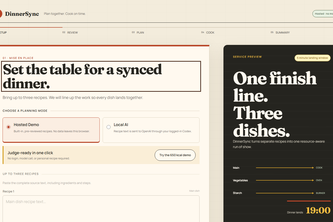
DinnerSync is a self-reported tool for planning home-cooked meals involving up to three recipes, one cook, one oven, and one or two burners. It claims to treat meal planning as a scheduling problem with human involvement, using deterministic code for core logic and optional AI assistance for recipe input.
What changed
The project description is a self-reported submission to the OpenAI 2026 hackathon. It presents a functional prototype with a hosted demo and a local AI feature, but no evidence of revenue, customers or adoption beyond its own claims.
Single most important open question
Is there any evidence that DinnerSync has moved beyond a hackathon prototype into product-market fit or commercial traction?
What The Product Actually Is
The description states that DinnerSync is a tool for planning home-cooked meals involving up to three recipes. It uses a five-stage flow: Setup, Review, Plan, Cook, and Summary.
- Setup records recipes, diner count, available time, target service time, optional kcal comparison, and kitchen resources.
- Review exposes source-backed and inferred recipe fields before they can affect the plan.
- Plan builds one timeline across dishes, dependencies, the cook, oven, and burners.
- Cook records what actually starts, runs late, becomes due, and completes. Each accepted event can trigger a deterministic replan.
- Summary compares the original finish with the actual finish, lists recorded delays and replan passes, shows the energy ledger, and names one timing lesson supported by the run.
The product is described as a Next.js 16 and React 19 application with deterministic TypeScript domain modules. It includes features such as shared timeline for one cook, one oven, and one or two burners; dependency, cycle, resource-conflict, and feasibility checks; event-based Start, Delay, Due, and Complete controls.
Not evidenced: No information about actual users, revenue, pricing, or customer adoption is provided.
Positioning & Claim Evolution
The description states that DinnerSync treats a home meal as a small scheduling problem with a human in the loop. It addresses the challenge of handoffs between recipes where one oven, a couple of burners, one pair of hands, and several steps need to land near the same dinner time.
It positions itself as an alternative to recipe apps that show one recipe at a time, offering instead a solution for managing multiple recipes in a coordinated way. It also claims to provide deterministic replanning when tasks run late, and to support both a hosted demo and optional local AI import with consent.
Not evidenced: No evidence of market positioning beyond the author's own description or any competitive differentiation from existing tools.
Target Customer & ICP
The description states that DinnerSync targets home cooks who struggle with planning meals involving multiple dishes. It is designed for one cook, one oven, and one or two burners, suggesting a focus on individual or small household use.
Not evidenced: No information about specific customer segments, personas, or market size is provided.
Business Model & Pricing Evidence
The description does not provide any evidence of a business model or pricing structure. It mentions that the public deployment is Hosted Demo only and that Local AI is disabled in production, but does not elaborate on monetization strategies.
Not evidenced: No revenue streams, pricing tiers, or monetization plans are described.
Technical & Delivery Signals
The project is built with Next.js 16, React 19, TypeScript, and uses a deterministic codebase for core logic. It includes features like:
- Shared timeline for one cook, one oven, and one or two burners.
- Dependency, cycle, resource-conflict, and feasibility checks.
- Event-based Start, Delay, Due, and Complete controls.
- Running tasks keep their resources when delayed; the rest of the plan moves around facts already in progress.
- Refresh-safe browser persistence with a wall-clock anchor.
- Per-dish and per-person energy calculation from source-labelled USDA FoodData Central records.
- Optional Local AI import with consent, strict structured output, source-evidence validation, and mandatory user review.
It also includes technical challenges addressed such as replanning around work that is already true, making model output reviewable, restoring time after a refresh, and failing closed at the Local AI boundary.
Not evidenced: No information about scalability, infrastructure, or delivery mechanisms beyond the described prototype.
Traction & Maturity Signals
The description states that the project was submitted to the OpenAI 2026 hackathon on Devpost. It includes a public Hosted Demo and a local AI feature, but no evidence of user adoption, revenue, or traction beyond its own claims.
Not evidenced: No information about users, customers, or any form of commercial traction is provided.
Competitive Context
The description does not provide any information about the competitive landscape. It does not mention competitors or how DinnerSync differentiates itself from existing meal planning or recipe apps.
Not evidenced: No evidence of competitive analysis or positioning relative to other tools in the market.
Open Questions & Risks
- Prototype-only: The project is described as a hackathon submission with no evidence of commercial traction.
- Limited scope: It supports only up to three recipes, one cook, one oven, and one or two burners.
- Local AI dependency: Local AI functionality depends on Codex installation, login, quota, exact model availability, and sandbox isolation — all of which are not guaranteed.
- No production deployment: The public deployment is Hosted Demo only; Local AI is disabled in production.
- No monetization strategy: No evidence of a business model or pricing structure.
Inference: These factors suggest that DinnerSync may be a proof-of-concept rather than a scalable product.
Questions the description leaves open
- What is the intended path from this prototype to a commercial product?
- Are there any plans for monetization or revenue generation beyond the current demo?
- How does the team plan to scale beyond the current limitations (e.g., number of recipes, cooks, appliances)?
- What are the key assumptions about user behavior and adoption that underpin the product design?
- Is there any internal data or feedback from users beyond what is described in the submission?
Overall Assessment
The description states that this project was submitted to the OpenAI 2026 hackathon on Devpost. There is no evidence of revenue, customers, or traction beyond its own claims.
Assessment Not evidenced. The project appears to be a prototype with limited commercial viability based on the information provided. No clear indication of product-market fit, scalability, or monetization strategy exists in the description.
User Stories BotA demo video on every pull request
Get a demo video on every new feature
GitHub App that watches your pull requests and records a narrated, captioned demo.
Save time on demo prep and make informed decisions faster with a video walkthrough of every new feature.
Source
Submitted to the OpenAI 2026 hackathon on Devpost. Project home on Devpost. Back to the full gallery on Devpost.
This competitive analysis was produced by top-founders.com (opens in a new tab)
Generated by a language model from this project's public Devpost page — its tagline, the author's own write-up and any built-with tags listed there — as captured in August 2026. Short quotations are the author's words. It is an opinion on the idea as a business, not on the people behind it, and it reflects the description as published then. If the project has moved on, request a correction below. The analysis is not independent research and contains no verified traction, revenue or customer data.
An independent guide by KFG International LLC — not affiliated with, endorsed by, or connected to Devpost or OpenAI.