

Archive position — measured, not model output
0 likes on Devpost
2,263 of the 7,850 archived projects have more likes, and 5,587 share exactly 0 — so this project's #5,712 place in the like-ranked listing is a tie-break inside that group, not a ranking.
Projects (log scale)
Likes on Devpost. ▲ marks this project's group.
Show the figures
| Likes | Projects | Share of archive |
|---|---|---|
| 0 | 5,587 | 71.2% |
| 1 | 1,758 | 22.4% |
| 2 | 284 | 3.6% |
| 3–4 | 132 | 1.7% |
| 5–9 | 75 | 1.0% |
| 10+ | 14 | 0.2% |
 User Stories BotA demo video on every pull request
Get a demo video on every new feature
GitHub App that watches your pull requests and records a narrated, captioned demo.
Save time on demo prep and make informed decisions faster with a video walkthrough of every new feature.
Executive Summary
The company appears to be a two-person team building an open-source, AI-native Source-to-Pay (S2P) platform for enterprise procurement. The project is self-reported as functional but lacks evidence of revenue, customers, or traction. The single most important open question is whether the platform will achieve adoption beyond its initial developer build, and how it will differentiate from existing S2P solutions in a crowded market.
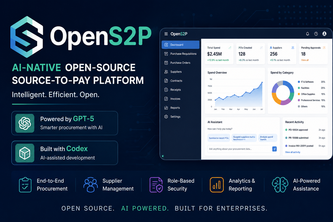
The description states that OpenS2P is an AI-native, open-source Source-to-Pay platform built with GPT-5 and Codex for procurement automation. It includes modules for purchase requisitions, orders, supplier management, and spend reporting. The team built it using Python, FastAPI, React, Docker, and PostgreSQL, integrating AI tools extensively during development.
The author claims the platform supports multi-tenancy, role-based security, REST APIs, and workflow-ready data models. It is positioned as a way to automate repetitive procurement tasks using AI. However, no evidence of actual users, revenue, or market traction is provided.
Confidence: Low. The analysis is based entirely on self-reported information from the project description.
What The Product Actually Is
The description states that OpenS2P is an AI-native, open-source Source-to-Pay (S2P) platform designed to automate enterprise procurement workflows.
It includes capabilities such as:
- Purchase Requisitions
- Purchase Orders
- Supplier Management
- Multi-tenant architecture
- Role-based security
- Workflow-ready data model
- Spend visibility and reporting
- REST APIs for enterprise integration
The platform is built using:
- Python
- FastAPI
- SQLAlchemy
- PostgreSQL
- Docker
- React 19 + TypeScript + Vite
AI tools like GPT-5 and Codex were used for development, including code generation, architecture decisions, debugging, documentation, and testing.
Inference: The platform appears to be a modular procurement system that integrates AI to reduce manual work in procurement processes. It is not described as a full ERP or marketplace solution but rather as an automation tool within the S2P lifecycle.
Positioning & Claim Evolution
The author states:
- OpenS2P is an AI-native, open-source Source-to-Pay platform.
- It aims to automate enterprise procurement using GPT-5 and Codex.
- The goal is to make procurement more intelligent, efficient, and accessible.
- It targets enterprise procurement teams who spend time on manual tasks like creating purchase requests, evaluating suppliers, routing approvals, and tracking purchasing activities.
The project evolved from a hackathon submission (Devpost) into a functional open-source platform with a roadmap that includes:
- AI procurement agents
- Intelligent approval workflows
- Contract lifecycle management
- Supplier collaboration portal
- Spend analytics
Inference: The positioning has shifted from a proof-of-concept to an ambition for a scalable, extensible procurement automation tool. However, the description does not indicate whether this is a standalone product or part of a larger ecosystem.
Target Customer & ICP
The description states:
- OpenS2P targets enterprise procurement teams.
- It aims to help teams reduce time spent on repetitive manual tasks such as:
- Creating purchase requests
- Evaluating suppliers
- Routing approvals
- Tracking purchasing activities
It is described as a platform for organizations of all sizes, although it is built with enterprise-grade features like multi-tenancy and role-based security.
Inference: The ICP appears to be procurement professionals or teams within mid-to-large enterprises seeking automation. However, no specific customer segments, personas, or use cases are detailed beyond the general description of manual tasks.
Business Model & Pricing Evidence
The description states:
- OpenS2P is an open-source platform.
- It includes REST APIs for enterprise integration.
- No pricing model or monetization strategy is mentioned.
There is no evidence of:
- Revenue streams
- Subscription tiers
- Licensing models
- Paid features or premium offerings
Inference: The business model is unclear. As an open-source project, it may rely on community contributions, donations, or future enterprise support contracts. No commercial traction or monetization path is evident.
Technical & Delivery Signals
The platform is built with:
- Backend: Python, FastAPI, SQLAlchemy, PostgreSQL
- Frontend: React 19 + TypeScript + Vite
- DevOps: Docker
- AI Tools: GPT-5 and Codex used for development (code generation, architecture, debugging, documentation)
The description mentions:
- Multi-tenant architecture
- Database migrations
- Scalable API design
- Modular domain modeling
Inference: The technical stack suggests a modern, scalable architecture suitable for enterprise use. However, no evidence of production deployment, performance metrics, or scalability testing is provided.
Traction & Maturity Signals
The description states:
- OpenS2P was built as part of the OpenAI 2026 hackathon.
- It is a functional open-source platform.
- The team has established a foundation for future sourcing, contracting, and supplier collaboration features.
There is no evidence of:
- Users or customer adoption
- Revenue or monetization
- Product-market fit
- Market validation
- Deployment in production environments
Inference: The project is at an early stage. It is functional but lacks real-world usage or traction. The roadmap shows ambition, but no maturity indicators are evident.
Competitive Context
The description does not mention:
- Competitors
- Market size
- Existing S2P platforms (e.g., SAP S/4HANA, Coupa, Oracle Procurement Cloud)
- Differentiation from existing solutions
Inference: The competitive landscape is unknown. OpenS2P appears to aim at the procurement automation space, but no positioning relative to established players or niche competitors is described.
Open Questions & Risks
- No revenue or customer data: The platform is self-reported as functional but lacks any evidence of adoption or monetization.
- Unproven market fit: No indication that the target customers have validated the need for this solution.
- AI dependency: Heavy reliance on GPT-5 and Codex may create risks if those tools change or become unavailable.
- Limited team size: Only two members, which may limit execution speed and scalability.
- Open-source model risk: Open-source projects often struggle to monetize or gain enterprise traction without clear commercial strategies.
Inference: The project is in a very early stage with no demonstrated traction. Risks include lack of market validation, technical dependencies, and limited team capacity.
Questions the description leaves open
- What specific procurement pain points are you solving for? How do you know these are real?
- Have you tested the platform with any actual enterprise users or procurement teams?
- What is your plan to monetize this open-source platform?
- How do you intend to scale beyond a two-person team?
- What are the key technical challenges you've faced in building multi-tenancy and workflow automation?
- Are there any existing S2P platforms that you're directly competing with, or are you targeting a niche?
- How do you plan to integrate with existing ERP or procurement systems?
Overall Assessment
Not evidenced
The description provides no evidence of:
- Revenue
- Customers
- Traction
- Market validation
- Commercial viability
It is unclear whether OpenS2P has moved beyond a proof-of-concept into a product with real-world use or commercial potential.
Inference: At this stage, the project is not suitable for investment or partnership unless further evidence of traction, market fit, or monetization strategy emerges. The platform may have potential but lacks demonstrated value.
User Stories BotA demo video on every pull request
Get a demo video on every new feature
GitHub App that watches your pull requests and records a narrated, captioned demo.
Save time on demo prep and make informed decisions faster with a video walkthrough of every new feature.
Source
Submitted to the OpenAI 2026 hackathon on Devpost. Project home on Devpost. Back to the full gallery on Devpost.
This competitive analysis was produced by top-founders.com (opens in a new tab)
Generated by a language model from this project's public Devpost page — its tagline, the author's own write-up and any built-with tags listed there — as captured in August 2026. Short quotations are the author's words. It is an opinion on the idea as a business, not on the people behind it, and it reflects the description as published then. If the project has moved on, request a correction below. The analysis is not independent research and contains no verified traction, revenue or customer data.
An independent guide by KFG International LLC — not affiliated with, endorsed by, or connected to Devpost or OpenAI.