

Archive position — measured, not model output
0 likes on Devpost
2,263 of the 7,850 archived projects have more likes, and 5,587 share exactly 0 — so this project's #3,747 place in the like-ranked listing is a tie-break inside that group, not a ranking.
Projects (log scale)
Likes on Devpost. ▲ marks this project's group.
Show the figures
| Likes | Projects | Share of archive |
|---|---|---|
| 0 | 5,587 | 71.2% |
| 1 | 1,758 | 22.4% |
| 2 | 284 | 3.6% |
| 3–4 | 132 | 1.7% |
| 5–9 | 75 | 1.0% |
| 10+ | 14 | 0.2% |
 User Stories BotA demo video on every pull request
Get a demo video on every new feature
GitHub App that watches your pull requests and records a narrated, captioned demo.
Save time on demo prep and make informed decisions faster with a video walkthrough of every new feature.
Executive Summary
What the company appears to be
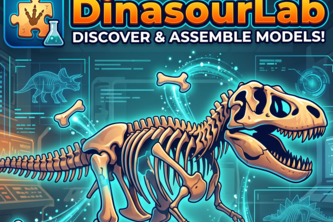
DinasourLab is a self-reported interactive digital experience for dinosaur education, built as a web-based application using AI tools like ChatGPT 5.6 and Codex. It presents 3D dinosaur models that users can view and assemble into puzzles. The author describes it as an educational tool aimed at elementary school teachers and children.
What changed
The project was submitted to the OpenAI 2026 hackathon, indicating a brief development cycle with a focus on prototyping using AI-assisted tools. No evidence of prior commercialization or product-market fit exists beyond this single submission.
Single most important open question
Is there any evidence of user engagement, customer feedback, or traction that would suggest the project has potential for growth or further development?
What The Product Actually Is
The description states that DinasourLab is a web-based interactive experience designed to teach about dinosaurs through 3D models and gamified puzzle assembly. It includes:
- A menu of 3D dinosaur models (including skeletons)
- Drag-and-drop puzzle functionality with progress tracking
- Use of reference images from ChatGPT prompts
- Integration with Supabase for user data and leaderboard features
- Deployment via Vercel and GitHub
The author claims the application was built using AI tools such as ChatGPT 5.6, Codex, and technologies like HTML5, Three.js, Supabase, and Vercel.
Inference: The product appears to be a prototype or proof-of-concept rather than a fully developed commercial offering.
Positioning & Claim Evolution
The author positions DinasourLab as an educational tool for children and teachers, aiming to make learning about dinosaurs more engaging through interactive 3D models and gamification. It is described as:
- A way to present dinosaur information in a fun, visual format
- Suitable for classroom use
- Designed with elementary school audiences in mind
There is no indication of broader positioning beyond this niche audience or any evolution from an initial idea to a more refined product vision.
Claim: The author states that the goal was to create a tool that “can be used to show in class and have fun assembling puzzles from prompts.”
Not evidenced: No evidence of market research, competitive positioning, or strategic direction beyond this single submission.
Target Customer & ICP
The description indicates that DinasourLab targets:
- Elementary school teachers
- Children aged around 6–12 years old
It is implied that the tool could be used in educational settings to enhance learning experiences.
Inference: The target customer segment seems limited to educators and young learners, with no evidence of broader commercial appeal or business-to-business (B2B) targeting.
Business Model & Pricing Evidence
There is no evidence provided regarding pricing, monetization strategy, or business model. The project is described as a hackathon submission without any indication of revenue streams or paid features.
Claim: The author states that the tool can be used in class and offers fun puzzle assembly.
Not evidenced: No mention of subscriptions, licensing, sales, or pricing models.
Technical & Delivery Signals
The project was built using:
- AI tools: ChatGPT 5.6, Codex
- Development platforms: GitHub, Vercel, Supabase
- Technologies: HTML5, Three.js
It includes features like:
- 3D model rendering
- Puzzle assembly with drag-and-drop interface
- Progress tracking and leaderboard functionality
Challenges mentioned include:
- Rendering issues with 3D models
- Incorrect texture colors
- Slow file uploads to GitHub
- Vercel serverless function errors
Inference: The project shows early-stage technical development using AI-assisted workflows but lacks scalability or production-grade architecture.
Traction & Maturity Signals
There is no evidence of traction, user adoption, or customer engagement beyond the hackathon submission. No metrics, usage data, or feedback from users are included in the description.
Not evidenced: No signs of product-market fit, retention, or growth indicators.
Competitive Context
The author does not mention any competitors or similar products. The project is described as a unique solution for teaching dinosaurs through interactive 3D models and puzzles.
Not evidenced: No competitive landscape analysis, market positioning, or differentiation strategy provided.
Open Questions & Risks
- Prototype-only nature: This appears to be a hackathon prototype with no evidence of commercial viability.
- No revenue or traction data: The project lacks any indication of monetization, users, or adoption.
- Limited scope and audience: Focus is narrow (elementary education), which may limit scalability.
- Dependency on AI tools: Heavy reliance on ChatGPT 5.6 and Codex raises questions about long-term sustainability and control over development.
- No clear path to market: No evidence of go-to-market strategy or distribution channels.
Inference: The project is at a very early stage and lacks the maturity required for investment or partnership consideration.
Questions the description leaves open
- What specific educational outcomes were you trying to achieve with this tool?
- Have you tested the application with actual teachers or students? If so, what feedback did you receive?
- Are there plans to expand beyond elementary education or add more features for older learners?
- How do you plan to monetize or scale this product if it gains traction?
- What are your thoughts on using AI tools like Codex for long-term development and maintenance?
Overall Assessment
Not evidenced: There is no evidence of revenue, customer base, traction, or commercial viability beyond a hackathon submission.
Assessment: At this stage, DinasourLab appears to be an experimental prototype with limited commercial potential. It does not meet the criteria for investment or partnership consideration based on the self-reported information alone.
User Stories BotA demo video on every pull request
Get a demo video on every new feature
GitHub App that watches your pull requests and records a narrated, captioned demo.
Save time on demo prep and make informed decisions faster with a video walkthrough of every new feature.
Source
Submitted to the OpenAI 2026 hackathon on Devpost. Project home on Devpost. Back to the full gallery on Devpost.
This competitive analysis was produced by top-founders.com (opens in a new tab)
Generated by a language model from this project's public Devpost page — its tagline, the author's own write-up and any built-with tags listed there — as captured in August 2026. Short quotations are the author's words. It is an opinion on the idea as a business, not on the people behind it, and it reflects the description as published then. If the project has moved on, request a correction below. The analysis is not independent research and contains no verified traction, revenue or customer data.
An independent guide by KFG International LLC — not affiliated with, endorsed by, or connected to Devpost or OpenAI.