

Archive position — measured, not model output
0 likes on Devpost
2,263 of the 7,850 archived projects have more likes, and 5,587 share exactly 0 — so this project's #5,710 place in the like-ranked listing is a tie-break inside that group, not a ranking.
Projects (log scale)
Likes on Devpost. ▲ marks this project's group.
Show the figures
| Likes | Projects | Share of archive |
|---|---|---|
| 0 | 5,587 | 71.2% |
| 1 | 1,758 | 22.4% |
| 2 | 284 | 3.6% |
| 3–4 | 132 | 1.7% |
| 5–9 | 75 | 1.0% |
| 10+ | 14 | 0.2% |
 User Stories BotA demo video on every pull request
Get a demo video on every new feature
GitHub App that watches your pull requests and records a narrated, captioned demo.
Save time on demo prep and make informed decisions faster with a video walkthrough of every new feature.
Executive Summary
What the company appears to be
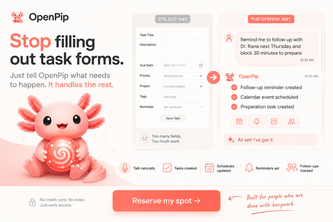
OpenPip is a self-reported personal operations companion built as an agent-first interface for managing life and work context. The author describes it as an “agent-first life operations companion” that connects existing tools (inbox, calendar, tasks, etc.) and turns them into bounded, reviewable next actions. It uses AI to triage inboxes, propose outcomes, and manage voice-based interaction — all while requiring explicit human approval before any consequential action.
What changed
The project was extended during the OpenAI Build Week hackathon. Key additions include a durable background triage job for inbox messages, on-device voice transcription and read-aloud capabilities, and an agent outcomes and review system where proposals are grounded in context and require user approval before execution.
Single most important open question — the commercial due-diligence read
Is there evidence of traction or product-market fit beyond the author’s own development and testing? The description is entirely self-reported with no mention of users, revenue, adoption, or customer feedback. There is no indication that this has moved beyond a prototype or personal project.
What The Product Actually Is
The description states that OpenPip is an agent-first personal operations companion. It connects a person’s existing work and life context — tasks, calendar, inbox, career materials, travel plans, and saved preferences — and turns that into bounded, reviewable next actions.
It includes:
- An intelligent inbox triage system that learns from prior handling of similar messages.
- A voice-first interface using browser-based speech recognition and local language models.
- A proposal pipeline that creates grounded, bounded proposals such as researching companies or preparing trip comparisons.
- A review queue showing what external action has occurred (or not), citing source context.
- Explicit human approval required before any consequential action.
The frontend is built with Next.js and talks to an authenticated proxy, which forwards requests to an agent service. Browser IndexedDB is used only for local caching; no data is stored as truth in the browser.
Evidence
- The author describes how it works: “connects a person’s existing work and life context”.
- It uses tools like Gmail, Google Calendar, Google Drive, OpenAI APIs, Claude Agent SDK, etc.
- It implements a background proposal pipeline that persists proposals and requires approval before execution.
- Voice features are implemented using browser capabilities with fallbacks.
Inference This is a personal productivity tool built around AI agents and human oversight. It’s not a SaaS product yet — it's described as a prototype or proof-of-concept.
Positioning & Claim Evolution
The author positions OpenPip as an “agent-first life operations companion” that avoids the typical pattern of personal AI products beginning with a chat box and leaving users to manage workflows manually.
Claims:
- It is designed to be a calm, readable dashboard of what the agent is doing for you.
- Voice is a first-class input but text and manual controls remain available.
- It does not automatically submit job applications, send draft replies, contact people, book travel, or start campaigns — all require explicit user approval.
- The interface avoids “complicated control panels” and focuses on showing what matters.
Evidence
- The author says: “People need help seeing what matters, what an agent has found, and what still needs a human decision.”
- It emphasizes that the UI is not a chat box but a dashboard with clear outcomes.
- It states that no-reply and transactional senders are excluded from networking records.
Inference The positioning reflects a desire to build trust in AI by making actions visible and controllable, rather than opaque or automated. This is a strong statement about user experience design and safety boundaries.
Target Customer & ICP
The description does not clearly identify a specific customer segment or ideal customer profile (ICP). It refers to “a person” and “people,” but does not define who those people are in terms of profession, age, use case, or behavior.
Evidence
- The author says: “People need help seeing what matters…”
- It targets users who manage multiple contexts (inbox, calendar, tasks, etc.)
- It is described as a personal operations companion
Inference The target appears to be individuals managing complex personal or professional lives, possibly professionals or knowledge workers. However, no segmentation or targeting criteria are provided.
Business Model & Pricing Evidence
There is no evidence of pricing, monetization strategy, or business model in the description.
Evidence
- No mention of revenue streams, subscriptions, freemium tiers, or paid features.
- No indication of whether this will be sold as a SaaS product, a standalone tool, or part of a larger platform.
Inference The project is currently a prototype or personal development effort. There is no evidence that it has moved into commercialization or pricing decisions.
Technical & Delivery Signals
The author reports building with:
- Frontend: Next.js, React, TypeScript
- Backend: Node.js, Express.js, Docker
- AI/ML: OpenAI APIs, Claude Agent SDK, GPT-5.6, Codex
- Cloud services: AWS, Amazon SES
- Browser technologies: IndexedDB, Web Speech API, Web Workers
Key technical elements:
- A durable background pipeline for proposals.
- Idempotent approval/rejection guards.
- Source provenance tracking.
- Real worker-status handling via proxy and scheduler.
- On-device voice processing with fallbacks.
Evidence
- The author says: “The frontend is a Next.js dashboard that talks only to an authenticated proxy.”
- It uses IndexedDB for local cache/resume behavior, not as source of truth.
- Voice features use capability detection and asset caching.
- Scheduler records lifecycle (queued → running → completed or failed).
Inference The technical stack suggests a modern web-based application with AI integration. The architecture emphasizes durability, safety, and observability — key traits for an agentic product.
Traction & Maturity Signals
There is no evidence of traction, adoption, or customer engagement beyond the author’s own development.
Evidence
- No mention of users, customers, or usage metrics.
- No revenue data, ARR, or headcount.
- The project was submitted to a hackathon and described as an extension built during that time.
- No external validation, reviews, or testimonials.
Inference This is likely a prototype or personal project. There is no indication of product-market fit or commercial viability at this stage.
Competitive Context
The description does not mention competitors or how OpenPip fits into the broader market landscape.
Evidence
- No reference to similar tools, platforms, or products.
- No discussion of competitive advantages or differentiation.
Inference Without context about existing solutions in the personal AI or productivity space, it's impossible to assess positioning or competitive dynamics. The author does not appear to have done a competitive analysis.
Open Questions & Risks
- No traction or product-market fit: The project is described as a prototype or hackathon submission with no evidence of real-world usage.
- Unproven commercial viability: No business model, pricing, or monetization strategy is evident.
- Limited team size: Only one member (Ana H.) is listed, which may limit scalability and development capacity.
- Self-reported nature: Everything described is unverified; there’s no independent confirmation of claims.
- Unclear path to market: No indication of how this would be distributed or sold beyond the author’s own use.
Evidence
- The project was submitted to a hackathon.
- No mention of users, customers, or revenue.
- Only one team member is listed.
- All information is self-reported and unverified.
Questions the description leaves open
- What problem are you solving for users beyond your own personal needs?
- How do you plan to validate product-market fit before scaling?
- Are there any early adopters or pilot users who have provided feedback?
- What is the long-term vision for monetization and distribution?
- How will you scale beyond a single developer’s capacity?
- What are the key assumptions in your product design, and how do you plan to test them?
- Have you considered privacy implications of collecting and processing personal data across multiple services?
Overall Assessment
Not evidenced.
There is no evidence that this project has moved beyond a prototype or personal development phase. No revenue, customers, traction, or commercial strategy are evident in the description.
The author describes a compelling vision for an agent-first productivity tool with strong safety and UX principles, but there is no indication of real-world adoption or business momentum.
Confidence level Low — based entirely on self-reported information without corroboration.
User Stories BotA demo video on every pull request
Get a demo video on every new feature
GitHub App that watches your pull requests and records a narrated, captioned demo.
Save time on demo prep and make informed decisions faster with a video walkthrough of every new feature.
Source
Submitted to the OpenAI 2026 hackathon on Devpost. Project home on Devpost. Back to the full gallery on Devpost.
This competitive analysis was produced by top-founders.com (opens in a new tab)
Generated by a language model from this project's public Devpost page — its tagline, the author's own write-up and any built-with tags listed there — as captured in August 2026. Short quotations are the author's words. It is an opinion on the idea as a business, not on the people behind it, and it reflects the description as published then. If the project has moved on, request a correction below. The analysis is not independent research and contains no verified traction, revenue or customer data.
An independent guide by KFG International LLC — not affiliated with, endorsed by, or connected to Devpost or OpenAI.