

Archive position — measured, not model output
0 likes on Devpost
2,263 of the 7,850 archived projects have more likes, and 5,587 share exactly 0 — so this project's #6,239 place in the like-ranked listing is a tie-break inside that group, not a ranking.
Projects (log scale)
Likes on Devpost. ▲ marks this project's group.
Show the figures
| Likes | Projects | Share of archive |
|---|---|---|
| 0 | 5,587 | 71.2% |
| 1 | 1,758 | 22.4% |
| 2 | 284 | 3.6% |
| 3–4 | 132 | 1.7% |
| 5–9 | 75 | 1.0% |
| 10+ | 14 | 0.2% |
 User Stories BotA demo video on every pull request
Get a demo video on every new feature
GitHub App that watches your pull requests and records a narrated, captioned demo.
Save time on demo prep and make informed decisions faster with a video walkthrough of every new feature.
Executive Summary
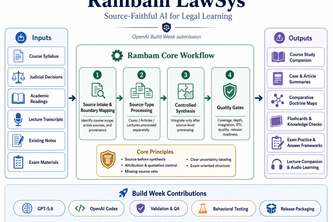
What the company appears to be: Rambam LawSys is a self-reported AI-powered system designed to process legal course materials (cases, readings, lectures) into structured, source-faithful study companions and exam-ready learning products. It was built during an OpenAI Build Week hackathon and is described as evolving from a "Custom GPT workflow" into a more structured system using Codex and GPT-5.6.
What changed: The project evolved from a personal or small-team methodology into a more formalized, testable, and repeatable system during the hackathon. It now supports processing real course materials and producing various learning products such as flashcards, exam questions, and study companions.
The single most important open question: Is there evidence of any real-world use beyond the author’s own testing or internal application? The description states no revenue, customers, or traction data are available — only self-reported claims about functionality and application to law-school courses.
What The Product Actually Is
- The description states that Rambam LawSys processes legal course materials including syllabi, judicial decisions, academic readings, lecture transcripts, and existing notes.
- It identifies source types (cases, articles, lectures) and processes them separately based on their format.
- For each source type, it extracts structured elements such as facts, legal questions, holdings, reasoning, and exam use for cases; thesis, argument structure, concepts, criticisms, and relationships for articles; and separates lecturer interpretation from underlying sources for lectures.
- It creates integrated learning products including:
- Course study companions
- Case and article summaries
- Comparative doctrine maps
- Flashcards and knowledge checks
- Exam questions and answer frameworks
- Lecture companions
- Podcasts and audio-learning scripts
- Controlled updates to canonical course notebooks
- The system is described as distinguishing between:
- What the original source says
- Lecturer interpretation
- Editorial synthesis
- Criticism
- External supplementation
- Uncertain or missing information
- It applies quality controls for source coverage, analytical depth, integration, exam usability, and Hebrew RTL document production.
Inference: The system appears to be a structured AI workflow that uses GPT-5.6 and Codex to parse legal content and generate educational outputs while maintaining attribution and source fidelity.
Positioning & Claim Evolution
- The description states that Rambam LawSys was created to solve the problem of generic AI tools that may omit distinctions, mix sources, misattribute ideas, or produce unverifiable answers.
- It positions itself as a tool that transforms legal course materials into structured, source-faithful and exam-ready learning systems.
- The system is described as being built around "source fidelity and controlled synthesis."
- It distinguishes between:
- Original source content
- Lecturer interpretation
- Editorial explanation
- Criticism or supplementation
- It does not automatically treat fluent answers as reliable; it can halt processing if sources are missing, attribution uncertain, or quality checks fail.
- The author claims that the system supports a controlled course-building workflow from intake to final learning products.
Inference: Rambam LawSys positions itself as a specialized educational AI tool for law students and educators, emphasizing accuracy, source control, and pedagogical utility over generic summarization.
Target Customer & ICP
- The description states that the system is designed for law students who must learn from hundreds of pages of legal materials.
- It also implies use by lecturers, teaching assistants, and educators involved in legal education.
- The system supports Hebrew RTL document production, suggesting a target audience in Israel or Hebrew-speaking legal institutions.
Inference: The primary customer is law students using the tool for exam preparation. Secondary users may include educators who want to create structured course materials or support student learning.
Business Model & Pricing Evidence
- Not evidenced.
- No mention of pricing, monetization strategy, revenue model, or commercial use cases in the description.
Inference: The project is described as a hackathon prototype with no evidence of any business model or pricing structure.
Technical & Delivery Signals
- Built using:
- GPT-5.6
- Codex
- Node.js
- HTML, CSS, JavaScript
- Markdown, JSON, Git, GitHub
- Automated testing tools
- The system uses structured manifests and behavioral test fixtures.
- It supports long-context reasoning across legal sources, pedagogy, source attribution, workflow design, quality assurance, and product development.
- It applies separate quality controls for:
- Source coverage
- Analytical depth
- Integration
- Exam usability
- Hebrew RTL document production
Inference: The technical stack suggests a modern AI-enhanced educational tool built with structured workflows and testing. The use of Codex and GPT-5.6 indicates an emphasis on natural language processing and structured output generation.
Traction & Maturity Signals
- The system has been applied to real law-school courses.
- It has been used to create:
- Complete study companions
- Reading notebooks
- Exam tools
- Knowledge checks
- Lecture-based learning products
- It can identify when a product is incomplete and prevent premature approval.
- The project was developed during an OpenAI Build Week hackathon.
- No evidence of revenue, customers, or adoption beyond the author’s own use.
Inference: There is limited evidence of real-world traction. The system is described as being applied to real courses but lacks any data on usage volume, user feedback, or commercial deployment.
Competitive Context
- Not evidenced.
- No mention of competitors, market size, or competitive positioning in the description.
Inference: No information is provided about existing tools or platforms in the legal education or AI-assisted learning space.
Open Questions & Risks
- The system is described as a single-person project (team size: 1).
- It is based on a hackathon prototype and lacks evidence of long-term development, testing, or commercial viability.
- No evidence of revenue, customers, or traction beyond the author’s own use.
- The tool is built using AI models like GPT-5.6, which may not be available for production use or may carry licensing risks.
- The system is described as being in early stages of development and not yet a student-facing platform.
Inference: The project is at an early stage with no commercial traction or evidence of scalability. Risks include lack of team resources, unproven market demand, and potential technical limitations in AI model availability or performance.
Questions the description leaves open
- What specific law-school courses have been processed using Rambam LawSys? Can you share examples of the outputs?
- How is source attribution validated in practice? Is there a manual review step?
- Has the system been tested with actual students or educators? What feedback has it received?
- Are there any plans to monetize or commercialize the tool? If so, what is the business model?
- What are the technical limitations of using GPT-5.6 in production, and how does the team plan to address them?
- How does the system handle multilingual content (e.g., Hebrew + English)?
- Is there any internal testing or validation data that supports its claims about accuracy and source fidelity?
Overall Assessment
- Not evidenced.
- No information is provided on valuation, funding history, or investment interest.
Inference: The project is described as a hackathon prototype with no evidence of commercial traction, funding, or investor interest. It is not yet ready for investment or partnership discussions based on the self-reported description alone.
User Stories BotA demo video on every pull request
Get a demo video on every new feature
GitHub App that watches your pull requests and records a narrated, captioned demo.
Save time on demo prep and make informed decisions faster with a video walkthrough of every new feature.
Source
Submitted to the OpenAI 2026 hackathon on Devpost. Project home on Devpost. Back to the full gallery on Devpost.
This competitive analysis was produced by top-founders.com (opens in a new tab)
Generated by a language model from this project's public Devpost page — its tagline, the author's own write-up and any built-with tags listed there — as captured in August 2026. Short quotations are the author's words. It is an opinion on the idea as a business, not on the people behind it, and it reflects the description as published then. If the project has moved on, request a correction below. The analysis is not independent research and contains no verified traction, revenue or customer data.
An independent guide by KFG International LLC — not affiliated with, endorsed by, or connected to Devpost or OpenAI.