

Archive position — measured, not model output
2 likes on Devpost
221 of the 7,850 archived projects have more likes, and 284 share exactly 2 — so this project's #352 place in the like-ranked listing is a tie-break inside that group, not a ranking.
Projects (log scale)
Likes on Devpost. ▲ marks this project's group.
Show the figures
| Likes | Projects | Share of archive |
|---|---|---|
| 0 | 5,587 | 71.2% |
| 1 | 1,758 | 22.4% |
| 2 | 284 | 3.6% |
| 3–4 | 132 | 1.7% |
| 5–9 | 75 | 1.0% |
| 10+ | 14 | 0.2% |
 User Stories BotA demo video on every pull request
Get a demo video on every new feature
GitHub App that watches your pull requests and records a narrated, captioned demo.
Save time on demo prep and make informed decisions faster with a video walkthrough of every new feature.
Executive Summary
The description states that J-bless plugin is a Chrome extension designed to help job seekers filter job postings based on commute time, skill alignment, and other practical factors. The tool automatically transforms job listings and user resumes into tailored CVs, cover letters, skill gap analysis, and commute plans using AI and mapping APIs.
Key changes: The project was built by two individuals over a short timeframe (likely during a hackathon), with no prior experience in Chrome extension development or AI resources. It leverages free credits from developer communities and tools like Codex for development.
The single most important open question is whether this tool has any real-world traction or adoption beyond its initial prototype, as the description provides no evidence of revenue, customers, or usage metrics.
What The Product Actually Is
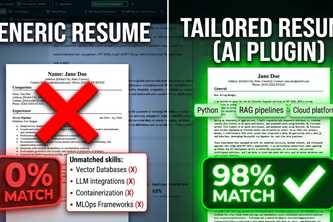
The description states that J-bless plugin is a smart Chrome extension. It claims to automatically transform job postings and user resumes into:
- Tailored LaTeX CVs
- Custom cover letters
- Skill gap analysis
- Commute plans
It uses technologies including CSS, Google Maps, Google Routes API, Groq, HTML, and JavaScript.
Positioning & Claim Evolution
The description states that the tool was inspired by the need to filter job listings based on practical realities like commuting time and skill alignment. It positions itself as helping job seekers prioritize roles that make sense for their daily lives and career profiles.
The project evolved from a personal challenge faced by one of the founders (a recently unemployed fresh graduate) into a tool aimed at solving a common bottleneck in job searching.
Target Customer & ICP
The description states that the target customer is job seekers, particularly recent graduates or those who are unemployed. The tool aims to help users filter through job listings based on practical factors such as:
- Physical distance
- Daily commuting time
- Skill matching with employer requirements
Business Model & Pricing Evidence
Not evidenced.
Technical & Delivery Signals
The description states that the extension was built by two individuals using Codex and free credits from the developer community. It was developed as a Manifest V3 Chrome extension, integrating external services like Google Maps and Routes API.
The authors claim they:
- Discovered and integrated API endpoints
- Mastered resourcefulness in utilizing free tools
- Demystified extension development
Traction & Maturity Signals
Not evidenced. The description states that this was a hackathon project submitted to the OpenAI 2026 hackathon, with no mention of any revenue, customer base, or usage metrics.
Competitive Context
Not evidenced.
Open Questions & Risks
The description states that:
- The team had no prior experience in Chrome extension development or AI resources
- The project was built using free credits and community resources
- It's a hackathon submission with no evidence of traction or commercial viability
This suggests significant risk around product maturity, scalability, and long-term sustainability.
Questions the description leaves open
- What is the current status of the product beyond the hackathon prototype?
- Have you validated the need for this tool with actual users?
- How do you plan to monetize this tool if it's not already generating revenue?
- What are your plans for scaling beyond the initial prototype?
- Can you provide any evidence of user feedback or testing?
Overall Assessment
Not evidenced. The description provides no information about revenue, customers, or traction that would support an investment or partnership decision. The project appears to be a hackathon prototype with no commercial evidence.
User Stories BotA demo video on every pull request
Get a demo video on every new feature
GitHub App that watches your pull requests and records a narrated, captioned demo.
Save time on demo prep and make informed decisions faster with a video walkthrough of every new feature.
Source
Submitted to the OpenAI 2026 hackathon on Devpost. Project home on Devpost. Back to the full gallery on Devpost.
This competitive analysis was produced by top-founders.com (opens in a new tab)
Generated by a language model from this project's public Devpost page — its tagline, the author's own write-up and any built-with tags listed there — as captured in August 2026. Short quotations are the author's words. It is an opinion on the idea as a business, not on the people behind it, and it reflects the description as published then. If the project has moved on, request a correction below. The analysis is not independent research and contains no verified traction, revenue or customer data.
An independent guide by KFG International LLC — not affiliated with, endorsed by, or connected to Devpost or OpenAI.