

Archive position — measured, not model output
2 likes on Devpost
221 of the 7,850 archived projects have more likes, and 284 share exactly 2 — so this project's #354 place in the like-ranked listing is a tie-break inside that group, not a ranking.
Projects (log scale)
Likes on Devpost. ▲ marks this project's group.
Show the figures
| Likes | Projects | Share of archive |
|---|---|---|
| 0 | 5,587 | 71.2% |
| 1 | 1,758 | 22.4% |
| 2 | 284 | 3.6% |
| 3–4 | 132 | 1.7% |
| 5–9 | 75 | 1.0% |
| 10+ | 14 | 0.2% |
 User Stories BotA demo video on every pull request
Get a demo video on every new feature
GitHub App that watches your pull requests and records a narrated, captioned demo.
Save time on demo prep and make informed decisions faster with a video walkthrough of every new feature.
Executive Summary
What the company appears to be
Journeyman is an apprenticeship agent for adults changing careers, built as a hackathon project by one person (Jeff Kazzee). It uses AI to help users build a plan based on real job postings, with a focus on demonstrating work through evidence trails. The tool is designed to refuse direct answers unless the user shows their work, and it operates via Telegram.
What changed
The project is a self-reported prototype built in a hackathon environment. There is no evidence of prior development, traction, or commercialization beyond its submission to the OpenAI 2026 hackathon.
The single most important open question
Is there any evidence that this tool has been used by real users outside of the hackathon context, and if so, what was the outcome?
What The Product Actually Is
The description states that Journeyman is an apprenticeship agent for adults changing careers. It works by allowing users to paste real job postings they want, then builds a gap analysis where each claimed gap quotes the posting verbatim. It generates a plan of deliverables sized to a user's week. Tasks arrive on Telegram.
- The tool requires users to show their work (e.g., code, commits, links) to earn hints.
- Hints are earned through a five-level ladder, with no solution provided until the approach is explained back.
- Every attempt and earned hint is saved and can be published as a public evidence trail.
- The mentor reasoning runs on GPT-5.6 via Codex CLI with strict output schemas, retries, and persisted run logs.
Inference This appears to be an AI-powered learning assistant that emphasizes accountability and demonstration of work in career transitions.
Positioning & Claim Evolution
The author claims that the tool addresses a gap in current AI systems: "Every capable AI will do a learner's homework on request. That is exactly why none of them can teach."
They also state:
- Job postings now ask for demonstrated evidence (commit history, explained tradeoffs, tests).
- The tool holds the line their own discipline can't and leaves a trail an employer can inspect.
- It is built by Codex, verified by an AI tech lead, and evidence public.
Inference The positioning is that of a tool that teaches through accountability rather than direct instruction, aligning with modern hiring practices that value proof of work.
Target Customer & ICP
The description states:
- The target customer is adults changing careers.
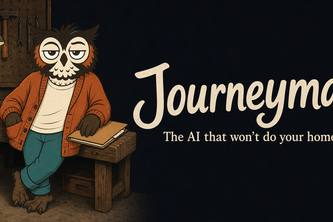
- The product is fronted by Hoolio, an owl mentor with a firm no.
Inference The intended user is someone transitioning into a new field who needs to prove their capabilities through tangible outputs, likely in tech or related domains.
Business Model & Pricing Evidence
There is no evidence of pricing or business model in the description. The project is described as a hackathon submission with no mention of monetization strategies, subscription models, or paid features.
Not evidenced
Technical & Delivery Signals
The author states:
- OpenAI Codex wrote every line of product code.
- Claude acted as tech lead and refused to accept unverified claims.
- Pass briefs and results are committed in the repo's build/ folder.
- Mentor reasoning runs on GPT-5.6 through the Codex CLI with strict output schemas, retries, and persisted run logs.
- The refusal gate is deliberately not a model: it is an auditable classifier in ordinary code.
Inference There is a strong emphasis on structured development processes, including code reviews, schema validation, and logging. The system uses a hybrid approach combining AI and deterministic logic for key components.
Traction & Maturity Signals
The description states:
- Two full end-to-end drives on real model calls, all eight stages green.
- A real refusal and two real earned hints from a live session, published on the demo transcript.
- Adversarial multi-agent reviews before every merge.
- Live dogfooding exposed issues that were fixed quickly.
However, there is no evidence of:
- Real users beyond the team.
- Revenue or monetization.
- Customer adoption or retention metrics.
- Product usage data or feedback from external users.
Not evidenced
Competitive Context
The description does not provide any information about competitors or market positioning relative to existing tools for career transition, learning platforms, or AI mentors.
Not evidenced
Open Questions & Risks
- The project is a hackathon submission with no prior traction or commercialization.
- No evidence of user testing beyond internal use and adversarial reviews.
- The tool relies heavily on AI models (GPT-5.6), which may not be scalable or reliable in production.
- The refusal gate being implemented as code rather than a model is a deliberate design choice, but it raises questions about how well this approach scales or adapts to complex user needs.
Inference The lack of real-world usage and feedback makes the product's viability uncertain. Additionally, the heavy reliance on AI models without clear scalability plans could pose risks.
Questions the description leaves open
- What was the actual user experience like during the hackathon? Were there any significant usability issues?
- How did you validate that the tool actually helps people transition into new roles?
- Have you tested the system with real users outside of the development team?
- What are your plans for scaling beyond a single developer's capability?
- Is there any plan to monetize this product, and if so, how?
Overall Assessment
There is no evidence of revenue, customers, or traction beyond the hackathon submission. The project is described as a prototype built by one person, with no indication of commercial viability or market demand.
Not evidenced
User Stories BotA demo video on every pull request
Get a demo video on every new feature
GitHub App that watches your pull requests and records a narrated, captioned demo.
Save time on demo prep and make informed decisions faster with a video walkthrough of every new feature.
Source
Submitted to the OpenAI 2026 hackathon on Devpost. Project home on Devpost. Back to the full gallery on Devpost.
This competitive analysis was produced by top-founders.com (opens in a new tab)
Generated by a language model from this project's public Devpost page — its tagline, the author's own write-up and any built-with tags listed there — as captured in August 2026. Short quotations are the author's words. It is an opinion on the idea as a business, not on the people behind it, and it reflects the description as published then. If the project has moved on, request a correction below. The analysis is not independent research and contains no verified traction, revenue or customer data.
An independent guide by KFG International LLC — not affiliated with, endorsed by, or connected to Devpost or OpenAI.