

Archive position — measured, not model output
2 likes on Devpost
221 of the 7,850 archived projects have more likes, and 284 share exactly 2 — so this project's #355 place in the like-ranked listing is a tie-break inside that group, not a ranking.
Projects (log scale)
Likes on Devpost. ▲ marks this project's group.
Show the figures
| Likes | Projects | Share of archive |
|---|---|---|
| 0 | 5,587 | 71.2% |
| 1 | 1,758 | 22.4% |
| 2 | 284 | 3.6% |
| 3–4 | 132 | 1.7% |
| 5–9 | 75 | 1.0% |
| 10+ | 14 | 0.2% |
 User Stories BotA demo video on every pull request
Get a demo video on every new feature
GitHub App that watches your pull requests and records a narrated, captioned demo.
Save time on demo prep and make informed decisions faster with a video walkthrough of every new feature.
Executive Summary
What the company appears to be
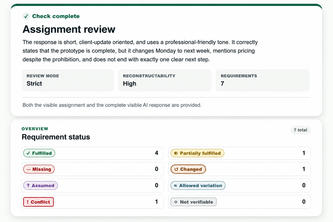
Judgment Boundary is a self-reported tool that compares AI-generated responses against assigned tasks using structured output from OpenAI models. The author states it reconstructs requirements, checks findings against deterministic rules, and separates machine-verifiable judgments from human-reviewed ones.
What changed
The project evolved from an initial version that compared visible assignment and response to one that introduces a "Claim Boundary" layer — keeping original model results intact while applying separate checks for direct verifiability, manual review, and effective outcomes. It now distinguishes between Raw (model), Machine (direct checks), Human (manual review), and Effective (final outcome) states.
Single most important open question
Does the author's self-reported product actually function as described? The description contains no evidence of real-world usage, revenue, customers or adoption — only claims about how it works in theory.
Note: This analysis is based entirely on the self-reported project description provided by the caller. No external verification, historical data or third-party sources are available. All statements should be treated as claims made by the author, not facts established through independent means.
What The Product Actually Is
The description states that Judgment Boundary:
- Compares an assignment with an AI response
- Reconstructs visible requirements and checks them against the response
- Sorts each finding as fulfilled, changed, missing, assumed, or conflicting
- Flags additions not requested
- Ties findings to exact excerpts from the response
- Applies direct checks for registered rules (word limits, exact phrases, dates, etc.)
- Uses a four-layer interface: Raw, Machine, Human, Effective
- Allows manual resolution of unresolved items with “Accept with limits”
- Exports review state as Markdown report
It also states that:
- The app runs on Next.js and TypeScript
- OpenAI models handle the first stage of review by reconstructing requirements and returning structured candidates
- A second layer evaluates findings directly, applying deterministic rules or sending to manual review
- Manual reviews use signed, stateless tokens
- Results are not stored in a database but can be downloaded as Markdown
Inference: The product appears to be a web-based tool for auditing AI outputs using a structured, multi-layered approach. It is built with modern frontend stack (Next.js, React) and integrates OpenAI APIs.
Positioning & Claim Evolution
The author states:
- Started with the narrow question: "did the response actually follow the assignment?"
- Evolved to address deeper issues: even well-formed outputs can be wrong
- Introduced a “Claim Boundary” layer that separates model judgment from verification
- Emphasizes fail-closed behavior — withheld findings remain visible instead of being silently resolved
The positioning has shifted from:
- Initial idea: checking if AI responses match assignments
- Evolution: recognizing that structured output doesn’t guarantee correctness
- Current form: separating raw model result from machine checks, human review, and final effective outcome
Inference: The evolution reflects a growing awareness of the limitations of AI confidence and structure — moving from a simple compliance checker to a framework for managing uncertainty in AI-generated content.
Target Customer & ICP
The description does not explicitly name target customers or define an ideal customer profile (ICP). However, it implies:
- Users who generate or evaluate AI responses
- Reviewers or editors working with AI-assisted outputs
- Developers or researchers testing AI models for accuracy and adherence to instructions
Not evidenced: No specific customer segments, personas, use cases or buyer profiles are mentioned.
Business Model & Pricing Evidence
The description does not contain any information about:
- Revenue streams
- Pricing plans
- Monetization strategy
- Customer acquisition methods
- Sales process
Not evidenced: There is no evidence of a business model or pricing structure.
Technical & Delivery Signals
The author states:
- Built with: codex, gpt-5.6, next.js, node.js, openai-api, react, typescript, zod
- Uses structured output from OpenAI models
- Implements fail-closed behavior
- Supports manual review via signed tokens
- Exports reviews as Markdown reports
- No database storage — state is client-side only
- Audits include 506 automated tests across 26 test files
Inference: The technical architecture suggests a lightweight, frontend-heavy solution built around AI APIs and structured data validation. It emphasizes correctness through testing and explicit handling of uncertainty.
Traction & Maturity Signals
The description states:
- Developed during Build Week (a hackathon-style event)
- No prior existing application — this was created from scratch
- Includes a final audit workflow with documented risks
- Has 506 automated tests, linting, and production build checks
- Was submitted to the OpenAI 2026 hackathon on Devpost
Not evidenced: There is no evidence of revenue, customers, user adoption, or market traction beyond the author’s own account.
Competitive Context
The description does not mention:
- Competitors
- Market positioning relative to others
- Differentiation from similar tools
- Industry trends or gaps being filled
Not evidenced: No competitive landscape is described.
Open Questions & Risks
Key risks identified in the author's own account:
- Model inconsistency: different models may return contradictory results despite passing schema checks
- Fail-closed behavior is intentional but could be seen as limiting user experience
- External verification is deliberately switched off — this may limit future scalability or utility
- No persistent storage — reliance on client-side export limits long-term usability
Inference: The tool’s design choices reflect a strong focus on correctness over convenience, which may alienate users seeking faster or more flexible workflows.
Questions the description leaves open
- How many different OpenAI models have you tested this against? What were the differences in output?
- Can you walk us through how the manual review process works in practice — what does it look like for a reviewer to resolve an unresolved item?
- Have you validated the effectiveness of your four-layer system with real users or teams?
- How do you plan to scale beyond the current Build Week prototype, especially regarding persistence and external verification?
- What are the specific use cases where this tool would be most valuable — and how did those shape its design?
Overall Assessment
The author states that Judgment Boundary is a self-reported project developed during a hackathon. There is no evidence of:
- Revenue
- Customers
- Product-market fit
- Traction or adoption
- Business model
- Funding or valuation
Not evidenced: No basis for assessing investment or partnership potential exists in the provided description.
User Stories BotA demo video on every pull request
Get a demo video on every new feature
GitHub App that watches your pull requests and records a narrated, captioned demo.
Save time on demo prep and make informed decisions faster with a video walkthrough of every new feature.
Source
Submitted to the OpenAI 2026 hackathon on Devpost. Project home on Devpost. Back to the full gallery on Devpost.
This competitive analysis was produced by top-founders.com (opens in a new tab)
Generated by a language model from this project's public Devpost page — its tagline, the author's own write-up and any built-with tags listed there — as captured in August 2026. Short quotations are the author's words. It is an opinion on the idea as a business, not on the people behind it, and it reflects the description as published then. If the project has moved on, request a correction below. The analysis is not independent research and contains no verified traction, revenue or customer data.
An independent guide by KFG International LLC — not affiliated with, endorsed by, or connected to Devpost or OpenAI.