

Archive position — measured, not model output
2 likes on Devpost
221 of the 7,850 archived projects have more likes, and 284 share exactly 2 — so this project's #357 place in the like-ranked listing is a tie-break inside that group, not a ranking.
Projects (log scale)
Likes on Devpost. ▲ marks this project's group.
Show the figures
| Likes | Projects | Share of archive |
|---|---|---|
| 0 | 5,587 | 71.2% |
| 1 | 1,758 | 22.4% |
| 2 | 284 | 3.6% |
| 3–4 | 132 | 1.7% |
| 5–9 | 75 | 1.0% |
| 10+ | 14 | 0.2% |
 User Stories BotA demo video on every pull request
Get a demo video on every new feature
GitHub App that watches your pull requests and records a narrated, captioned demo.
Save time on demo prep and make informed decisions faster with a video walkthrough of every new feature.
Executive Summary
What the company appears to be
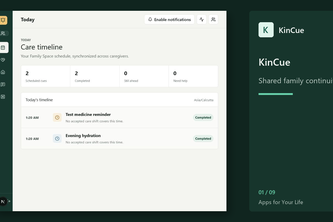
KinCue is a self-reported family coordination tool built for private household spaces where caregivers manage care routines, handovers, reminders, and important documents. It allows family members to sign in with Google, assign care shifts, receive notifications, and store household knowledge in a shared but role-aware space.
What changed
The project was submitted as part of the OpenAI 2026 hackathon. The author describes it as a prototype built using Next.js, React, Firebase, Supabase, and AI tools like GPT-5.6 and Gemini. It includes features such as caregiver assignment, AI-assisted handovers, scheduled cues, and document storage.
Single most important open question
Is there any evidence of actual usage or traction beyond the hackathon prototype?
What The Product Actually Is
The description states that KinCue is a private family space for managing care routines, reminders, household knowledge, and documents. It supports:
- Care profiles linked to household members
- Repeatable care routines with schedules and instructions
- Care shift assignments (primary and backup)
- Synchronized cues, alarms, and browser notifications
- AI-assisted handovers that extract structured data from unstructured updates
- A family Vault for storing important files
- Role-based access control via Firebase Authentication and Firestore
The product is described as a responsive web application built with Next.js, React, TypeScript, and uses Firebase for authentication and data synchronization, and Supabase for private document storage.
Claim: KinCue is a family coordination platform.
Evidence: The author’s own write-up describes the functionality and architecture of the tool.
Inference: It appears to be a prototype or MVP built for a hackathon.
Supporting evidence: The project was submitted to the OpenAI 2026 hackathon; no mention of production users, revenue, or ongoing development beyond the demo.
Positioning & Claim Evolution
The author positions KinCue as a solution to the problem of fragile knowledge transfer in families — where one person holds all care-related information and must hand it over when they are unavailable. The goal is to make family knowledge shared, gradual, and actionable, rather than left inside one person’s head.
Key claims include:
- KinCue makes responsibility explicit by requiring caregivers to accept shifts.
- It converts unstructured caregiver updates into structured AI handovers.
- AI is conservative — it preserves source excerpts, does not invent details, and requires human confirmation before saving extracted information.
Claim: KinCue aims to solve the problem of care knowledge transfer in families.
Evidence: The author describes inspiration behind the product as a response to this issue.
Inference: The positioning suggests KinCue is intended for use by families managing elderly or dependent members.
Supporting evidence: Features like care routines, shift assignments, and emergency contacts imply a focus on caregiving scenarios.
Target Customer & ICP
The description does not explicitly define target customers or an ideal customer profile (ICP). However, it implies the tool is aimed at:
- Families managing care routines for elderly or dependent members
- Households with multiple caregivers who need to coordinate responsibilities
- Users seeking a centralized, private space for household knowledge and documents
Claim: KinCue targets families coordinating care.
Evidence: The inspiration section and feature set point toward this audience.
Inference: It may also appeal to households with complex or multi-generational caregiving needs.
Supporting evidence: Features like backup caregivers, shift coverage, and structured handovers suggest complexity in care coordination.
Business Model & Pricing Evidence
There is no mention of pricing, monetization, or business model in the description. The project was built as a hackathon submission and lacks any indication of revenue streams or customer acquisition plans.
Claim: No evidence of business model or pricing.
Evidence: The author does not describe how KinCue would be sold, who pays for it, or what kind of monetization strategy exists.
Technical & Delivery Signals
The project is built using:
- Next.js, React, TypeScript
- Firebase Authentication and Firestore for user management and data sync
- Supabase Storage for private document handling
- Codex and GPT-5.6 used during development
- Edge runtime via Cloudflare Workers (vinext)
- Zod for schema validation in AI pipelines
The system supports:
- Real-time synchronization across devices
- Role-based access control
- AI-assisted extraction of structured data from caregiver updates
- Secure document storage with expiring signed links
Claim: KinCue uses modern web and cloud technologies.
Evidence: The author lists the tech stack used in building the product.
Inference: The use of edge computing, AI pipelines, and secure storage suggests a technical sophistication beyond basic tools.
Supporting evidence: Features like real-time sync, role-aware Firestore rules, and AI extraction imply advanced engineering.
Traction & Maturity Signals
There is no evidence of traction or user adoption beyond the hackathon prototype. The project has:
- A single team member (Ravideep Singh)
- No mention of customers, users, or revenue
- No data on active usage or retention
- No indication of ongoing development or product iteration post-hackathon
Claim: No evidence of traction or maturity.
Evidence: The description is limited to a hackathon submission with no signs of real-world deployment or user engagement.
Competitive Context
The author does not reference any competitors. However, based on the features described (care routines, caregiver assignments, AI handovers), KinCue could be positioned in markets related to:
- Family care coordination tools
- Elderly care management platforms
- Shared household knowledge systems
No direct comparison or competitive analysis is provided.
Claim: No evidence of competitive landscape.
Evidence: The description does not name competitors or analyze the market space.
Open Questions & Risks
Key risks and open questions include:
- Lack of traction or user data — this is a prototype, not a product in use
- Single founder — limited team capacity for execution
- No monetization strategy — unclear path to revenue
- AI dependency without validation — AI handovers are described as conservative but no evidence of accuracy or reliability in practice
- Limited scope — focused on family coordination, not scalable beyond that niche
Claim: Lack of traction and unclear business model.
Evidence: No mention of users, revenue, or monetization.
Inference: The product may struggle to scale without significant iteration or external validation.
Supporting evidence: Prototype nature and single-person team suggest early-stage development.
Questions the description leaves open
- What is the actual user base beyond the hackathon prototype?
- How do you plan to monetize this product, if at all?
- Have you tested the AI handover pipeline with real users or caregivers?
- Is there a roadmap for expanding beyond family coordination into broader care ecosystems?
- What are your plans for scaling beyond a single developer team?
Overall Assessment
This is a self-reported hackathon prototype with no evidence of traction, revenue, or customer adoption. The author describes a functional tool with promising features but does not provide any indication that it has moved beyond the experimental phase.
Claim: Not ready for investment or partnership.
Evidence: No data on usage, customers, or monetization; only a prototype built in a short timeframe.
Inference: If this were to evolve into a product, it would require significant development and user testing before any commercial viability could be assessed.
Supporting evidence: The project is described as a hackathon submission with no mention of iteration or market validation.
User Stories BotA demo video on every pull request
Get a demo video on every new feature
GitHub App that watches your pull requests and records a narrated, captioned demo.
Save time on demo prep and make informed decisions faster with a video walkthrough of every new feature.
Source
Submitted to the OpenAI 2026 hackathon on Devpost. Project home on Devpost. Back to the full gallery on Devpost.
This competitive analysis was produced by top-founders.com (opens in a new tab)
Generated by a language model from this project's public Devpost page — its tagline, the author's own write-up and any built-with tags listed there — as captured in August 2026. Short quotations are the author's words. It is an opinion on the idea as a business, not on the people behind it, and it reflects the description as published then. If the project has moved on, request a correction below. The analysis is not independent research and contains no verified traction, revenue or customer data.
An independent guide by KFG International LLC — not affiliated with, endorsed by, or connected to Devpost or OpenAI.