

Archive position — measured, not model output
2 likes on Devpost
221 of the 7,850 archived projects have more likes, and 284 share exactly 2 — so this project's #359 place in the like-ranked listing is a tie-break inside that group, not a ranking.
Projects (log scale)
Likes on Devpost. ▲ marks this project's group.
Show the figures
| Likes | Projects | Share of archive |
|---|---|---|
| 0 | 5,587 | 71.2% |
| 1 | 1,758 | 22.4% |
| 2 | 284 | 3.6% |
| 3–4 | 132 | 1.7% |
| 5–9 | 75 | 1.0% |
| 10+ | 14 | 0.2% |
 User Stories BotA demo video on every pull request
Get a demo video on every new feature
GitHub App that watches your pull requests and records a narrated, captioned demo.
Save time on demo prep and make informed decisions faster with a video walkthrough of every new feature.
Executive Summary
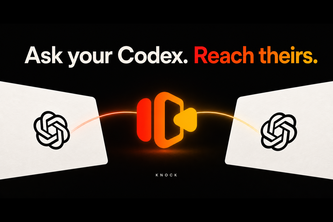
Knock is a self-reported tool that enables two people to collaborate using their own private Codex agents while maintaining control over each agent's context, tools, permissions, and approvals. The project was built as part of the OpenAI 2026 hackathon by a team of two (Théo Reumont and Rémi Duplé). It uses a desktop Electron gateway, local MCP bridge, and server-side control plane to facilitate agent collaboration without exposing private data. The description states that Knock is designed for human-to-human coordination through agents, with a focus on durable, encrypted communication between agents in separate environments.
The most important open question is whether the described protocol can be scaled beyond two-person workflows or if it remains limited to narrow use cases due to its current design and lack of demonstrated traction or user feedback. The project has no evidence of revenue, customers, or adoption beyond its own self-reporting.
What The Product Actually Is
The description states that Knock is a system enabling two people to ask their own Codex agents to collaborate while each person retains control over their agent's private context, tools, permissions, and approvals. It uses an Electron-based desktop gateway for macOS and Windows, a local MCP bridge, a Vercel control plane, Neon append-only event log, Upstash for real-time wake state, and WebSockets for communication.
Knock allows agents to ask each other questions, request human input, propose actions, return artifacts, and report what was actually done. It operates through an invitation process that opens a compact desktop pop-up, where the recipient can accept or decline with optional notes or reasons. Once accepted, collaboration continues in visible Codex tasks.
The system is described as a "narrow, durable coordination layer" rather than another chat application. It does not give Knock servers access to private data such as calendar, email, drive, GitHub, CRM data, local files, or private Codex context.
Positioning & Claim Evolution
The author states that Knock aims to solve the problem of cooperation breaking when tasks cross from one person's context into another's. The inspiration came from seeing someone on X (@0xDesigner) create a motion design of Codex collaboration, which made the authors realize the possibilities for agent collaboration.
The claim evolution shows a progression from an idea ("we wanted someone to say 'Ask Rémi's Codex to find a meeting time with me next week'") to a working prototype that implements this concept. The project positions itself as addressing a missing piece for AGI, though it is not clear whether this refers to the broader field of artificial general intelligence or specifically to agent collaboration.
The authors also state they built a "generic four-participant protocol" for two humans and their two agents, suggesting an intention to expand beyond the current two-person workflow. However, there is no evidence that this expansion has occurred or been tested in practice.
Target Customer & ICP
The description states that Knock is designed for two people who each have their own Codex agent and want to collaborate on tasks that require both agents' access to different contexts or tools. The system assumes that users are already using Codex agents and have some level of technical familiarity with AI tools.
There is no evidence provided about specific customer segments, personas, or use cases beyond the general idea of human-to-human collaboration through agents. The authors do not describe any target industries, job functions, or typical user workflows beyond the basic two-person collaboration scenario.
Business Model & Pricing Evidence
Not evidenced. The description does not contain any information about pricing models, monetization strategies, or business models. There is no mention of subscriptions, usage fees, enterprise licensing, or other commercial arrangements.
Technical & Delivery Signals
The project was built using technologies including bun, codex, electron, mcp, neon, next.js, openai, postgresql, typescript, upstash, vercel, and websockets. It uses a cross-platform Electron gateway for macOS and Windows, a local MCP bridge, Vercel control plane, Neon append-only event log, Upstash for real-time wake state, and WebSockets for communication.
The system is described as having a "generic four-participant protocol" that includes exact contact discovery, explicit invitations, correlated questions and answers, human approvals, action receipts, durable cursor recovery, encrypted local credentials, and installable desktop builds. It also mentions that the loopback gateway injects an encrypted device credential without exposing it to Codex.
Traction & Maturity Signals
Not evidenced. The description does not contain any information about revenue, customers, user adoption, or product maturity beyond its status as a hackathon submission. There is no evidence of traction, market validation, or user feedback from actual deployments.
Competitive Context
Not evidenced. The description does not provide any information about competitors, market positioning, or competitive landscape. No mention is made of existing solutions for agent collaboration or coordination tools in the market.
Open Questions & Risks
- The project is described as a hackathon submission with no evidence of commercial traction or user adoption.
- There is no evidence of revenue, customers, or business model beyond self-reporting.
- The system appears to be limited to two-person workflows, with group collaboration being planned but not implemented.
- No information about scalability, performance, or security implications for larger deployments.
- The project lacks independent verification or third-party validation of its claims.
- The description does not indicate whether the team has experience building production-grade software or scaling products.
Questions the description leaves open
- What specific problems are you solving that existing tools don't address?
- How do you plan to scale beyond the two-person workflow?
- What is your path to revenue and customer acquisition?
- Have you tested this with real users or teams?
- What are the technical limitations of the current implementation?
- How do you handle edge cases in agent collaboration?
- What is your timeline for expanding from two to multiple participants?
- How do you ensure security and privacy when agents interact across contexts?
Overall Assessment
Not evidenced. The description provides no information about investment history, funding rounds, or partnership opportunities. There is no evidence of commercial viability, market traction, or financial performance that would support an investment or partnership decision. The project remains at the prototype/hackathon stage with no demonstrated path to product-market fit or revenue generation.
User Stories BotA demo video on every pull request
Get a demo video on every new feature
GitHub App that watches your pull requests and records a narrated, captioned demo.
Save time on demo prep and make informed decisions faster with a video walkthrough of every new feature.
Source
Submitted to the OpenAI 2026 hackathon on Devpost. Project home on Devpost. Back to the full gallery on Devpost.
This competitive analysis was produced by top-founders.com (opens in a new tab)
Generated by a language model from this project's public Devpost page — its tagline, the author's own write-up and any built-with tags listed there — as captured in August 2026. Short quotations are the author's words. It is an opinion on the idea as a business, not on the people behind it, and it reflects the description as published then. If the project has moved on, request a correction below. The analysis is not independent research and contains no verified traction, revenue or customer data.
An independent guide by KFG International LLC — not affiliated with, endorsed by, or connected to Devpost or OpenAI.