

Archive position — measured, not model output
2 likes on Devpost
221 of the 7,850 archived projects have more likes, and 284 share exactly 2 — so this project's #358 place in the like-ranked listing is a tie-break inside that group, not a ranking.
Projects (log scale)
Likes on Devpost. ▲ marks this project's group.
Show the figures
| Likes | Projects | Share of archive |
|---|---|---|
| 0 | 5,587 | 71.2% |
| 1 | 1,758 | 22.4% |
| 2 | 284 | 3.6% |
| 3–4 | 132 | 1.7% |
| 5–9 | 75 | 1.0% |
| 10+ | 14 | 0.2% |
 User Stories BotA demo video on every pull request
Get a demo video on every new feature
GitHub App that watches your pull requests and records a narrated, captioned demo.
Save time on demo prep and make informed decisions faster with a video walkthrough of every new feature.
Executive Summary
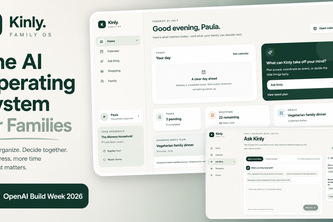
Kinly is an AI-powered family operating system that the author describes as turning everyday family conversations into coordinated plans, shared tasks, meals and schedules—while respecting each member’s time and privacy.
The project was built by a single developer (Paula López Anel) during a hackathon using Next.js, TypeScript, React, Supabase, PostgreSQL, Vercel, and OpenAI API. It includes an MVP with features such as AI-assisted family planning through natural language, shared calendars, task coordination, shopping lists, meal planning, and privacy-aware event handling.
The author states that Kinly interprets requests, asks follow-up questions when needed, and creates structured plans for review before confirmation. The system is designed to respect household members' time and preferences, and to avoid over-automation by requiring user confirmation.
Key commercial due-diligence open questions include:
- How does Kinly handle privacy and data governance at scale?
- What are the actual adoption or usage metrics (if any)?
- Is there a clear path to monetization beyond initial development?
Most important open question
Does Kinly have any evidence of real-world traction, customer feedback, or revenue generation? The description is entirely self-reported and lacks any verifiable data on users, customers, or business outcomes.
What The Product Actually Is
The description states that Kinly is an AI-powered family operating system. It allows families to coordinate everyday household activities using natural language input.
Key features described include:
- AI-assisted family planning through natural conversation
- Shared family calendars and availability
- Household task coordination
- Collaborative shopping lists
- Meal planning and recipes
- Family member profiles and household context
- Privacy-aware personal and shared events
- Review and confirmation flows before plans are added
The system uses natural language processing to interpret unstructured requests, identify participants, timing, tasks, meals, and shopping needs, and present a structured plan for user review.
It is built as a full-stack web application, using technologies such as:
- Frontend: Next.js, React, TypeScript, Tailwind CSS
- Backend: Supabase, PostgreSQL
- AI: OpenAI API (specifically GPT-5.6), Codex
The author notes that Kinly does not simply generate text responses but interprets requests, considers household context, and asks for clarification when needed.
Inference The product appears to be a prototype or MVP focused on family coordination workflows, with an emphasis on AI-driven planning and user control over automated actions.
Positioning & Claim Evolution
The author positions Kinly as:
- An AI-powered family operating system
- A tool that turns everyday family conversations into coordinated plans
- A system that respects each member’s time and privacy
It is described as addressing the problem of fragmented coordination tools (e.g., calendars, messaging apps, shopping lists) where the mental load of organizing information falls on one person.
The author also mentions future directions:
- Pet Care module
- Personal Health Intelligence integration with wearable devices like Apple Health or Ultrahuman Ring
These expansions suggest a vision for Kinly evolving into a comprehensive family management platform that integrates health, wellbeing, and household coordination.
Claim vs. Fact
The positioning is self-reported and claims to solve a common problem in family life. No evidence of market validation or customer feedback is provided.
Target Customer & ICP
The description states that Kinly targets families, particularly those coordinating everyday household activities such as:
- Scheduling
- Meal planning
- Task division
- Shopping lists
- Shared calendars and availability
It also mentions that the system respects each member’s time and privacy, implying a need for structured coordination among multiple individuals with varying schedules and preferences.
The author notes that Kinly is designed to understand different household roles and contexts, suggesting an ICP focused on:
- Multi-member households
- Families seeking centralized planning tools
- Users who value privacy in shared environments
There is no mention of specific demographics or personas beyond “families.” No evidence exists regarding segmentation or targeting strategies.
Inference The target customer is likely a multi-generational family unit, possibly with working parents, children, and/or elderly members, who seek centralized yet privacy-respecting coordination tools.
Business Model & Pricing Evidence
The description does not contain any information about:
- Revenue model
- Pricing strategy
- Monetization plans
- Customer acquisition costs
- Unit economics
It only describes the product’s functionality and technical architecture.
Inference There is no evidence of a defined business model or pricing structure. The project appears to be in early development, with no indication of commercial viability or monetization mechanisms.
Technical & Delivery Signals
The author reports building Kinly using:
- Frontend: Next.js, React, TypeScript, Tailwind CSS
- Backend: Supabase, PostgreSQL
- AI Integration: OpenAI API (specifically GPT-5.6), Codex
- Deployment: Vercel
Key technical decisions include:
- Using AI to interpret natural language requests and convert them into structured plans
- Implementing clarification flows when information is missing
- Designing review and confirmation steps before applying changes
- Balancing automation with user control
The author also mentions using Codex iteratively for development, including translating ideas into implementation plans, debugging, and refining logic.
Inference The technical stack suggests a modern, full-stack SaaS approach with AI integration. However, the lack of production data or scalability details limits confidence in delivery readiness.
Traction & Maturity Signals
The description states that Kinly was built during a hackathon (OpenAI 2026) and is currently an MVP.
It includes:
- A working prototype
- Functional AI planning workflows
- Integration with calendar, task, meal, and shopping features
- User review and confirmation flows
However, there is no evidence of:
- Real-world usage or adoption
- Customer feedback or testimonials
- Revenue or monetization
- Product-market fit validation
- Scaling beyond the MVP stage
Inference Kinly is at a very early stage—likely pre-product-market fit. No traction signals are evident.
Competitive Context
The description does not mention any competitors or direct market comparisons.
It implies that Kinly addresses a gap in fragmented family coordination tools, such as:
- Calendars
- Messaging apps
- Shopping lists
- Notes
However, no evidence is provided about existing solutions or how Kinly differentiates from them.
Inference The competitive landscape is unknown. Kinly may be entering an unoccupied space or competing with general-purpose productivity tools that lack family-specific features.
Open Questions & Risks
Several risks and open questions are present based on the self-reported description:
- Single-person development: The entire project was built by one individual, raising concerns about scalability, support, and long-term maintenance.
- No traction or revenue: No evidence of real users, customers, or monetization.
- Unverified AI behavior: While it uses GPT-5.6, no details on how accuracy, bias, or reliability are ensured in family contexts.
- Privacy concerns: The system handles personal and shared data; however, no clear governance or compliance framework is described.
- Vision vs. execution: The author outlines ambitious future modules (e.g., health, pet care), but there’s no indication of roadmap planning or resource allocation.
Inference This is a high-risk, early-stage idea with limited commercial viability or traction. It lacks the foundation for scalable growth or investment readiness.
Questions the description leaves open
- What specific privacy and data governance policies are in place to protect family information?
- Have you conducted any user testing or gathered feedback from families using the system?
- How do you plan to scale beyond a single developer, especially for future modules like health and pet care?
- Is there a clear path toward monetization or revenue generation?
- What are your plans for integrating with existing family tools (e.g., Apple Health, Google Calendar)?
- How does Kinly handle edge cases in natural language interpretation (e.g., ambiguous phrases like “we’re all going”)?
- Are you planning to build a team or seek additional funding beyond the hackathon phase?
Overall Assessment
The description presents Kinly as an early-stage prototype built during a hackathon, with no evidence of traction, revenue, or customer adoption.
While the concept is compelling and aligns with trends in AI-powered personalization and family coordination, there are no verifiable signals of commercial viability, product-market fit, or scalability.
The project is:
- Self-reported only
- Unverified
- At MVP stage
- Lacks any business model or monetization evidence
Assessment Not ready for investment or partnership. The idea has potential but requires significant development, user validation, and commercial execution before it can be considered a viable opportunity.
User Stories BotA demo video on every pull request
Get a demo video on every new feature
GitHub App that watches your pull requests and records a narrated, captioned demo.
Save time on demo prep and make informed decisions faster with a video walkthrough of every new feature.
Source
Submitted to the OpenAI 2026 hackathon on Devpost. Project home on Devpost. Back to the full gallery on Devpost.
This competitive analysis was produced by top-founders.com (opens in a new tab)
Generated by a language model from this project's public Devpost page — its tagline, the author's own write-up and any built-with tags listed there — as captured in August 2026. Short quotations are the author's words. It is an opinion on the idea as a business, not on the people behind it, and it reflects the description as published then. If the project has moved on, request a correction below. The analysis is not independent research and contains no verified traction, revenue or customer data.
An independent guide by KFG International LLC — not affiliated with, endorsed by, or connected to Devpost or OpenAI.