

Archive position — measured, not model output
2 likes on Devpost
221 of the 7,850 archived projects have more likes, and 284 share exactly 2 — so this project's #356 place in the like-ranked listing is a tie-break inside that group, not a ranking.
Projects (log scale)
Likes on Devpost. ▲ marks this project's group.
Show the figures
| Likes | Projects | Share of archive |
|---|---|---|
| 0 | 5,587 | 71.2% |
| 1 | 1,758 | 22.4% |
| 2 | 284 | 3.6% |
| 3–4 | 132 | 1.7% |
| 5–9 | 75 | 1.0% |
| 10+ | 14 | 0.2% |
 User Stories BotA demo video on every pull request
Get a demo video on every new feature
GitHub App that watches your pull requests and records a narrated, captioned demo.
Save time on demo prep and make informed decisions faster with a video walkthrough of every new feature.
Executive Summary
What the company appears to be
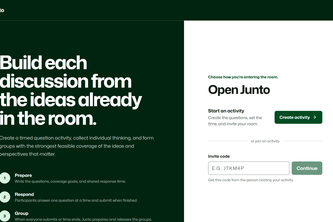
Junto is a room-based web application designed for instructors to form discussion groups from students’ submitted answers. It uses AI to analyze responses and apply constrained optimization to group students based on complementary knowledge, aiming to reduce instructor administrative burden while improving classroom discussions.
What changed
The project evolved from an initial focus on correct answers to a broader concept of “coverage units” — recognizing that in open-ended subjects, disagreement and diverse perspectives are valuable. It now separates language interpretation (via LLMs) from deterministic grouping (via CP-SAT optimizer), with the goal of making group formation both explainable and reliable.
The single most important open question
Is there a real market need for this tool among educators or institutions, and if so, what is the path to adoption and traction?
Note: This analysis is based entirely on the self-reported description provided by the author. No external verification, revenue data, customer base, or traction evidence is available.
What The Product Actually Is
The description states that Junto is a room-based web application for forming discussion groups from students’ submitted answers. It allows instructors to:
- Create an activity
- Upload reference material
- Define questions and ideas/perspectives worth covering
- Have students join via invite code and answer individually
- Close responses and let Junto analyze, group, and assign students into purposeful small groups
Key technical components include:
- Frontend: React, Vite, TypeScript
- Backend: FastAPI, PostgreSQL, Pydantic, OR-Tools CP-SAT
- AI integration: OpenAI API for interpreting responses into coverage units; structured output used by optimizer
- Optimization logic: Constrained optimization to maximize coverage across groups while respecting group size constraints
Inference: The product is built as a classroom tool, not a general-purpose collaboration platform. It is described as being useful in both objective and open-ended subjects.
Positioning & Claim Evolution
The description states that Junto was inspired by the idea of removing administrative burden from grouping while creating more fruitful discussions. Originally, it focused on correct answers but evolved to embrace coverage units, which represent concepts, reasoning steps, evidence, arguments, objections, or perspectives — not just right or wrong.
This shift reflects a change in positioning:
- Initial claim: Grouping based on correctness
- Current claim: Grouping based on complementary knowledge and discussion quality
The author notes that AI is used primarily as an interpreter (to identify ideas), while the optimizer ensures group consistency. This separation of concerns is presented as a key strength.
Claim vs Fact: The evolution in approach shows intent to refine product logic, but no evidence of prior usage or feedback from users is included.
Target Customer & ICP
The description identifies instructors as the primary users. These are likely educators working in academic settings where structured group discussions are common — such as university-level courses or high school classes.
Junto appears to target:
- Educators who want to improve student engagement through discussion groups
- Institutions looking for tools that reduce manual workload during live classes
There is no indication of specific segments beyond general education, nor any mention of K–12 vs higher ed focus.
Not evidenced: No explicit ICP or persona definition beyond “instructor.” No evidence of institutional adoption or pilot programs.
Business Model & Pricing Evidence
The description does not contain any information about pricing models, monetization strategies, or business model assumptions.
Not evidenced: No mention of revenue streams, subscription tiers, licensing, or commercial plans.
Technical & Delivery Signals
Key technical elements:
- Built with modern stack: React/Vite/TypeScript (frontend), FastAPI/Python (backend)
- Uses OR-Tools CP-SAT for optimization
- Integrates OpenAI API for semantic interpretation
- Structured validation via Pydantic and SQLAlchemy
- Simulated student profiles included for testing/demo purposes
The system separates:
- Language understanding (LLM-based)
- Group assignment logic (deterministic solver)
Inference: The architecture suggests a scalable, modular design that could support integration with LMS platforms or broader educational ecosystems.
Traction & Maturity Signals
There is no evidence of traction, customers, revenue, or usage metrics. The project was submitted to the OpenAI 2026 hackathon and includes simulated data for demonstration purposes.
Not evidenced: No real-world deployment, user feedback, or performance data beyond internal testing.
Competitive Context
The description does not reference existing competitors or similar tools in the space of classroom group formation or AI-assisted discussion facilitation. It is unclear whether there are comparable products in the market.
Not evidenced: No competitive landscape analysis or differentiation strategy described.
Open Questions & Risks
- Unproven market demand: No evidence of real-world usage or institutional interest.
- Limited scope of use case: Designed for classroom settings; unclear if it can scale beyond that.
- Dependency on AI quality: Reliance on structured LLM outputs introduces risk of misinterpretation or inconsistency.
- No commercial viability signal: No pricing, monetization, or go-to-market strategy described.
- Hackathon project: Likely early-stage prototype with no long-term development plan.
Inference: The tool may be technically sound but lacks commercial traction or institutional validation.
Questions the description leaves open
- What specific educational institutions or educators have expressed interest in using this tool?
- How does Junto handle cases where student responses are incomplete, vague, or contain errors?
- Are there any pilot programs or trials with actual instructors or students?
- What is the intended pricing model and target customer segment?
- How does Junto integrate with existing learning management systems (LMS)?
- What kind of performance benchmarks have been established for coverage accuracy and group quality?
- Has the team considered scalability beyond small classroom sizes?
Overall Assessment
There is no evidence that Junto has achieved product-market fit, traction, or commercial viability.
The project is described as a hackathon submission with simulated data and no real-world deployment. While it demonstrates technical capability in combining AI interpretation and optimization for group formation, there is no indication of:
- Real users
- Revenue
- Institutional adoption
- Scalable business model
Assessment: Not ready for investment or partnership at this stage. The idea has potential but requires further validation through real-world use cases and clear commercialization strategy.
User Stories BotA demo video on every pull request
Get a demo video on every new feature
GitHub App that watches your pull requests and records a narrated, captioned demo.
Save time on demo prep and make informed decisions faster with a video walkthrough of every new feature.
Source
Submitted to the OpenAI 2026 hackathon on Devpost. Project home on Devpost. Back to the full gallery on Devpost.
This competitive analysis was produced by top-founders.com (opens in a new tab)
Generated by a language model from this project's public Devpost page — its tagline, the author's own write-up and any built-with tags listed there — as captured in August 2026. Short quotations are the author's words. It is an opinion on the idea as a business, not on the people behind it, and it reflects the description as published then. If the project has moved on, request a correction below. The analysis is not independent research and contains no verified traction, revenue or customer data.
An independent guide by KFG International LLC — not affiliated with, endorsed by, or connected to Devpost or OpenAI.