

Archive position — measured, not model output
0 likes on Devpost
2,263 of the 7,850 archived projects have more likes, and 5,587 share exactly 0 — so this project's #4,282 place in the like-ranked listing is a tie-break inside that group, not a ranking.
Projects (log scale)
Likes on Devpost. ▲ marks this project's group.
Show the figures
| Likes | Projects | Share of archive |
|---|---|---|
| 0 | 5,587 | 71.2% |
| 1 | 1,758 | 22.4% |
| 2 | 284 | 3.6% |
| 3–4 | 132 | 1.7% |
| 5–9 | 75 | 1.0% |
| 10+ | 14 | 0.2% |
 User Stories BotA demo video on every pull request
Get a demo video on every new feature
GitHub App that watches your pull requests and records a narrated, captioned demo.
Save time on demo prep and make informed decisions faster with a video walkthrough of every new feature.
Executive Summary
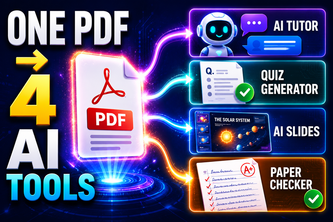
The description states that GenAI Smart Education Platform is an AI-powered tool designed to transform educational PDFs into interactive learning and teaching assets such as tutoring, quizzes, slide decks, and assessment reports. The author describes a modular backend built with FastAPI and LangGraph workflows, using tools like Chroma, Docling, and OpenAI for document processing and retrieval-augmented generation (RAG). The platform distinguishes itself by offering distinct student and instructor tools, including a document assistant, quiz generator, slides generator, paper checker, and RAGAS evaluation. It claims to support multiple question types (theoretical, numerical, programming) and integrates structured document parsing with LLM-based processing.
The author notes that the project was built for the OpenAI 2026 hackathon and includes no evidence of revenue, customers, or traction beyond its own description. The system is described as a prototype with challenges around memory management, page alignment, handwriting recognition, and persistence. No external validation or market data is provided.
The single most important open question
Is there any evidence that this platform has been used by students or instructors in real-world settings, or whether it has achieved any adoption or feedback from users beyond the developer's own account?
What The Product Actually Is
The description states that GenAI Smart Education Platform is an AI-powered system that processes educational PDFs and generates various learning and teaching materials. It includes:
- A document assistant that answers theoretical, numerical, and programming questions using indexed textbook content.
- A quiz generator that extracts topics from a book’s table of contents and creates downloadable question and answer papers.
- A slides generator that produces grounded presentation drafts, which can be reviewed and exported as PowerPoint files.
- A paper checker that reads solved papers and marking schemes, proposes marks for short-answer questions, supports human review, and generates a final PDF report.
- A RAGAS evaluation tool to measure retrieval and answer quality.
The system is built using FastAPI, LangGraph, Chroma, Docling, OpenAI, and other technologies. It uses document ingestion via Docling to parse text-based PDFs into Markdown, chunks them with hybrid chunking, embeds them with OpenAI embeddings, and stores them in Chroma for retrieval.
Inference The platform appears to be a prototype built for a hackathon, not yet deployed in production or used by end users.
Positioning & Claim Evolution
The description states that the platform was inspired by a need for interactive tools in education, where static materials like textbooks and lecture notes are common but lack interactivity. It aims to help students get immediate, contextual help and instructors save time preparing quizzes, presentations, and assessment reports.
It positions itself as an AI-powered platform that goes beyond summarization to create practical workflows grounded in uploaded educational content.
Inference The positioning is centered on solving inefficiencies in traditional education workflows through automation. However, the claim of being a "platform" implies broader functionality than what’s described — it's unclear if this is a single product or a suite of tools built on shared infrastructure.
Target Customer & ICP
The description states that the platform targets students and instructors, offering separate tool areas for each group. For students, it provides a document assistant to answer questions based on textbook content. For instructors, it offers quiz generation, slide creation, and paper checking capabilities.
There is no indication of specific customer segments beyond these two roles (student/instructor), nor any evidence of segmentation by educational level or institution type.
Inference The ICP appears to be educators and learners using printed or digital textbooks in academic settings. No further targeting or persona development is evident.
Business Model & Pricing Evidence
The description does not provide any information about pricing, monetization strategies, or business model assumptions. It only describes the technical architecture and functionality of the platform.
Not evidenced
Technical & Delivery Signals
The system is built with:
- Backend: FastAPI, LangGraph, Python
- Document ingestion: Docling (for parsing PDFs into Markdown), Chroma for vector storage
- LLM integration: OpenAI models
- Frontend: React, Vite, Axios
- Tools used: Langchain, Pydantic, python-pptx, ReportLab, uvicorn
It uses hybrid chunking to preserve document structure, redacts PII, classifies query types (theoretical vs numerical/programming), and applies reranking for retrieval quality.
Inference The technical stack suggests a modern, modular approach using RAG and LLMs. However, the system is described as a prototype with memory and persistence limitations — e.g., chat history stored in process memory, not persisted.
Traction & Maturity Signals
The description states that this project was submitted to the OpenAI 2026 hackathon and includes no evidence of revenue, customer acquisition, or usage metrics beyond its own account. It also notes several challenges faced during development, such as:
- Memory management issues
- Page alignment problems
- Handwriting recognition limitations
- Lack of persistent storage for user sessions or generated assets
There is no mention of user testing, feedback loops, or product-market fit validation.
Not evidenced
Competitive Context
The description does not provide any information about competitors or the broader competitive landscape. It does not reference existing tools in the educational AI space, nor does it describe how this platform differentiates from them.
Not evidenced
Open Questions & Risks
- Prototype nature: The system is described as a hackathon project with no evidence of production use or user feedback.
- Limited persistence and scalability: Chat history and generated assets are stored in memory, not persisted.
- Technical complexity without real-world validation: Challenges like page alignment, handwriting recognition, and context limits suggest potential issues scaling to real-world usage.
- No pricing or monetization strategy: The platform lacks any indication of how it would be monetized or whether it’s intended for commercial deployment.
- Single developer team: The project is built by one person (Muhammad Bilal), which raises questions about long-term maintenance and scalability.
Inference This is a proof-of-concept with no demonstrated traction, market validation, or business model. It may be suitable for experimentation but not for investment or partnership without further evidence of viability.
Questions the description leaves open
- What specific educational institutions or users have tested this platform? Have there been any user interviews or feedback sessions?
- How does the system handle privacy and data security, especially when processing sensitive student information?
- Are there plans to integrate with existing LMS platforms (e.g., Canvas, Moodle)?
- What is the expected path from prototype to commercial product? Is there a roadmap for scaling beyond the current architecture?
- Has the team considered how to monetize this platform, and what pricing model they might adopt?
- How does the system manage large documents or multiple books in one session without exceeding context limits?
Overall Assessment
The description states that GenAI Smart Education Platform is a hackathon project built by one developer. It includes no evidence of revenue, customers, or traction beyond its own self-reporting.
Assessment Not evidenced as a viable investment or partnership opportunity at this stage. The platform shows technical capability and potential use cases but lacks commercial validation, scalability planning, or any indication of real-world adoption.
The author states that the system is a prototype with known limitations in persistence, memory management, and handling complex workflows — all of which are critical for a product intended for educational institutions or learners.
Confidence level Low. The entire analysis is based on self-reported information with no external corroboration or evidence of traction.
User Stories BotA demo video on every pull request
Get a demo video on every new feature
GitHub App that watches your pull requests and records a narrated, captioned demo.
Save time on demo prep and make informed decisions faster with a video walkthrough of every new feature.
Source
Submitted to the OpenAI 2026 hackathon on Devpost. Project home on Devpost. Back to the full gallery on Devpost.
This competitive analysis was produced by top-founders.com (opens in a new tab)
Generated by a language model from this project's public Devpost page — its tagline, the author's own write-up and any built-with tags listed there — as captured in August 2026. Short quotations are the author's words. It is an opinion on the idea as a business, not on the people behind it, and it reflects the description as published then. If the project has moved on, request a correction below. The analysis is not independent research and contains no verified traction, revenue or customer data.
An independent guide by KFG International LLC — not affiliated with, endorsed by, or connected to Devpost or OpenAI.