

Archive position — measured, not model output
0 likes on Devpost
2,263 of the 7,850 archived projects have more likes, and 5,587 share exactly 0 — so this project's #6,245 place in the like-ranked listing is a tie-break inside that group, not a ranking.
Projects (log scale)
Likes on Devpost. ▲ marks this project's group.
Show the figures
| Likes | Projects | Share of archive |
|---|---|---|
| 0 | 5,587 | 71.2% |
| 1 | 1,758 | 22.4% |
| 2 | 284 | 3.6% |
| 3–4 | 132 | 1.7% |
| 5–9 | 75 | 1.0% |
| 10+ | 14 | 0.2% |
 User Stories BotA demo video on every pull request
Get a demo video on every new feature
GitHub App that watches your pull requests and records a narrated, captioned demo.
Save time on demo prep and make informed decisions faster with a video walkthrough of every new feature.
Executive Summary
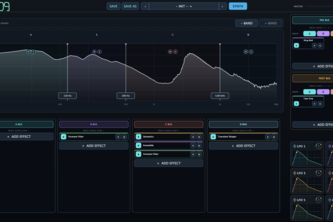
Ratio9 is a self-reported FM synthesizer built by one developer (Max Voorhesse) using C++ and the JUCE framework, with AI assistance from OpenAI's Codex. The project was submitted to the OpenAI 2026 hackathon. It claims to offer an intuitive, visual FM synthesis workflow while maintaining power for advanced sound design.
The author states that Ratio9 is designed to make FM synthesis approachable without sacrificing depth, and includes features like variable envelopes, visual modulation, multiband effects, and a performance-focused interface. The description indicates the use of AI in development but does not provide evidence of revenue, customers, or adoption.
Key open question
Is there any evidence that Ratio9 has achieved traction or user feedback beyond the author’s own account?
What The Product Actually Is
The description states that Ratio9 is a modern FM synthesizer. It is described as:
- Designed to make advanced sound design approachable without sacrificing power.
- Built in C++ using the JUCE framework for cross-platform VST3 and AU support.
- Includes features such as:
- Variable Envelopes
- Visual FM workflow
- Multiband Effects
- Performance-focused interface
The author notes that AI (specifically Codex) was used during development to assist with architecture, DSP implementation, debugging, UI development, and solving engineering problems.
Inference The product is a plugin-based synthesizer intended for use in digital audio workstations (DAWs), targeting electronic music producers or sound designers.
Positioning & Claim Evolution
The author states that Ratio9 aims to make FM synthesis visual, intuitive, and fun, while preserving its power. It positions itself as an instrument that helps users spend less time navigating menus and more time creating sounds.
Key claims include:
- Keeps the depth of traditional FM synthesizers.
- Makes FM synthesis approachable without sacrificing complexity.
- Uses a visual workflow to simplify complex routing.
- Focuses on experimentation and fast sound design.
There is no indication of prior versions or evolution in positioning beyond this single self-reported description.
Inference The product is positioned as an entry-level to mid-level FM synthesizer aimed at producers who want access to advanced sound design but lack experience with traditional FM tools.
Target Customer & ICP
The author states that Ratio9 is intended for producers who want to experiment and create sounds quickly, especially those interested in FM synthesis. It is described as being built for "performance-focused" use, suggesting it targets users who value speed and ease of use in their creative process.
There is no mention of specific customer segments or personas beyond general electronic music producers or sound designers.
Inference The target customer appears to be independent or semi-professional electronic musicians or sound designers working with DAWs, though the description does not confirm actual users or market segmentation.
Business Model & Pricing Evidence
The description provides no evidence of pricing, revenue streams, or business model. It does not state whether Ratio9 will be sold as a paid plugin, offered for free, or monetized through other means.
There is no mention of licensing, subscriptions, or any commercial structure beyond the author’s own development efforts.
Inference No business model or pricing information is evidenced; it remains unknown how the product would be monetized if released to market.
Technical & Delivery Signals
The project was built using:
- Language: C++
- Framework: JUCE
- Platforms: VST3 and AU (cross-platform support)
- Development tools: AI assistance from OpenAI’s Codex
Notable technical elements mentioned include:
- Variable envelopes
- Multiband effects engine
- Modulation system designed to be both powerful and intuitive
- UI built for experimentation and fast sound design
The author notes that AI helped with architecture, DSP implementation, debugging, refactoring, UI development, and solving difficult engineering problems.
Inference The technical stack suggests a high-performance plugin with modern UI design and integration of AI in development. However, no evidence of delivery or release exists beyond the project submission.
Traction & Maturity Signals
There is no evidence of traction, customers, revenue, or user feedback beyond the author’s own account. The project was submitted to a hackathon and has not been released publicly.
The author mentions:
- Planned improvements (more modulation sources, effects, presets)
- Continued UI refinement based on user feedback
- Long-term goal of making Ratio9 one of the most intuitive FM synthesizers available
But there is no indication that users have interacted with it or provided input beyond the author’s own vision.
Inference No traction signals are evident; the product remains in early-stage development or prototype form.
Competitive Context
The description does not provide information about competitors or market positioning relative to existing FM synthesizers. It does not name other tools, platforms, or products that might compete with Ratio9.
There is no discussion of how Ratio9 compares technically or functionally to existing solutions in the marketplace.
Inference No competitive context is provided; it is unclear whether Ratio9 addresses a gap or overlaps with existing offerings.
Open Questions & Risks
Key risks and open questions based on the self-reported description:
- Single developer: The entire project was built by one person (Max Voorhesse), which raises concerns about scalability, maintenance, and long-term support.
- No commercial traction: No evidence of users, revenue, or adoption beyond the author’s own claims.
- Unverified claims: All features and functionality are self-reported; no independent verification exists.
- AI dependency: Heavy reliance on AI for development may raise questions about code quality, ownership, and reproducibility.
- Limited scope: The project is described as a prototype or early-stage tool with future enhancements planned.
Inference The lack of external validation, user feedback, or commercial activity raises significant uncertainty around viability and potential success in the market.
Questions the description leaves open
- What specific problems have you encountered in implementing the modulation system?
- How do you plan to validate that the visual workflow improves usability over traditional FM interfaces?
- Have you tested Ratio9 with actual users or producers? If so, what feedback did you receive?
- What is your long-term roadmap for monetization and product development?
- Can you describe how the AI-assisted development process affected code quality and maintainability?
- How do you intend to distribute and market Ratio9 once it’s ready for release?
Overall Assessment
There is no evidence of revenue, customers, or traction beyond the author's own description. The project appears to be a prototype developed during a hackathon, with no indication of commercialization or user engagement.
Given the lack of verified data and the single-developer nature of the project, any investment or partnership decision would be highly speculative at this stage.
Inference The current state of Ratio9 is that of an unproven concept. Without further evidence of traction, market fit, or product-market alignment, it is not suitable for commercial due diligence or investment consideration.
User Stories BotA demo video on every pull request
Get a demo video on every new feature
GitHub App that watches your pull requests and records a narrated, captioned demo.
Save time on demo prep and make informed decisions faster with a video walkthrough of every new feature.
Source
Submitted to the OpenAI 2026 hackathon on Devpost. Project home on Devpost. Back to the full gallery on Devpost.
This competitive analysis was produced by top-founders.com (opens in a new tab)
Generated by a language model from this project's public Devpost page — its tagline, the author's own write-up and any built-with tags listed there — as captured in August 2026. Short quotations are the author's words. It is an opinion on the idea as a business, not on the people behind it, and it reflects the description as published then. If the project has moved on, request a correction below. The analysis is not independent research and contains no verified traction, revenue or customer data.
An independent guide by KFG International LLC — not affiliated with, endorsed by, or connected to Devpost or OpenAI.