

Archive position — measured, not model output
0 likes on Devpost
2,263 of the 7,850 archived projects have more likes, and 5,587 share exactly 0 — so this project's #2,315 place in the like-ranked listing is a tie-break inside that group, not a ranking.
Projects (log scale)
Likes on Devpost. ▲ marks this project's group.
Show the figures
| Likes | Projects | Share of archive |
|---|---|---|
| 0 | 5,587 | 71.2% |
| 1 | 1,758 | 22.4% |
| 2 | 284 | 3.6% |
| 3–4 | 132 | 1.7% |
| 5–9 | 75 | 1.0% |
| 10+ | 14 | 0.2% |
 User Stories BotA demo video on every pull request
Get a demo video on every new feature
GitHub App that watches your pull requests and records a narrated, captioned demo.
Save time on demo prep and make informed decisions faster with a video walkthrough of every new feature.
Executive Summary
What the company appears to be
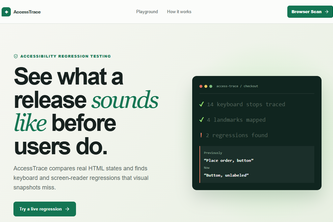
AccessTrace is a developer tool designed to detect accessibility regressions in web applications before release. It compares a known-good baseline with a candidate version and identifies newly introduced issues related to keyboard navigation, screen reader support, and other accessibility concerns. The tool supports both static HTML comparison (Playground) and live browser scanning (Browser Scan), with an emphasis on safe, deterministic fixes.
What changed
The project was submitted as part of the OpenAI 2026 hackathon. It is described as a self-contained prototype built using Next.js, React, TypeScript, Playwright, and Codex. The author states that it includes three core features: finding regressions, suggesting safe fixes, and scanning live websites.
Single most important open question
Is there evidence of any real-world usage or traction beyond the hackathon submission? The description provides no data on adoption, revenue, customer feedback, or product-market fit beyond its own claims.
What The Product Actually Is
The description states that AccessTrace:
- Compares a known-good baseline with a changed candidate version.
- Identifies newly introduced accessibility regressions.
- Offers two main modes: Playground (for local HTML) and Browser Scan (for live URLs).
- Provides “apply patches” functionality for safe fixes.
- Uses Chromium to simulate real keyboard navigation and tab traversal.
- Leverages Codex for code generation and remediation.
Inference It appears to be a developer-focused accessibility testing tool that integrates into workflows by identifying issues during development or pre-release phases.
Positioning & Claim Evolution
The description states:
- The tool aims to make accessibility failures visible before they reach real users.
- It focuses on keyboard and screen-reader journeys, not just visual checks.
- It provides actionable fixes rather than generic warnings.
- It was built with a focus on transparency about limitations and prioritizing trustworthy over broad suggestions.
Inference The positioning is that of an automated accessibility regression detection tool for developers, emphasizing safety and accuracy in fix generation. The evolution seems to be from basic checking to full workflow integration (finding, fixing, verifying).
Target Customer & ICP
The description states:
- The primary users are developers working on web applications.
- It targets teams looking to prevent accessibility regressions during product updates.
Inference The ideal customer profile likely includes frontend developers or QA engineers in software development teams who care about inclusive design and want to automate parts of their accessibility testing process.
Business Model & Pricing Evidence
Not evidenced.
The description does not mention any pricing model, monetization strategy, or business model. There is no indication of whether this will be offered as a SaaS product, open-source tool, or other format.
Technical & Delivery Signals
The description states:
- Built with Next.js, React, TypeScript, Playwright, and Codex.
- Uses Chromium for real browser behavior simulation.
- Implements static HTML parsing in Playground mode.
- Supports live URL scanning via rendered browser environments.
- Focuses on deterministic fixes to avoid misleading results.
Inference The technical stack suggests a modern web application with backend logic for accessibility analysis. The use of Playwright and Chromium indicates attention to realistic user interaction simulation. Use of Codex implies AI-assisted code generation capabilities.
Traction & Maturity Signals
Not evidenced.
There is no mention of:
- Customers or users.
- Revenue or funding rounds.
- Product adoption metrics.
- Market traction beyond the hackathon submission.
- Any form of product maturity beyond prototype status.
Competitive Context
Not evidenced.
The description does not reference existing tools in the accessibility testing space, nor does it compare AccessTrace to competitors. No competitive positioning or differentiation is stated.
Open Questions & Risks
Risk 1
No evidence of real-world usage or product-market fit beyond a hackathon prototype.
Risk 2
The tool relies heavily on Codex for remediation, which may limit scalability or reliability if not fully controlled or auditable.
Risk 3
Limited scope in current features (only deterministic fixes, no CI integration yet) suggests early-stage development and potential lack of enterprise readiness.
Open Question
No mention of any commercialization plan, team size beyond one person, or roadmap beyond hackathon goals indicates a high risk of limited execution capability.
Questions the description leaves open
- What is the current stage of development beyond the hackathon? Is there a working prototype or alpha version?
- Have you tested AccessTrace with real-world web applications or teams?
- How do you plan to scale beyond deterministic fixes and integrate into CI/CD pipelines?
- Are there any partnerships or early adopters in the developer tooling or accessibility space?
- What is your long-term vision for monetization or product positioning?
Overall Assessment
Not evidenced.
There is no evidence of:
- Revenue, ARR, or funding.
- Customer traction or market validation.
- Product-market fit.
- Team experience or track record.
- Any commercial viability beyond the hackathon submission.
Confidence Level Low. This is a self-reported prototype with no external validation or traction data. The tool shows promise in addressing a known problem but lacks evidence of real-world utility, adoption, or business model.
User Stories BotA demo video on every pull request
Get a demo video on every new feature
GitHub App that watches your pull requests and records a narrated, captioned demo.
Save time on demo prep and make informed decisions faster with a video walkthrough of every new feature.
Source
Submitted to the OpenAI 2026 hackathon on Devpost. Project home on Devpost. Back to the full gallery on Devpost.
This competitive analysis was produced by top-founders.com (opens in a new tab)
Generated by a language model from this project's public Devpost page — its tagline, the author's own write-up and any built-with tags listed there — as captured in August 2026. Short quotations are the author's words. It is an opinion on the idea as a business, not on the people behind it, and it reflects the description as published then. If the project has moved on, request a correction below. The analysis is not independent research and contains no verified traction, revenue or customer data.
An independent guide by KFG International LLC — not affiliated with, endorsed by, or connected to Devpost or OpenAI.