

Archive position — measured, not model output
0 likes on Devpost
2,263 of the 7,850 archived projects have more likes, and 5,587 share exactly 0 — so this project's #6,240 place in the like-ranked listing is a tie-break inside that group, not a ranking.
Projects (log scale)
Likes on Devpost. ▲ marks this project's group.
Show the figures
| Likes | Projects | Share of archive |
|---|---|---|
| 0 | 5,587 | 71.2% |
| 1 | 1,758 | 22.4% |
| 2 | 284 | 3.6% |
| 3–4 | 132 | 1.7% |
| 5–9 | 75 | 1.0% |
| 10+ | 14 | 0.2% |
 User Stories BotA demo video on every pull request
Get a demo video on every new feature
GitHub App that watches your pull requests and records a narrated, captioned demo.
Save time on demo prep and make informed decisions faster with a video walkthrough of every new feature.
Executive Summary
What the company appears to be
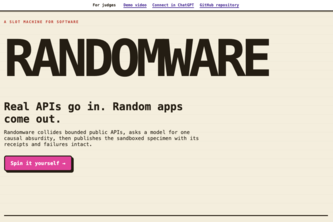
Randomware is a self-reported software invention engine that uses GPT-5.6 to generate unique, single-page applications by combining 2–3 real public APIs and a visual style cartridge. It operates as a "slot machine for software" where each spin produces a novel app concept, which is then executed in a sandboxed environment with strict access controls.
What changed
The project description does not indicate any prior version or evolution; it appears to be a one-off submission to the OpenAI 2026 hackathon. There is no evidence of prior development, product iteration, or commercial activity beyond this single build.
Single most important open question
Is there any evidence that Randomware has achieved meaningful traction, revenue, or customer adoption — either in its current form or as a prototype for future commercialization?
What The Product Actually Is
The description states that Randomware is a slot machine for software, where:
- A spin selects 2–3 real public APIs from a registry.
- One of eight visual style cartridges is applied.
- GPT-5.6 invents a structured concept and generates a complete single-page app.
- The app runs in an opaque sandboxed iframe with strict access controls.
- Failed specimens receive "honest death certificates" that explain the cause.
Inference The product is built to generate novel, non-template-based software concepts using AI and public APIs. It enforces constraints on execution via a broker and static validator.
Positioning & Claim Evolution
The author claims:
- Randomware is inspired by the Japanese band Omoide Hatoba ("Memory Wharf"), which collides unrelated signals to produce something unplanned.
- The creative bet is that this approach answers "AI slop" by optimizing for implausible, singular existence rather than plausible usefulness.
- Hallucination becomes the point, but it must be grounded in working software with receipts.
Inference The positioning is experimental and anti-template. It positions itself as a tool for generating unique, non-commercial inventions — not a product for building real business applications.
Target Customer & ICP
Not evidenced.
The description does not define:
- Who uses Randomware.
- What problem it solves for users.
- Whether there are any target personas or customer segments.
Absence of evidence
No indication of a defined customer base, user type, or use case beyond the author’s own experimentation.
Business Model & Pricing Evidence
Not evidenced.
The description does not contain:
- Any information about pricing.
- Revenue streams.
- Monetization strategy.
- Whether Randomware is intended for sale or distribution.
Absence of evidence
No business model or pricing data are provided. The project appears to be a hackathon submission with no commercial intent.
Technical & Delivery Signals
The description states:
- Built using: apps-sdk, chatgpt, cloudflare-d1, cloudflare-workers, codex, gpt-5.6, javascript, mcp, node.js, openai, rest-api, web-audio.
- Budget: $100, honestly metered.
- No owner API keys at runtime; all generation runs in the player's own ChatGPT session.
- Server-side broker blocks unauthorized network access via static validator.
- Source code and logs are inspectable on every specimen page.
Inference The technical stack is minimal, hackathon-grade, and relies heavily on AI tooling (ChatGPT Plus, GPT-5.6) and Cloudflare infrastructure. It enforces sandboxing and data integrity through a broker and validator.
Traction & Maturity Signals
Not evidenced.
The description does not include:
- Any metrics or usage data.
- Evidence of customers or users.
- Signs of product adoption or iteration.
- Indicators of commercial viability or growth.
Absence of evidence
There is no evidence of traction, revenue, or user engagement beyond the author’s own testing and submission.
Competitive Context
Not evidenced.
The description does not mention:
- Competitors in the space.
- Similar tools or platforms.
- Market positioning relative to others.
Absence of evidence
No competitive landscape or market context is provided.
Open Questions & Risks
Inference
- Unproven commercial viability: The project is a hackathon submission with no evidence of traction, revenue, or customer demand.
- High dependency on AI hallucination: The core value proposition relies on GPT-5.6 generating novel ideas — which may not scale or be reliable for real-world use.
- Limited execution environment: The product only works within a specific sandboxed runtime and is tied to ChatGPT sessions, limiting its accessibility or utility.
- No monetization path: No evidence of how Randomware would generate revenue or sustain itself.
Questions the description leaves open
- What is the intended use case for Randomware beyond the hackathon?
- Is there any plan to commercialize this concept, and if so, what does that look like?
- How would you scale this beyond a single developer’s runtime environment?
- Are there any technical or legal risks associated with using public APIs in this way?
- What is the long-term vision for Randomware — is it a tool for creativity or a product for developers?
Overall Assessment
Not evidenced.
The description does not provide:
- Any indication of funding, valuation, or investor interest.
- Evidence of a scalable business model.
- Signs of strategic partnerships or market traction.
Absence of evidence
No basis to assess whether Randomware is a viable investment or partnership opportunity. It appears to be an experimental prototype with no demonstrated commercial potential.
User Stories BotA demo video on every pull request
Get a demo video on every new feature
GitHub App that watches your pull requests and records a narrated, captioned demo.
Save time on demo prep and make informed decisions faster with a video walkthrough of every new feature.
Source
Submitted to the OpenAI 2026 hackathon on Devpost. Project home on Devpost. Back to the full gallery on Devpost.
This competitive analysis was produced by top-founders.com (opens in a new tab)
Generated by a language model from this project's public Devpost page — its tagline, the author's own write-up and any built-with tags listed there — as captured in August 2026. Short quotations are the author's words. It is an opinion on the idea as a business, not on the people behind it, and it reflects the description as published then. If the project has moved on, request a correction below. The analysis is not independent research and contains no verified traction, revenue or customer data.
An independent guide by KFG International LLC — not affiliated with, endorsed by, or connected to Devpost or OpenAI.