

Archive position — measured, not model output
1 like on Devpost
505 of the 7,850 archived projects have more likes, and 1,758 share exactly 1 — so this project's #1,767 place in the like-ranked listing is a tie-break inside that group, not a ranking.
Projects (log scale)
Likes on Devpost. ▲ marks this project's group.
Show the figures
| Likes | Projects | Share of archive |
|---|---|---|
| 0 | 5,587 | 71.2% |
| 1 | 1,758 | 22.4% |
| 2 | 284 | 3.6% |
| 3–4 | 132 | 1.7% |
| 5–9 | 75 | 1.0% |
| 10+ | 14 | 0.2% |
 User Stories BotA demo video on every pull request
Get a demo video on every new feature
GitHub App that watches your pull requests and records a narrated, captioned demo.
Save time on demo prep and make informed decisions faster with a video walkthrough of every new feature.
Executive Summary
What the company appears to be: A single-person project (Alex Pate) developing a native Windows C++ application for radio control car racing telemetry analysis. The tool captures and synchronizes data from multiple devices (RaceBox, VBOX/VBO, Sanwa) to enable lap comparison, performance review, and time-gain/loss analysis.
What changed: The project evolved from a JavaScript/React browser prototype to a native Windows C++ application using DirectX 11 and Dear ImGui. This transition was driven by performance needs—specifically, the inability of the browser version to handle large telemetry sessions efficiently.
Single most important open question: Is there evidence of real-world adoption or traction from racers? The description states no revenue, customers, or usage data beyond the author's own experience and testing.
Analysis basis: This is a self-reported, unverified account from the project author. No third-party corroboration exists for any claims made.
What The Product Actually Is
The description states that RaceBox Telemetry Viewer is:
- A native Windows C++ application built with C++20, DirectX 11, Dear ImGui, and ImPlot
- Designed to capture RaceBox Micro telemetry
- Capable of combining GPS, VBOX/VBO, and Sanwa radio data into synchronized views
- Used for reviewing laps, comparing performance, and discovering time gains/losses
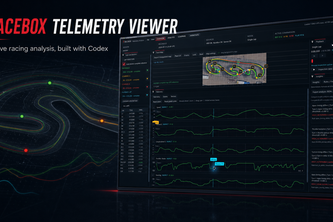
- Able to replay position on calibrated aerial maps, examine speed, G-force, altitude, throttle, brake, and steering
- Features corner event detection (braking, turn-in, apex, throttle pickup, full throttle, steering corrections)
- Provides timing calculations, line deviation analysis, and time gained/lost metrics
- Supports three-lap synchronized comparison, editable corners, sector definitions, annotations, and persistent workspaces
The application is described as a lightweight tool that runs locally without internet or browser dependencies.
Positioning & Claim Evolution
The author states:
- The tool was built to address limitations in existing telemetry tools, which "showed data without clearly explaining where time was gained or lost"
- It combines practical racing knowledge with accurate telemetry analysis
- The goal is to provide deterministic driver insights rather than just visualizations
- The project evolved from a browser prototype to a native C++ application, driven by performance needs
The positioning appears to be:
- A specialized tool for RC car racers who want detailed, synchronized telemetry analysis
- Positioned as an improvement over existing tools that lack clear time-gain/loss explanations
- Not described as a commercial product or platform; rather, it's framed as a personal project with potential for broader use
Inference: The author claims to have transitioned from a non-software background into building a functional native application using AI assistance (OpenAI Codex), suggesting an evolution from idea to implementation.
Target Customer & ICP
The description states:
- The tool is intended for racers who want to review laps, compare performance, and discover where they gain or lose time
- It supports radio control car racing, specifically with devices like RaceBox, VBOX/VBO, and Sanwa
- The author has experience as an RC mechanic, business owner, and driver
Inference: The primary customer is likely amateur or semi-professional RC racers who use these specific telemetry devices and want detailed performance analysis. However, no evidence of actual users or customer segments beyond the author's own experience.
Business Model & Pricing Evidence
Not evidenced.
The description does not mention:
- Any pricing model
- Revenue streams
- Commercial partnerships
- Subscription plans or licensing fees
- Target market monetization strategy
No indication that this is a commercial product or service offering.
Technical & Delivery Signals
The description states:
- Built with C++20, DirectX 11, Dear ImGui, ImPlot
- Transitioned from JavaScript/React browser app to native C++ application
- Supports synchronized telemetry from multiple devices (RaceBox, VBOX/VBO, Sanwa)
- Handles large telemetry sessions efficiently
- Uses automated tests covering parsing, timing, calibration, persistence, analysis rules, graph ordering, DirectX fallback, and memory behavior
- Includes seven automated native test targets
Inference: The technical approach shows a deliberate shift toward performance optimization. The use of native code, DirectX, and Dear ImGui suggests attention to responsiveness and low-level control.
Traction & Maturity Signals
Not evidenced.
The description does not contain:
- Any mention of users or customers
- Revenue data
- Adoption metrics
- Product usage statistics
- Market traction indicators
The project is described as a single-person effort with no external validation or user feedback beyond the author’s own testing and experience.
Competitive Context
Not evidenced.
The description does not:
- Name competitors
- Describe competitive advantages
- Mention market positioning relative to other telemetry tools
- Provide context on existing solutions in the RC racing telemetry space
No evidence of a competitive landscape is provided.
Open Questions & Risks
Inference: Based on the self-reported nature of the description and lack of external validation:
- No traction or adoption: The project appears to be a personal endeavor with no evidence of real-world usage.
- Single-person operation: With only one team member (Alex Pate), scalability and long-term maintenance are uncertain.
- Unverified claims: All features, performance, and functionality are self-reported without independent verification.
- Limited commercial viability: No indication of monetization or business model beyond the author’s own use case.
- AI dependency: The project relies heavily on AI assistance (Codex) for development, which may raise questions about sustainability if that tooling changes.
Questions the description leaves open
- What specific telemetry data sources do you currently support, and how many users are actively using them?
- How does the synchronization of data from different devices work in practice? Can you demonstrate this with examples?
- Have you received feedback from actual racers or teams who use the tool?
- Is there a plan to expand beyond the current set of supported telemetry formats (RaceBox, VBOX/VBO, Sanwa)?
- What is your roadmap for monetization or commercialization?
- How do you ensure accuracy and reliability in corner timing and analysis when dealing with real-world variations in data quality?
- What are the limitations of the current version that prevent broader adoption?
Overall Assessment
Not evidenced.
The description provides no information about:
- Financials
- Valuation
- Funding history
- Strategic partners or investors
- Commercial potential or market opportunity
This is a self-reported personal project with no evidence of traction, revenue, or commercial viability. It appears to be an experimental tool developed by one individual for personal use and possibly future expansion.
The author describes the tool as functional but does not indicate any business model, customer base, or monetization strategy. The lack of external validation makes it difficult to assess its potential value for investment or partnership.
User Stories BotA demo video on every pull request
Get a demo video on every new feature
GitHub App that watches your pull requests and records a narrated, captioned demo.
Save time on demo prep and make informed decisions faster with a video walkthrough of every new feature.
Source
Submitted to the OpenAI 2026 hackathon on Devpost. Project home on Devpost. Back to the full gallery on Devpost.
This competitive analysis was produced by top-founders.com (opens in a new tab)
Generated by a language model from this project's public Devpost page — its tagline, the author's own write-up and any built-with tags listed there — as captured in August 2026. Short quotations are the author's words. It is an opinion on the idea as a business, not on the people behind it, and it reflects the description as published then. If the project has moved on, request a correction below. The analysis is not independent research and contains no verified traction, revenue or customer data.
An independent guide by KFG International LLC — not affiliated with, endorsed by, or connected to Devpost or OpenAI.