

Archive position — measured, not model output
1 like on Devpost
505 of the 7,850 archived projects have more likes, and 1,758 share exactly 1 — so this project's #1,768 place in the like-ranked listing is a tie-break inside that group, not a ranking.
Projects (log scale)
Likes on Devpost. ▲ marks this project's group.
Show the figures
| Likes | Projects | Share of archive |
|---|---|---|
| 0 | 5,587 | 71.2% |
| 1 | 1,758 | 22.4% |
| 2 | 284 | 3.6% |
| 3–4 | 132 | 1.7% |
| 5–9 | 75 | 1.0% |
| 10+ | 14 | 0.2% |
 User Stories BotA demo video on every pull request
Get a demo video on every new feature
GitHub App that watches your pull requests and records a narrated, captioned demo.
Save time on demo prep and make informed decisions faster with a video walkthrough of every new feature.
Executive Summary
What the company appears to be
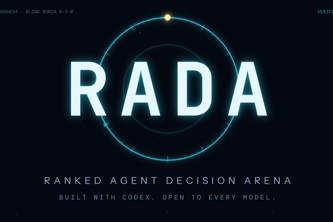
RADA — Ranked Agent Decision Arena — is a self-reported local, vendor-neutral control plane for AI coding agents. The author states it enables multiple AI models to compete anonymously on task execution plans, using blind voting and deterministic verification to determine the best approach. It is built with Python standard library and includes a CLI, browser interface, and mock mode.
What changed
The project was developed during a hackathon (OpenAI 2026) and is described as a proof-of-concept for orchestrating AI agents in a structured, auditable way. It introduces a new workflow where models bid, vote, execute, and review without direct human intervention, aiming to avoid vendor bias and improve accountability.
Single most important open question
Is there any evidence of real-world usage or adoption beyond the author's own development and testing? The description states no revenue, customers, or traction data are available.
What The Product Actually Is
The description states that RADA is a local, vendor-neutral control plane for AI coding agents. It connects multiple models (e.g., Claude Code, Codex CLI, Gemini CLI, Grok Build) in a structured decision process involving:
- Bidding: Each agent submits a structured proposal with confidence, approach, risks, and effort.
- Blind voting: Proposals are anonymized and ranked using Borda count.
- Execution: Only the winning agent works in the repository.
- Verification: A deterministic command determines final status (PASS/FAIL/INCONCLUSIVE).
- Independent review: Runner-up reviews the winner’s work without overriding.
- Audit: All steps are recorded in JSON.
It supports three interfaces: CLI, shared model room, and browser interface. It is written entirely with Python standard library and includes a mock mode for testing without API keys.
Evidence
- The author states RADA connects Claude Code, Codex CLI, Gemini CLI, and Grok Build.
- It implements bidding, blind voting, execution, verification, review, and audit steps.
- Interfaces include CLI, browser, and shared model room.
- Built with Python standard library; includes mock mode.
Inference RADA is a local tool for orchestrating AI agents in a structured decision-making process. It does not appear to be a commercial product or service yet.
Positioning & Claim Evolution
The author states that RADA was created to solve the problem of being a "human router" between multiple AI coding agents, where users had to copy context and guess which model would be best for a task.
The central claim is:
“What if the models had to compete anonymously on the quality of their plans, judge one another, and leave an auditable explanation of the final decision?”
This positions RADA as:
- A neutral layer above AI agents.
- A decision-making framework for AI teams.
- An auditable control plane that removes vendor bias.
The author also states that no individual vendor has a strong incentive to build such a neutral router, which implies RADA is a novel approach to AI agent coordination.
Evidence
- The author describes the problem of human routing between models.
- States that models claim to solve almost anything, making self-assessment unreliable.
- Positions RADA as an independent layer above agents.
Inference RADA positions itself as a framework for AI agent collaboration with accountability and auditability — not a product for end-users but a tool for developers or teams managing AI workflows.
Target Customer & ICP
The description does not explicitly state target customers or personas. However, the author implies that RADA is intended for:
- Developers or teams using multiple AI coding agents.
- Users who want to avoid vendor bias and improve decision-making in AI workflows.
- Those working on complex tasks requiring structured collaboration among models.
It is described as a local tool, suggesting it may be used by individuals or small teams rather than large enterprises.
Evidence
- The tool is built for local use, with no mention of cloud infrastructure or SaaS delivery.
- It is designed to work with command-line tools and supports mock mode.
- No explicit customer segments or personas are mentioned.
Inference RADA likely targets developers or small teams who want structured AI agent workflows. It does not appear to be a commercial product for large-scale adoption.
Business Model & Pricing Evidence
The description does not provide any information about pricing, monetization, or business model. The author states that the project is self-reported and unverified, with no revenue, customers, or traction data available.
Evidence
- No mention of pricing, subscriptions, or monetization.
- No indication of commercial use or sales channels.
Inference There is no evidence of a business model or pricing structure. The tool appears to be a proof-of-concept or prototype.
Technical & Delivery Signals
The author states that RADA:
- Is built entirely with Python standard library.
- Includes a deterministic mock mode for testing without API keys.
- Supports CLI, browser, and shared model room interfaces.
- Uses Borda count for blind voting.
- Implements failure isolation, role assignment, and audit logging in JSON.
It also includes:
- A deterministic verifier that does not silently convert missing evidence into success.
- Optional multi-agent collaboration with one accountable writer (lead) and independent reviewer.
- Support for Windows and Linux environments.
- Public test suite of 54 tests verified on clean environments.
Evidence
- Built with Python standard library.
- Includes mock mode, deterministic verifier, JSON audit logs.
- Supports CLI, browser, shared model room.
- Uses Borda count for voting.
- Implements failure isolation and role separation.
Inference RADA is a technical prototype designed to be lightweight, portable, and auditable. It shows strong engineering effort in handling cross-platform compatibility and agent coordination.
Traction & Maturity Signals
The description states that the project was developed during a hackathon (OpenAI 2026) and includes:
- A live run producing NEFARIN: Core Defense, a self-contained offline browser game.
- A staff run with separate lead, adviser, and reviewer roles.
- Public test suite of 54 tests verified on clean environments.
However, there is no evidence of:
- Revenue
- Customers
- Product adoption
- Market traction
Evidence
- Live runs produced a working game artifact.
- Public test suite of 54 tests.
- Staff protocol with lead, adviser, and reviewer roles.
Inference The project is in early development or prototype stage. It has not demonstrated commercial traction or user adoption.
Competitive Context
The description does not mention competitors or existing tools in the AI agent coordination space. The author states that no individual vendor has a strong incentive to build a neutral router, implying RADA fills a gap in the market.
Evidence
- No mention of competitors.
- Author claims no vendor has an incentive to build a neutral router.
Inference There is no evidence of direct competition or market positioning. RADA may be a novel approach, but it is not positioned against existing tools.
Open Questions & Risks
Key risks and open questions based on the description:
- No commercial traction or adoption: The project is described as a hackathon prototype with no revenue or customers.
- Limited scope: It is a local tool focused on AI coding agents, not a general-purpose platform.
- Self-reported only: No independent verification of claims or performance.
- No pricing or monetization model: Unclear how it would be commercialized.
- Single developer team: Only one member listed (baronq6-droid Skiba).
- No external validation or feedback: The project is described as self-developed and unverified.
Evidence
- No revenue, customers, or adoption data.
- Single-member team.
- No pricing or monetization model.
- Self-reported only.
Inference RADA is a prototype with no commercial viability or traction. It may not be ready for production use or market entry.
Questions the description leaves open
- What specific use cases are you targeting beyond the hackathon demo?
- How do you plan to scale beyond local execution and single-agent workflows?
- Are there any plans to monetize this tool, and if so, how?
- Have you tested RADA with external users or teams beyond your own development?
- What is the long-term roadmap for RADA beyond AI coding agents?
- How do you ensure that the deterministic verification step remains robust across different tasks and models?
Overall Assessment
The description states that this project was submitted to a hackathon and is self-reported, unverified, and without revenue or traction data.
Assessment Not evidenced.
There is no evidence of:
- Revenue
- Customers
- Market traction
- Commercial viability
- Product-market fit
This appears to be a proof-of-concept prototype, not a commercial product. It may have potential for future development, but as of now, there is no basis for investment or partnership consideration.
Inference RADA is an early-stage idea with strong technical execution and clear intent. However, it lacks any commercial evidence or traction to support further due diligence or investment decisions.
User Stories BotA demo video on every pull request
Get a demo video on every new feature
GitHub App that watches your pull requests and records a narrated, captioned demo.
Save time on demo prep and make informed decisions faster with a video walkthrough of every new feature.
Source
Submitted to the OpenAI 2026 hackathon on Devpost. Project home on Devpost. Back to the full gallery on Devpost.
This competitive analysis was produced by top-founders.com (opens in a new tab)
Generated by a language model from this project's public Devpost page — its tagline, the author's own write-up and any built-with tags listed there — as captured in August 2026. Short quotations are the author's words. It is an opinion on the idea as a business, not on the people behind it, and it reflects the description as published then. If the project has moved on, request a correction below. The analysis is not independent research and contains no verified traction, revenue or customer data.
An independent guide by KFG International LLC — not affiliated with, endorsed by, or connected to Devpost or OpenAI.