

Archive position — measured, not model output
1 like on Devpost
505 of the 7,850 archived projects have more likes, and 1,758 share exactly 1 — so this project's #1,769 place in the like-ranked listing is a tie-break inside that group, not a ranking.
Projects (log scale)
Likes on Devpost. ▲ marks this project's group.
Show the figures
| Likes | Projects | Share of archive |
|---|---|---|
| 0 | 5,587 | 71.2% |
| 1 | 1,758 | 22.4% |
| 2 | 284 | 3.6% |
| 3–4 | 132 | 1.7% |
| 5–9 | 75 | 1.0% |
| 10+ | 14 | 0.2% |
 User Stories BotA demo video on every pull request
Get a demo video on every new feature
GitHub App that watches your pull requests and records a narrated, captioned demo.
Save time on demo prep and make informed decisions faster with a video walkthrough of every new feature.
Executive Summary
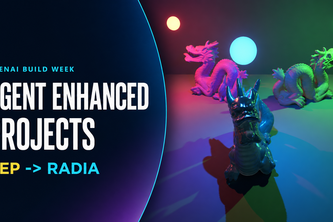
The description states that Radia is a quaternion-based rendering engine built using the AEP (Agent Enhanced Projects) framework, implemented in Rust. The project was submitted to the OpenAI 2026 hackathon by a single developer, Laird WT. It claims to use an agent-based system with "rational" and "mechanical" enforcement of project rules, backed by ADRs (Architecture Decision Records), CLI tooling, and git hooks.
The author describes AEP as a framework that enforces decisions and workflows through both AI agents and code-based mechanisms. The system is said to prevent drift in project definitions and enforce strict governance over agent behavior.
Key commercial due-diligence question: What is the actual utility or adoption of this framework beyond a single developer's personal use case?
There is no evidence of revenue, customers, traction, or product-market fit beyond the author’s own description. The project appears to be an experimental tool built for personal development and demonstration purposes.
What The Product Actually Is
- The description states that Radia is a quaternion-based real-time global illumination and rendering engine.
- It was built using the AEP (Agent Enhanced Projects) framework.
- The rendering engine is implemented in Rust.
- AEP itself is described as a framework of context-light skills, CLI tooling, git hooks, agent definitions, ADR lifecycle management, and strict project rules.
- AEP includes mechanisms for enforcing decisions via both agents and mechanical tooling.
- It also includes a dedicated Janitor agent for managing artifacts and experiments.
Not evidenced:
- Whether Radia is a standalone product or part of a larger system.
- If the rendering engine has any public or commercial use cases.
- The actual performance or capabilities of the rendering engine beyond author claims.
Positioning & Claim Evolution
- The project positions itself as an agent-enhanced development framework that combines "rational" (AI agent-based) and "mechanical" (code-based enforcement) elements.
- It is described as a way to enforce decisions and prevent drift, using ADRs and structured workflows.
- The author states that the system was built to address issues with uncontrolled AI agents ("they can do whatever they want") by introducing mechanical enforcement.
- The project evolved from a personal tool into a framework for building projects, including a rendering engine and text-to-speech generation.
Inferred:
- The positioning is aimed at developers or teams looking to enforce governance in AI-assisted workflows.
- The evolution suggests an intent to scale beyond a single use case.
Not evidenced:
- Whether the framework has been adopted by others.
- How it differentiates from existing tools like Git hooks, CI/CD pipelines, or other project governance systems.
Target Customer & ICP
- The description does not clearly identify a target customer or ideal customer profile (ICP).
- It is implied that the framework is aimed at developers or teams working with AI agents.
- The author mentions using it for personal development and demonstration purposes, suggesting a self-developer or early-stage developer use case.
Inferred:
- A potential ICP could be developers or teams seeking to govern AI agent behavior in software projects.
- It may appeal to those working with agent-based workflows, especially in environments where drift or lack of structure is an issue.
Not evidenced:
- No specific customer personas, use cases, or market segments are described.
- No evidence of existing customers or user feedback.
Business Model & Pricing Evidence
- The description does not mention any pricing model or business model.
- It is unclear whether the framework is intended to be open-source, freemium, or commercially licensed.
- The project was submitted as a hackathon entry, suggesting it may be experimental or non-commercial at this stage.
Not evidenced:
- No revenue streams, monetization plans, or pricing information.
- No indication of whether the framework is offered as a service or product.
Technical & Delivery Signals
- The system is built in Rust, which suggests performance and safety considerations.
- It uses AEP framework with components like CLI tooling, git hooks, agent definitions, ADR lifecycle management, and plugin/skill-based architecture.
- The author mentions using CODEX, GPT 5.6 Sol, and ChatGPT documentation for development.
- The system includes a Janitor agent for artifact management.
- AEP is described as core and spokes based, where specific skills are fetched on demand but agents are aware of all skills.
Inferred:
- The framework may be designed to reduce drift in AI-assisted projects.
- It appears to integrate with existing developer tooling like Git, CLI, and LSP.
Not evidenced:
- No evidence of scalability or performance benchmarks.
- No information about deployment, infrastructure, or delivery mechanisms beyond the author’s own use.
Traction & Maturity Signals
- The project was submitted to a hackathon, indicating early-stage development.
- It is described as being built by a single developer (Laird WT).
- The author mentions using it for personal projects and demonstrations, including building a rendering engine and text-to-speech system in one session.
- There is no evidence of:
- Revenue
- Customers
- Product adoption
- Market traction
Not evidenced:
- No data on usage, user engagement, or product-market fit.
- No evidence of any commercial or community adoption.
Competitive Context
- The description does not mention specific competitors.
- It implies a framework for AI agent governance and project structure enforcement, which may overlap with tools like:
- Git hooks
- CI/CD pipelines
- LSP (Language Server Protocol)
- Agent-based development platforms
- Architecture decision record systems
Inferred:
- The project may compete with or complement existing developer tooling for AI-assisted workflows.
- It could be seen as a hybrid of AI agent orchestration and code enforcement.
Not evidenced:
- No competitive analysis, market positioning, or differentiation from similar tools.
- No evidence of any competitors or market presence.
Open Questions & Risks
- The project is described as being built by a single developer, which raises questions about scalability, maintenance, and long-term support.
- It was submitted to a hackathon, suggesting it is in an experimental or early-stage phase.
- There is no evidence of:
- Revenue
- Customers
- Product-market fit
- Traction or adoption
- The framework is described as self-developed, with no mention of external validation, testing, or community involvement.
- The author’s own claims about the system’s effectiveness (e.g., “difference after first hour”) are not independently verified.
Inferred:
- Risk of limited scalability due to single-person development.
- Risk of low adoption if the framework does not solve a widespread problem.
Questions the description leaves open
- What specific problems does AEP solve that existing tools (e.g., Git hooks, CI/CD systems) do not?
- How is the framework intended to be used by others beyond personal development?
- Has the framework been tested or validated in any real-world projects or teams?
- Is there a plan for open-sourcing or commercializing AEP?
- What are the long-term goals for Radia and AEP, and how do they align with market needs?
- How does AEP handle conflicts between agent behavior and mechanical enforcement?
- Are there any plans to integrate with existing developer platforms (e.g., GitHub, VS Code)?
- What is the roadmap for future development beyond the current hackathon version?
Overall Assessment
- The project is described as a single-developer hackathon submission, with no evidence of revenue, customers, or traction.
- It is positioned as an experimental framework for AI agent governance and project enforcement.
- There is no clear indication of commercial viability or market demand.
- The author’s claims about the system’s effectiveness are self-reported and unverified.
Assessment: Not evidenced.
The description does not provide sufficient evidence to assess whether this represents a viable product, business model, or investment opportunity. It appears to be an experimental tool with no demonstrated adoption or commercial traction.
User Stories BotA demo video on every pull request
Get a demo video on every new feature
GitHub App that watches your pull requests and records a narrated, captioned demo.
Save time on demo prep and make informed decisions faster with a video walkthrough of every new feature.
Source
Submitted to the OpenAI 2026 hackathon on Devpost. Project home on Devpost. Back to the full gallery on Devpost.
This competitive analysis was produced by top-founders.com (opens in a new tab)
Generated by a language model from this project's public Devpost page — its tagline, the author's own write-up and any built-with tags listed there — as captured in August 2026. Short quotations are the author's words. It is an opinion on the idea as a business, not on the people behind it, and it reflects the description as published then. If the project has moved on, request a correction below. The analysis is not independent research and contains no verified traction, revenue or customer data.
An independent guide by KFG International LLC — not affiliated with, endorsed by, or connected to Devpost or OpenAI.