

Archive position — measured, not model output
0 likes on Devpost
2,263 of the 7,850 archived projects have more likes, and 5,587 share exactly 0 — so this project's #3,732 place in the like-ranked listing is a tie-break inside that group, not a ranking.
Projects (log scale)
Likes on Devpost. ▲ marks this project's group.
Show the figures
| Likes | Projects | Share of archive |
|---|---|---|
| 0 | 5,587 | 71.2% |
| 1 | 1,758 | 22.4% |
| 2 | 284 | 3.6% |
| 3–4 | 132 | 1.7% |
| 5–9 | 75 | 1.0% |
| 10+ | 14 | 0.2% |
 User Stories BotA demo video on every pull request
Get a demo video on every new feature
GitHub App that watches your pull requests and records a narrated, captioned demo.
Save time on demo prep and make informed decisions faster with a video walkthrough of every new feature.
Executive Summary
What the company appears to be
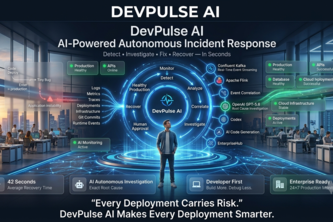
DevPulse AI (formerly NetPulse AI) is a self-reported autonomous incident resolution system for software engineering teams. It claims to use AI agents — including GPT-5.6 and Codex — to detect, analyze, and fix production incidents in real time, with one human approval required before deployment.
What changed
The project evolved from a hackathon submission (Devpost entry) into a conceptual SaaS product with a defined pricing model ($49/repo/month), integration roadmap, and multi-agent architecture. The author states it was built for the OpenAI 2026 hackathon.
Single most important open question
Is there any evidence of actual customer adoption, revenue, or real-world usage beyond the self-reported demo and prototype?
What The Product Actually Is
The description states that DevPulse AI is an autonomous incident resolution agent. It operates using a 3-agent pipeline:
- WatcherAgent: monitors Kafka streams for code events (build failures, deploy errors, runtime spikes).
- AnalysisAgent (GPT-5.6): reads error logs, stack traces, and git history to produce root cause, severity score, and revenue impact.
- RemediationAgent (Codex): writes the corrected code patch, commit message, and PR description.
The system is described as having a human-in-the-loop approval mechanism, where engineers approve or reject fixes before deployment. It uses real-time event streaming via Confluent Kafka, orchestrated by Apache Flink, with React + TypeScript for frontend and Socket.io for real-time updates.
Not evidenced:
- Whether the system has been deployed in production.
- Whether any actual incidents have been resolved using this pipeline.
- Whether the described agents are integrated into a live product or remain conceptual.
Positioning & Claim Evolution
The author states that DevPulse AI is positioned to reduce incident resolution time from 4.2 hours (manual) to 42 seconds, by automating root cause detection and fix generation.
It claims to be:
- A reactive system, triggered by real-time events.
- An autonomous agent pipeline, not a single GPT call.
- Built with responsible AI principles — human approval is part of the architecture, not an afterthought.
The positioning evolved from a hackathon prototype to a SaaS product in development, with a pricing model ($49/repo/month) and integration roadmap (Slack, PagerDuty).
Inferred:
- The system is positioned as a tool for reducing engineering downtime.
- It targets teams managing production codebases with high incident frequency.
Target Customer & ICP
The description states that DevPulse AI targets:
- Software engineers who experience frequent production alerts.
- Teams dealing with high incident resolution times (4.2 hours).
- Organizations where engineers spend 30% of their time debugging instead of building.
It is implied that the system is aimed at engineering teams, not product managers or executives, and specifically those using codebases monitored via Kafka.
Not evidenced:
- Specific customer segments or personas.
- Whether the system targets startups, enterprises, or mid-sized engineering teams.
- Any actual customer interviews or feedback.
Business Model & Pricing Evidence
The author states that DevPulse AI will be launched as a SaaS product, with a pricing model of $49 per repo per month. It is claimed that one prevented incident pays for a year of the tool.
It also states:
- The system will support multi-repo monitoring.
- A learning loop will improve fix quality over time.
- Integration with Slack and PagerDuty is planned.
Not evidenced:
- Any revenue or customer data.
- Whether pricing has been validated with potential customers.
- Whether the SaaS model has been tested or prototyped.
Technical & Delivery Signals
The system is built using:
- Apache Flink for event correlation
- Confluent Kafka for real-time event streaming
- GPT-5.6 and Codex for AI processing
- OpenAI Agents SDK for orchestration
- React + TypeScript for frontend
- Socket.io for real-time updates
- Railway for deployment
The author claims:
- The system resolves incidents in under 42 seconds.
- It uses a multi-agent pipeline, not a single AI call.
- It has a human-in-loop approval gate.
Inferred:
- The architecture is designed for real-time, event-driven processing.
- The use of Kafka and Flink suggests a focus on scalable, streaming data pipelines.
Traction & Maturity Signals
The author states:
- A 42-second resolution time was achieved in demo.
- 97% AI confidence on root cause analysis.
- ₹18,97,014 estimated revenue saved per major incident.
- Built a genuine multi-agent pipeline.
- The system is designed with responsible AI principles.
However:
- No evidence of actual customers or usage.
- No revenue data or user feedback.
- No mention of any pilot programs or beta users.
- The project was submitted to a hackathon — no indication of post-hackathon traction.
Not evidenced:
- Any real-world deployment or adoption.
- Customer retention or usage metrics.
- Product-market fit validation.
Competitive Context
The author does not provide any information about competitors. The description is silent on:
- Who else is solving similar problems (e.g., incident response, AI debugging tools).
- How DevPulse AI differentiates from existing solutions.
Not evidenced:
- Competitor landscape.
- Market positioning or differentiation strategy.
- Any competitive advantage claimed by the author.
Open Questions & Risks
- Unverified claims: All performance metrics (42-second resolution, 97% confidence) are self-reported and unvalidated.
- No real-world usage: No evidence of actual deployment or customer feedback.
- AI hallucination risk: The use of GPT-5.6 and Codex in production contexts raises concerns about accuracy and reliability without validation.
- Human-in-loop is a design choice, but not necessarily a scalable solution for large engineering teams.
- Hackathon prototype: The system was built for a hackathon, with no indication of post-hackathon development or productization.
Questions the description leaves open
- What real-world incidents have been resolved using this system?
- How is the accuracy of root cause analysis validated in practice?
- Has the system been tested on actual production codebases, not just simulated ones?
- What are the actual costs and risks of deploying AI-generated fixes in production?
- How does the system handle false positives or misidentified issues?
- Have you conducted any user testing with engineers who would use this tool?
- Is there a plan to validate pricing with potential customers before launch?
Overall Assessment
Not evidenced:
- No revenue, customer data, or traction.
- The project is described as a hackathon prototype, not a product in development.
Confidence level: Low.
The description is self-reported and unverified. It lacks any evidence of real-world usage, revenue, or customer validation. The system is presented as a conceptual SaaS product with a pricing model, but no proof of concept or market traction exists.
Inference:
If the founders can demonstrate actual use cases, validated performance metrics, and early customer feedback, this could evolve into a compelling commercial opportunity. As it stands, it is a conceptual prototype with strong claims but no evidence of execution.
User Stories BotA demo video on every pull request
Get a demo video on every new feature
GitHub App that watches your pull requests and records a narrated, captioned demo.
Save time on demo prep and make informed decisions faster with a video walkthrough of every new feature.
Source
Submitted to the OpenAI 2026 hackathon on Devpost. Project home on Devpost. Back to the full gallery on Devpost.
This competitive analysis was produced by top-founders.com (opens in a new tab)
Generated by a language model from this project's public Devpost page — its tagline, the author's own write-up and any built-with tags listed there — as captured in August 2026. Short quotations are the author's words. It is an opinion on the idea as a business, not on the people behind it, and it reflects the description as published then. If the project has moved on, request a correction below. The analysis is not independent research and contains no verified traction, revenue or customer data.
An independent guide by KFG International LLC — not affiliated with, endorsed by, or connected to Devpost or OpenAI.