

Archive position — measured, not model output
0 likes on Devpost
2,263 of the 7,850 archived projects have more likes, and 5,587 share exactly 0 — so this project's #3,730 place in the like-ranked listing is a tie-break inside that group, not a ranking.
Projects (log scale)
Likes on Devpost. ▲ marks this project's group.
Show the figures
| Likes | Projects | Share of archive |
|---|---|---|
| 0 | 5,587 | 71.2% |
| 1 | 1,758 | 22.4% |
| 2 | 284 | 3.6% |
| 3–4 | 132 | 1.7% |
| 5–9 | 75 | 1.0% |
| 10+ | 14 | 0.2% |
 User Stories BotA demo video on every pull request
Get a demo video on every new feature
GitHub App that watches your pull requests and records a narrated, captioned demo.
Save time on demo prep and make informed decisions faster with a video walkthrough of every new feature.
Executive Summary
What the company appears to be
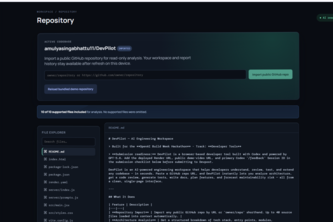
DevPilot is a browser-based AI engineering workspace that allows users to paste a public GitHub repo URL and receive six AI-powered tools in one interface: Architecture, Code Review, Tests, Docs, Feature Planner, and Time Machine.
What changed
The project was built as part of the OpenAI 2026 hackathon. It is self-reported as a stateless, file-in-context tool with no login or database required. The author states it uses GPT-5.6 and Codex for core functionality, and was scaffolded using React + Vite on the frontend and Node/Express on the backend.
Single most important open question
Is there any evidence of traction, revenue, or customer adoption beyond the hackathon submission?
What The Product Actually Is
The description states that DevPilot is a browser-based AI engineering workspace. It allows users to paste a public GitHub repo URL and pulls source files directly from the GitHub API into a live workspace. From there, it offers six tools in one place:
- Architecture — tech stack, entry points, modules, complexity notes
- Code Review — file-level findings (security, code smells, performance) with specific fixes
- Tests — generated test suite with edge cases called out
- Docs — production-ready README written from the actual code
- Feature Planner — describe a feature in plain English, get back an implementation plan with affected files and a checklist
- Time Machine — six-month maintainability forecast with concrete suggestions to cut down technical debt
No login, no database, nothing to install — import a repo and start working.
Inference The product is described as stateless, file-in-context, and without authentication or persistent data storage. It is designed for immediate use upon importing a repo.
Positioning & Claim Evolution
The author states that DevPilot was built to address the common developer pain point of spending hours understanding unfamiliar codebases before being able to contribute. The tool aims to "read the code and hand back answers instead of making you dig for them."
Claim
It is positioned as a tool developers would reach for on day one of a new codebase.
Inference The product is framed as a developer productivity tool that automates common onboarding tasks using AI. It does not appear to be targeting end-users or non-technical stakeholders, but rather technical teams and individual developers.
Target Customer & ICP
The description states that DevPilot is built for developers who are unfamiliar with a codebase and want to quickly understand it. The author emphasizes the tool's utility in onboarding to new projects.
Inference The primary customer is likely a developer or engineering team working with open-source or internal repositories they have not previously seen.
Not evidenced No explicit segmentation, persona details, or evidence of target customer size or type beyond general developer use cases.
Business Model & Pricing Evidence
The description states that DevPilot is a browser-based tool with no login, database, or installation required. It does not mention any pricing model or monetization strategy.
Inference The tool appears to be free to use for public repos, with no indication of paid features or subscriptions.
Not evidenced No evidence of revenue, pricing tiers, monetization plans, or customer acquisition costs.
Technical & Delivery Signals
The project was built using:
- Frontend: React 18 + Vite
- Backend: Node/Express
- AI models: GPT-5.6 via OpenAI API
- Tools: Codex (used for scaffolding)
- GitHub integration: via GitHub API
Key technical decisions include:
- Stateless, file-in-context architecture with no auth or database
- Capping context at 40 files / 50KB per file to stay within model limits
- Prompt engineering to ensure clean JSON output from GPT-5.6
- Handling edge cases like rate limits, private repos, truncated trees, and oversized files
Inference The architecture is designed for simplicity and immediate usability, with a focus on avoiding persistent state or complex setup.
Traction & Maturity Signals
The project was submitted to the OpenAI 2026 hackathon. No evidence of revenue, customers, or adoption beyond this submission exists in the description.
Not evidenced No data on usage, retention, user feedback, or product maturity beyond a hackathon prototype.
Competitive Context
No mention of competitors or competitive landscape is provided in the description.
Not evidenced No information about existing tools or platforms that may offer similar functionality (e.g., GitHub Copilot, CodeGeeX, Tabnine, etc.).
Open Questions & Risks
- No traction or revenue evidence: The tool exists only as a hackathon submission with no indication of adoption or monetization.
- Unverified AI model: GPT-5.6 is mentioned but not confirmed; the description does not clarify if this is a real model or a placeholder.
- Limited scope: The tool works only with public GitHub repos and lacks support for private repos or incremental updates.
- No scalability assumptions: The architecture is described as stateless, which may limit long-term product evolution.
Questions the description leaves open
- What is the actual model being used (e.g., GPT-5.6 confirmed or placeholder)?
- Are there any plans to monetize the tool beyond its current hackathon form?
- How does the tool handle private repositories or enterprise use cases?
- Is there any internal testing or feedback from developers using it?
- What are the technical limitations of the current file-in-context approach, and how might they scale?
Overall Assessment
Not evidenced: No information is provided on valuation, funding rounds, team traction, or commercial viability beyond a hackathon submission.
Inference The project appears to be an early-stage prototype with no demonstrated product-market fit, revenue, or user base. It may have potential as a proof-of-concept or idea for further development but lacks the evidence needed for investment or partnership consideration at this stage.
User Stories BotA demo video on every pull request
Get a demo video on every new feature
GitHub App that watches your pull requests and records a narrated, captioned demo.
Save time on demo prep and make informed decisions faster with a video walkthrough of every new feature.
Source
Submitted to the OpenAI 2026 hackathon on Devpost. Project home on Devpost. Back to the full gallery on Devpost.
This competitive analysis was produced by top-founders.com (opens in a new tab)
Generated by a language model from this project's public Devpost page — its tagline, the author's own write-up and any built-with tags listed there — as captured in August 2026. Short quotations are the author's words. It is an opinion on the idea as a business, not on the people behind it, and it reflects the description as published then. If the project has moved on, request a correction below. The analysis is not independent research and contains no verified traction, revenue or customer data.
An independent guide by KFG International LLC — not affiliated with, endorsed by, or connected to Devpost or OpenAI.