

Archive position — measured, not model output
0 likes on Devpost
2,263 of the 7,850 archived projects have more likes, and 5,587 share exactly 0 — so this project's #6,181 place in the like-ranked listing is a tie-break inside that group, not a ranking.
Projects (log scale)
Likes on Devpost. ▲ marks this project's group.
Show the figures
| Likes | Projects | Share of archive |
|---|---|---|
| 0 | 5,587 | 71.2% |
| 1 | 1,758 | 22.4% |
| 2 | 284 | 3.6% |
| 3–4 | 132 | 1.7% |
| 5–9 | 75 | 1.0% |
| 10+ | 14 | 0.2% |
 User Stories BotA demo video on every pull request
Get a demo video on every new feature
GitHub App that watches your pull requests and records a narrated, captioned demo.
Save time on demo prep and make informed decisions faster with a video walkthrough of every new feature.
Executive Summary
Company: Qorx Zero
Self-reported basis: The description is entirely self-reported and unverified, based on a Devpost submission for the OpenAI 2026 hackathon. No external corroboration or historical data is available.
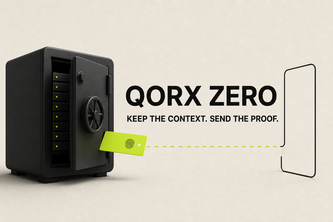
What it appears to be: A browser-based tool that enables local storage of project decisions for AI coding tools (specifically using Codex and GPT-5.6), with a focus on limiting what information is sent to the AI model by only transmitting a small, visible proof frame.
Key change: The author states that Qorx Zero introduces a device-local memory layer that avoids sending all project context to an AI, instead allowing only a deterministic, capped set of relevant records to be shared with GPT-5.6.
Single most important open question: Does the product actually function as described in a real-world developer workflow, or is it limited to a demo or prototype?
What The Product Actually Is
The description states that Qorx Zero:
- Stores project decisions in IndexedDB on the developer's device.
- Makes retrieval decisions visible (e.g., shows which records matched, scores, matched terms, source hashes).
- Caps the information sent to GPT-5.6 at five records and 1,600 characters.
- Uses a deterministic ranker based on keyword relevance, importance, and recency.
- Deletes expired or manually deleted records before ranking.
- Sends only the current question and visible proof frame to a server running an OpenAI Responses API adapter using GPT-5.6 Terra.
- Instructs GPT-5.6 to answer only from the provided proof and cite source hashes.
Inference: The product is a browser-based memory layer for AI coding tools, designed to keep sensitive or irrelevant project data local while enabling controlled sharing with an AI model.
Positioning & Claim Evolution
The author states:
- AI coding tools are good at the next task but fail to maintain context across many tasks.
- Sending everything to a remote memory service gives up control.
- Qorx Zero centralizes project memory on the developer's device.
- It allows for “visible proof” and “explicit forgetting,” which are presented as key features.
Inference: The positioning is that of a privacy-preserving, context-aware AI assistant layer. The claim evolution suggests a shift from opaque, remote AI memory to local, inspectable, and controllable project memory.
Target Customer & ICP
The description states:
- Qorx Zero is for developers using AI coding tools like Codex.
- It is designed to work with GPT-5.6 and Codex.
- The product is built for use in a browser environment (IndexedDB, OpenAI API).
Inference: The target customer is likely a developer or engineering team using AI-assisted coding tools in a browser-based workflow.
Business Model & Pricing Evidence
The description does not state:
- Whether Qorx Zero has a business model.
- Whether it charges for use.
- Whether pricing exists or is planned.
Not evidenced: No evidence of pricing, monetization, or business model.
Technical & Delivery Signals
The description states:
- Built with Codex and GPT-5.6.
- Uses IndexedDB for local storage.
- Implements a deterministic ranker.
- Includes automated tests and an independent validation notebook.
- The server receives only the question and proof frame.
- GPT-5.6 is instructed to answer only from provided proof.
Inference: The product appears to be a prototype or demo-level tool, built with a clear technical architecture that separates local storage from AI interaction.
Traction & Maturity Signals
The description states:
- It was submitted to the OpenAI 2026 hackathon.
- Includes tests, notebook, architecture, provider adapter, demo source, captions, and dated Build Week evidence.
- The same repository includes all components for public inspection.
Not evidenced: No revenue, customers, or adoption data. No indication of product usage beyond the submission context.
Competitive Context
The description does not state:
- Who the competitors are.
- How Qorx Zero compares to existing AI memory or context tools.
- Whether similar solutions exist in the market.
Not evidenced: No competitive analysis or positioning relative to other tools.
Open Questions & Risks
- The product is described as a hackathon submission, not a commercial product.
- It is built for browser use with IndexedDB, which may limit scalability or integration.
- The author states that “the decisive product choices stayed human,” suggesting limited automation or AI-driven decision-making beyond the demo.
- No evidence of real-world usage, adoption, or feedback from users.
Inference: Risk of being a prototype or proof-of-concept with no clear path to commercialization or real-world utility.
Questions the description leaves open
- What is the actual use case for this tool in a developer workflow?
- How does it integrate into existing AI coding tools like Codex?
- Has it been tested beyond the demo environment?
- Are there plans to scale beyond browser-based IndexedDB storage?
- What are the limitations of the deterministic ranker in real-world scenarios?
- How is user feedback or data collection handled, if at all?
Overall Assessment
The description states that Qorx Zero was submitted as a hackathon project and includes no evidence of:
- Revenue
- Customers
- Product traction
- Commercial viability
- Business model
Inference: The product is not ready for investment or partnership at this stage. It appears to be an early-stage prototype or demo, with no demonstrated commercial or user adoption.
User Stories BotA demo video on every pull request
Get a demo video on every new feature
GitHub App that watches your pull requests and records a narrated, captioned demo.
Save time on demo prep and make informed decisions faster with a video walkthrough of every new feature.
Source
Submitted to the OpenAI 2026 hackathon on Devpost. Project home on Devpost. Back to the full gallery on Devpost.
This competitive analysis was produced by top-founders.com (opens in a new tab)
Generated by a language model from this project's public Devpost page — its tagline, the author's own write-up and any built-with tags listed there — as captured in August 2026. Short quotations are the author's words. It is an opinion on the idea as a business, not on the people behind it, and it reflects the description as published then. If the project has moved on, request a correction below. The analysis is not independent research and contains no verified traction, revenue or customer data.
An independent guide by KFG International LLC — not affiliated with, endorsed by, or connected to Devpost or OpenAI.