

Archive position — measured, not model output
2 likes on Devpost
221 of the 7,850 archived projects have more likes, and 284 share exactly 2 — so this project's #294 place in the like-ranked listing is a tie-break inside that group, not a ranking.
Projects (log scale)
Likes on Devpost. ▲ marks this project's group.
Show the figures
| Likes | Projects | Share of archive |
|---|---|---|
| 0 | 5,587 | 71.2% |
| 1 | 1,758 | 22.4% |
| 2 | 284 | 3.6% |
| 3–4 | 132 | 1.7% |
| 5–9 | 75 | 1.0% |
| 10+ | 14 | 0.2% |
 User Stories BotA demo video on every pull request
Get a demo video on every new feature
GitHub App that watches your pull requests and records a narrated, captioned demo.
Save time on demo prep and make informed decisions faster with a video walkthrough of every new feature.
Executive Summary
Company: CounterPart AI
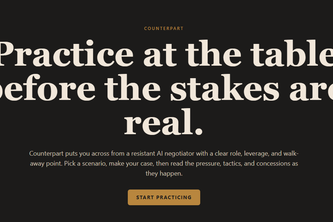
Self-reported purpose: A negotiation practice tool that simulates high-stakes negotiations against an AI counterpart who resists weak arguments and provides real-time coaching.
What changed: The project description indicates a self-contained, hackathon-built prototype focused on AI-driven negotiation simulation with coaching feedback. No evidence of prior traction, revenue or customer adoption is provided.
Single most important open question: Is there a viable commercial market for this tool, and if so, what would be the path to monetization?
What The Product Actually Is
The description states that CounterPart AI is an application where users negotiate against an AI counterpart in simulated scenarios such as salary negotiation, rent renewal, freelance contract pricing, or vendor disputes. The AI is designed to resist weak arguments and only concede when presented with real leverage (e.g., market data, competing offers). Users receive real-time coaching on their tactics and a post-session report with scores and takeaways.
- Product function: Simulated negotiation practice with AI counterpart.
- Core features:
- Scenario-based negotiation (predefined or custom).
- Resistance to weak arguments; only moves in response to verifiable leverage.
- Real-time coaching sidebar identifying tactics used by the AI and evaluating user moves.
- Post-session scored report including anchoring quality, concession pace, and specific takeaways.
Inference: The product appears to be a proof-of-concept built for a hackathon, not yet a commercial offering. It is described as a prototype with no evidence of production deployment or monetization.
Positioning & Claim Evolution
The description states that the goal was to create a negotiation practice tool that doesn't just "play along" but acts as a difficult sparring partner — one that makes users better by being resistant and realistic. The positioning is framed around practical, high-stakes negotiation training rather than theoretical advice.
- Positioning claim: A realistic negotiation simulator with coaching.
- Evolution of claims:
- Initial idea: "Most negotiation advice is theoretical" → need for practice against a resistant AI.
- Refinement: AI must resist not just emotionally but on the basis of leverage.
- Coaching focus: Real-time feedback and post-session scoring.
Inference: The positioning evolved from general “practice tool” to a more specific, high-fidelity simulation with coaching. However, no evidence of market validation or user testing beyond the hackathon is provided.
Target Customer & ICP
The description does not define a specific customer segment or ideal customer profile (ICP). It implies that users are individuals looking to improve negotiation skills in professional or personal contexts — such as job seekers, freelancers, or business professionals.
- Target user: Individuals practicing negotiation skills.
- ICP: Not evidenced. No segmentation or persona details provided.
- Use case scenarios:
- Salary negotiation
- Rent renewal
- Freelance contract pricing
- Vendor price dispute
Inference: The ICP is likely self-directed learners or professionals seeking to improve their negotiation skills, but no evidence of actual users or market demand exists.
Business Model & Pricing Evidence
There is no evidence in the description of a business model or pricing structure. The project is described as a hackathon submission with no mention of monetization, subscriptions, or paid features.
- Business model: Not evidenced.
- Pricing evidence: Not evidenced.
- Monetization strategy: Not evidenced.
Inference: No commercialization plan or revenue stream is evident from the description. The tool appears to be a prototype without a defined path to monetization.
Technical & Delivery Signals
The project was built using Codex as a coding agent, with FastAPI backend, Groq API (Llama 3.3 70B), React frontend, and SQLite for custom scenarios. It includes voice output via browser speech synthesis but lacks voice input due to technical limitations.
- Tech stack: Codex, FastAPI, Groq API (Llama 3.3), React, Vite, Tailwind CSS, SQLite, Web Speech API.
- Architecture:
- Single combined model call per turn for AI reply and coaching classification.
- Custom scenarios stored in SQLite.
- Delivery discipline: Built with iterative testing using Codex prompts and live UI checks.
Inference: The technical implementation is a prototype built under time constraints. It shows some sophistication in integrating AI models and real-time feedback, but lacks production-grade infrastructure or scalability.
Traction & Maturity Signals
The description does not include any evidence of traction, revenue, users, or adoption beyond the hackathon submission. No data on usage, retention, or engagement is provided.
- Traction: Not evidenced.
- Maturity: Prototype built for a hackathon; no production deployment or user feedback.
- User base: Not evidenced.
Inference: The project has no demonstrated traction or maturity beyond the initial development phase. It is not yet a product in use by customers.
Competitive Context
The description does not mention any competitors or market context. No evidence of existing tools or platforms offering similar negotiation practice or coaching is provided.
- Competitive landscape: Not evidenced.
- Differentiation: AI resistance and real-time coaching are claimed as unique features, but no comparison to existing tools is made.
Inference: There is no evidence of competitive analysis or awareness of the broader market for negotiation training tools. The project appears to be in a vacuum without external context.
Open Questions & Risks
Several risks and open questions are evident from the self-reported description:
- No commercial traction or revenue: The tool is a prototype with no evidence of monetization.
- Limited scalability: Built for a hackathon, not production-ready.
- Dependency on free-tier APIs: Reliance on Groq’s free tier may limit long-term viability.
- Unproven market demand: No evidence of customer interest or validation beyond the authors’ own claims.
- Technical limitations: Voice input was disabled due to browser-level issues; no clear path to resolution.
Inference: The project is a prototype with no commercial risk assessment, no user validation, and limited scalability. It may not be ready for market entry without significant development.
Questions the description leaves open
- What is the intended target customer segment, and how did you identify them?
- How do you plan to monetize this tool, and what pricing model are you considering?
- Have you tested the product with real users beyond the hackathon?
- What are your plans for scaling beyond the current prototype?
- How do you intend to validate that the AI's resistance is realistic and effective in practice?
- What is the long-term vision for the product, and how does it differ from existing tools?
Overall Assessment
The project is a hackathon prototype with no evidence of traction, revenue, or customer adoption. It is described as a tool for practicing negotiation skills against an AI counterpart that resists weak arguments and provides coaching feedback.
- Commercial viability: Not evidenced.
- Investment potential: Low — no demonstrated market need, no revenue model, no user base.
- Partnership opportunity: Not evident — the product is not yet a commercial offering.
Inference: This is a concept in early development with no clear path to commercialization. It may be a promising idea, but it is not ready for investment or partnership without further development and market validation.
User Stories BotA demo video on every pull request
Get a demo video on every new feature
GitHub App that watches your pull requests and records a narrated, captioned demo.
Save time on demo prep and make informed decisions faster with a video walkthrough of every new feature.
Source
Submitted to the OpenAI 2026 hackathon on Devpost. Project home on Devpost. Back to the full gallery on Devpost.
This competitive analysis was produced by top-founders.com (opens in a new tab)
Generated by a language model from this project's public Devpost page — its tagline, the author's own write-up and any built-with tags listed there — as captured in August 2026. Short quotations are the author's words. It is an opinion on the idea as a business, not on the people behind it, and it reflects the description as published then. If the project has moved on, request a correction below. The analysis is not independent research and contains no verified traction, revenue or customer data.
An independent guide by KFG International LLC — not affiliated with, endorsed by, or connected to Devpost or OpenAI.