

Archive position — measured, not model output
2 likes on Devpost
221 of the 7,850 archived projects have more likes, and 284 share exactly 2 — so this project's #296 place in the like-ranked listing is a tie-break inside that group, not a ranking.
Projects (log scale)
Likes on Devpost. ▲ marks this project's group.
Show the figures
| Likes | Projects | Share of archive |
|---|---|---|
| 0 | 5,587 | 71.2% |
| 1 | 1,758 | 22.4% |
| 2 | 284 | 3.6% |
| 3–4 | 132 | 1.7% |
| 5–9 | 75 | 1.0% |
| 10+ | 14 | 0.2% |
 User Stories BotA demo video on every pull request
Get a demo video on every new feature
GitHub App that watches your pull requests and records a narrated, captioned demo.
Save time on demo prep and make informed decisions faster with a video walkthrough of every new feature.
Executive Summary
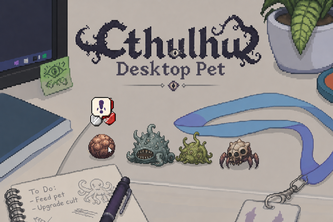
The company appears to be a solo developer project named Cthulhu Desktop Pet, a desktop-based idle game with Lovecraftian horror themes. The author states it combines desktop pets with idle progression and automatic battles, running on Windows. It was built during OpenAI Build Week using Godot 4, GDScript, and AI tools like Codex and GPT-5.6.
What changed: The project evolved from a simple desktop pet prototype into a playable game with combat, progression systems, and evolving creatures — all within one hackathon week.
The single most important open question: Is there any evidence of user engagement or monetization beyond the author's own playtesting? The description does not indicate whether anyone else has played or paid for this product.
This analysis is based entirely on the self-reported, unverified account provided by the project author. No third-party verification, revenue data, customer base or traction metrics are available.
What The Product Actually Is
The description states that Cthulhu Desktop Pet is a desktop-based idle game where players collect creatures inspired by Lovecraftian horror, unlock stronger companions, gather Faith, recruit followers, and defend their desktop against enemies from different civilizations. It includes automatic battles, enemy waves, bosses, pet evolution, progression systems, and desktop interactions.
It runs directly on the Windows desktop and is described as a lightweight companion that coexists with the user's normal workflow.
The author claims this is a game combining desktop pets with idle progression and automatic battles. No evidence of actual gameplay footage, user testing, or product demos is provided.
Positioning & Claim Evolution
The author positions Cthulhu Desktop Pet as an idle companion that evolves, battles, and accompanies users during their daily workflow. The project began as a simple desktop pet but evolved into a more complex game with progression systems and combat mechanics.
It leverages AI tools (Codex, GPT-5.6) to accelerate development, though the author notes that manual work remains critical for integrating AI-generated content into a production-ready game.
The claim is that this project started as a desktop pet and grew into a full-fledged idle game with AI-assisted development. This evolution is self-reported and lacks external validation or demonstration of traction.
Target Customer & ICP
The description does not identify specific target customers or personas. It implies the product is for users who enjoy desktop pets, idle games, and Lovecraftian horror themes. The author mentions that the game runs on Windows and integrates into daily workflows.
No explicit customer segments or ICP are defined in the self-reported description.
Business Model & Pricing Evidence
There is no evidence of a business model or pricing strategy in the provided description. The author does not mention monetization, subscriptions, purchases, or any revenue-generating mechanism.
The business model and pricing are not evidenced; the project appears to be a personal development effort without commercial intent stated.
Technical & Delivery Signals
The project was built using:
- Godot 4
- GDScript
- Visual Studio Code
- OpenAI Codex extension
- GPT-5.6
Development was accelerated by AI tools, but the author emphasizes that manual effort remains necessary for asset preparation and integration.
The technical stack is self-reported. No evidence of scalability, performance metrics, or delivery pipeline maturity is provided.
Traction & Maturity Signals
The project is described as a v0.1.0 milestone released during an OpenAI Build Week hackathon. It includes features like automatic battles, enemy waves, bosses, pet evolution, and progression systems. The author notes that the game was completed within one week.
There is no evidence of user engagement, downloads, or adoption beyond the author’s own playtesting.
No traction signals are evident; the project is at an early development stage with no external validation or usage data.
Competitive Context
The description does not mention competitors or market positioning. It references desktop pets and idle games as inspirations but does not compare to existing products in those categories.
No competitive landscape is described, nor any indication of how this product fits into the broader market for desktop companions or idle games.
Open Questions & Risks
- Solo developer project: One-person team may limit scalability and long-term maintenance.
- No monetization strategy: No evidence of a path to revenue or user conversion.
- Unproven traction: No external validation, usage data, or customer feedback.
- AI dependency risks: Reliance on AI tools like Codex and GPT-5.6 may be unstable or proprietary.
- Limited scope: The project is described as a prototype with no indication of long-term roadmap or expansion beyond the initial version.
These are inferred risks from the self-reported nature of the description, not confirmed facts.
Questions the description leaves open
- What is your plan for monetization and user acquisition?
- Have you tested this product with other users outside of your own playtesting?
- How do you intend to scale beyond a single-person development effort?
- Are there any plans to release on platforms like Steam or other distribution channels?
- What are the key challenges in transitioning from prototype to a production-ready game?
These questions aim to uncover gaps in the self-reported description and assess the founder's clarity around commercial viability.
Overall Assessment
There is no evidence of revenue, customers, or traction to support an investment or partnership decision. The project is described as a solo developer effort during a hackathon with no indication of commercial intent or user engagement.
This is a preliminary prototype with no demonstrated market fit or business model. It cannot be evaluated for investment or partnership potential without further evidence of traction, monetization, or scalability.
User Stories BotA demo video on every pull request
Get a demo video on every new feature
GitHub App that watches your pull requests and records a narrated, captioned demo.
Save time on demo prep and make informed decisions faster with a video walkthrough of every new feature.
Source
Submitted to the OpenAI 2026 hackathon on Devpost. Project home on Devpost. Back to the full gallery on Devpost.
This competitive analysis was produced by top-founders.com (opens in a new tab)
Generated by a language model from this project's public Devpost page — its tagline, the author's own write-up and any built-with tags listed there — as captured in August 2026. Short quotations are the author's words. It is an opinion on the idea as a business, not on the people behind it, and it reflects the description as published then. If the project has moved on, request a correction below. The analysis is not independent research and contains no verified traction, revenue or customer data.
An independent guide by KFG International LLC — not affiliated with, endorsed by, or connected to Devpost or OpenAI.