

Archive position — measured, not model output
0 likes on Devpost
2,263 of the 7,850 archived projects have more likes, and 5,587 share exactly 0 — so this project's #6,183 place in the like-ranked listing is a tie-break inside that group, not a ranking.
Projects (log scale)
Likes on Devpost. ▲ marks this project's group.
Show the figures
| Likes | Projects | Share of archive |
|---|---|---|
| 0 | 5,587 | 71.2% |
| 1 | 1,758 | 22.4% |
| 2 | 284 | 3.6% |
| 3–4 | 132 | 1.7% |
| 5–9 | 75 | 1.0% |
| 10+ | 14 | 0.2% |
 User Stories BotA demo video on every pull request
Get a demo video on every new feature
GitHub App that watches your pull requests and records a narrated, captioned demo.
Save time on demo prep and make informed decisions faster with a video walkthrough of every new feature.
Executive Summary
What the company appears to be
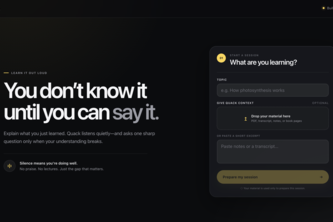
Quack is a voice-based learning tool designed to enforce the Feynman technique by providing real-time feedback during verbal explanations. The product claims to stay silent while users are correct and interrupt them immediately when they make an error or skip a step.
What changed
This is a self-reported project submitted as part of the OpenAI 2026 hackathon. It does not appear to have any prior commercial traction, revenue, or customer data. The description indicates it was built in one day using AI tools and is presented as a proof-of-concept with no evidence of market adoption.
Single most important open question
Is there a viable market need for a tool that enforces the Feynman technique through voice-based interruption, and can this be scaled beyond a single developer’s prototype?
What The Product Actually Is
The description states that Quack is a voice tutor that uses AI to listen to users explain topics aloud. It claims to remain silent while the user speaks correctly but interrupts them immediately when they say something factually incorrect, skip steps, or use filler language.
It operates through:
- A voice model (GPT-Realtime-2.1) for speech-to-speech interaction.
- A parallel transcription-only connection that checks claims in real time against a ground-truth brief.
- A reasoning engine (GPT-5.6) to generate the ground-truth brief, detect contradictions, and write session recaps.
- A dual WebRTC architecture, built with React, FastAPI, and TypeScript.
The product is described as a finished prototype, not a commercial offering.
Inference: The author claims it works in real-time with mid-sentence interruption. However, no evidence of actual performance or user testing exists beyond the self-report.
Positioning & Claim Evolution
The author positions Quack as:
- A voice tutor that enforces the Feynman technique.
- A tool that listens actively, unlike traditional voice assistants which offer encouragement or fill gaps.
- A product that never gives answers directly, forcing users to find their own corrections.
It is framed as a solution to the “illusion of understanding” — where people believe they know something until asked to explain it.
Claim: The tool uses silence as an active feedback mechanism.
Inference: This positioning implies a niche educational or self-improvement market, but no evidence supports whether this resonates with users or markets.
Target Customer & ICP
The description states that the inspiration came from the author's personal experience of struggling to explain concepts after reading them — a common issue among students and professionals learning new material.
It is implied that Quack targets:
- Students
- Professionals seeking mastery in technical or academic fields
- Anyone who wants to improve their ability to articulate ideas clearly
However, no explicit segmentation or persona definition is provided beyond the author’s own experience.
Not evidenced: No data on actual target personas, usage patterns, or customer interviews.
Business Model & Pricing Evidence
There is no evidence of any business model or pricing structure in the description. The project is presented as a hackathon submission and not as a commercial product.
Claim: The tool is built for personal use or study.
Not evidenced: No indication of monetization, subscriptions, or paid features.
Technical & Delivery Signals
The author describes building Quack using:
- AI models: Codex, GPT-5.6, GPT-Realtime-2.1
- Frameworks: FastAPI, React, Vite
- Technologies: WebRTC, speech-to-speech, TypeScript, Python
Key technical decisions include:
- Using a wait_for_user tool to enforce silence.
- Implementing a parallel transcription-and-classification channel to enable mid-sentence interruption.
- Using Codex for scaffolding and tuning.
Inference: The author demonstrates technical sophistication in handling voice AI challenges like latency, interruptions, and model behavior control. However, this is based on one-day development and lacks validation or scalability evidence.
Traction & Maturity Signals
The description states:
- It was built in a single day.
- It is a finished prototype, not a product in the market.
- No mention of users, customers, or adoption metrics.
Not evidenced: No signs of traction, revenue, or user engagement beyond the author’s own account.
Competitive Context
There are no references to existing tools or competitors in the description. The author does not compare Quack to other learning platforms, voice assistants, or educational technologies.
Not evidenced: No competitive landscape or differentiation analysis provided.
Open Questions & Risks
- Unproven market demand — no evidence of user need or adoption.
- Prototype-only status — lacks commercial viability or scalability.
- AI dependency risks — relies heavily on proprietary models (e.g., GPT-5.6, GPT-Realtime-2.1), which may not be available long-term.
- Technical complexity — the described architecture is complex and may not scale easily.
- No monetization strategy — no indication of how it would generate revenue.
Inference: The product appears to be a creative experiment rather than a commercial endeavor, raising questions about its path to market or sustainability.
Questions the description leaves open
- What specific educational or professional use cases do you see for Quack?
- How did you validate the idea with potential users before building it?
- Are there any plans to test the tool in real-world learning environments?
- What are your thoughts on the long-term viability of relying on proprietary AI models like GPT-5.6 and GPT-Realtime-2.1?
- How would you monetize Quack if you were to commercialize it?
- Have you considered how to handle edge cases in real-time speech processing, such as background noise or accents?
Overall Assessment
This is a self-reported hackathon project, not a commercial product. The description indicates no revenue, customers, or traction. It is presented as a technical demonstration with strong initial design and execution, but lacks evidence of market demand or scalability.
Assessment: Not suitable for investment or partnership at this stage. A prototype with potential, but unproven commercial viability.
User Stories BotA demo video on every pull request
Get a demo video on every new feature
GitHub App that watches your pull requests and records a narrated, captioned demo.
Save time on demo prep and make informed decisions faster with a video walkthrough of every new feature.
Source
Submitted to the OpenAI 2026 hackathon on Devpost. Project home on Devpost. Back to the full gallery on Devpost.
This competitive analysis was produced by top-founders.com (opens in a new tab)
Generated by a language model from this project's public Devpost page — its tagline, the author's own write-up and any built-with tags listed there — as captured in August 2026. Short quotations are the author's words. It is an opinion on the idea as a business, not on the people behind it, and it reflects the description as published then. If the project has moved on, request a correction below. The analysis is not independent research and contains no verified traction, revenue or customer data.
An independent guide by KFG International LLC — not affiliated with, endorsed by, or connected to Devpost or OpenAI.